Dog Eating Cat Litter? Block the Doorway Before Training
Dog eating cat litter? A 36-inch gate, a 7 x 5.5 in cat door and a box 1.5x your cat's length, plus the 3 signs that mean a vet call (no drilling).

Alfredo RamsesFounder · November 9, 2026 · 21 min read

On this page10 sections
- 1Dog Eating Cat Litter Is Scavenging, Not a Missing Mineral
- 2When a Dog Eating Cat Litter Is a Vet Call, Before Any Furniture Moves
- 3Why the Gate You Own Did Not Work, and Why Training Comes Second
- 4Block the Doorway: Gate Height, the Cat's Opening and a Renter's No-Cut Option
- 5The Box Against the Cat's Length and the Dog's Reach
- 6What a Lid or a Top Entry Costs the Cat
- 7Scoop Before the Dog Finds It, Then Train as the Top-Up
- 8With Two Cats, the Dog Changes the Box Count
- 9Shut the Door With the Box Behind It, Then Watch the Cat for a Week
- 10Frequently Asked Questions
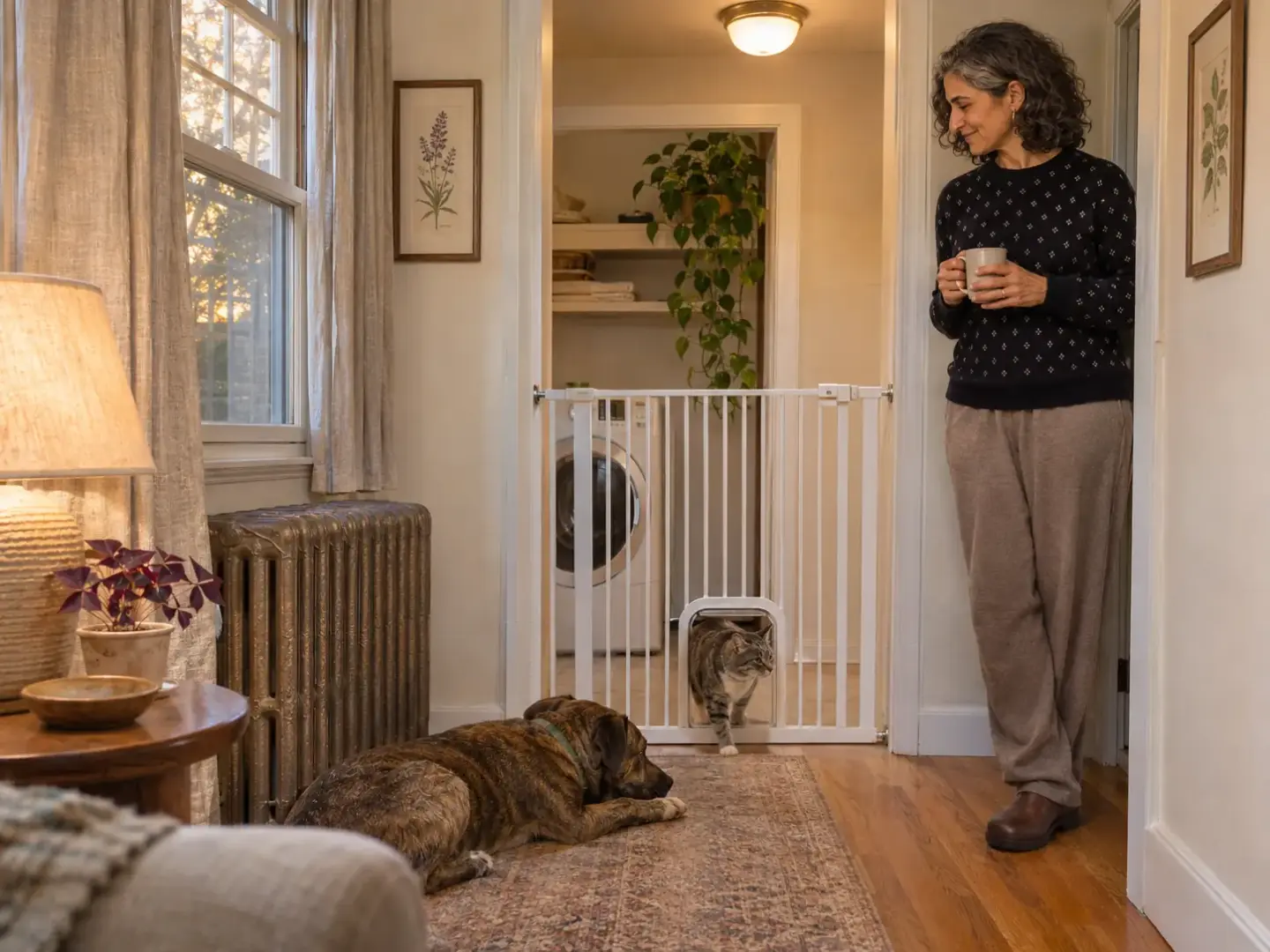
You step out of the room for one phone call and come back to litter across the rug, a cat watching from the top of the sofa and a dog with the face of someone who has no idea what you mean. Dog eating cat litter is rarely a flaw of character on either side: the dog has found a tray that still smells like food, and the cat’s box has turned into somebody else’s pantry. A habit like this pays the dog every time it works, and it works when nobody is looking, so the fix that holds is the one that does not need you in the room. This guide takes it in that order, with the doorway closed first, training second, and a price counted in the cat’s currency for every step.
Quick Answer
Shut the doorway first and train second, because the dog collects his reward when nobody is watching.
- Block the room door with a tall gate that has a cat door.
- Size the box at 1.5 times the cat’s nose-to-tail-base length.
- Place the box out of the dog’s reach but easy for the cat.
- Scoop on a schedule that leaves nothing to find.
- Teach leave it, and give the dog’s nose another job.
- Call the vet for a lot of litter, repeated vomiting, no appetite, no stools.
Dog Eating Cat Litter Is Scavenging, Not a Missing Mineral
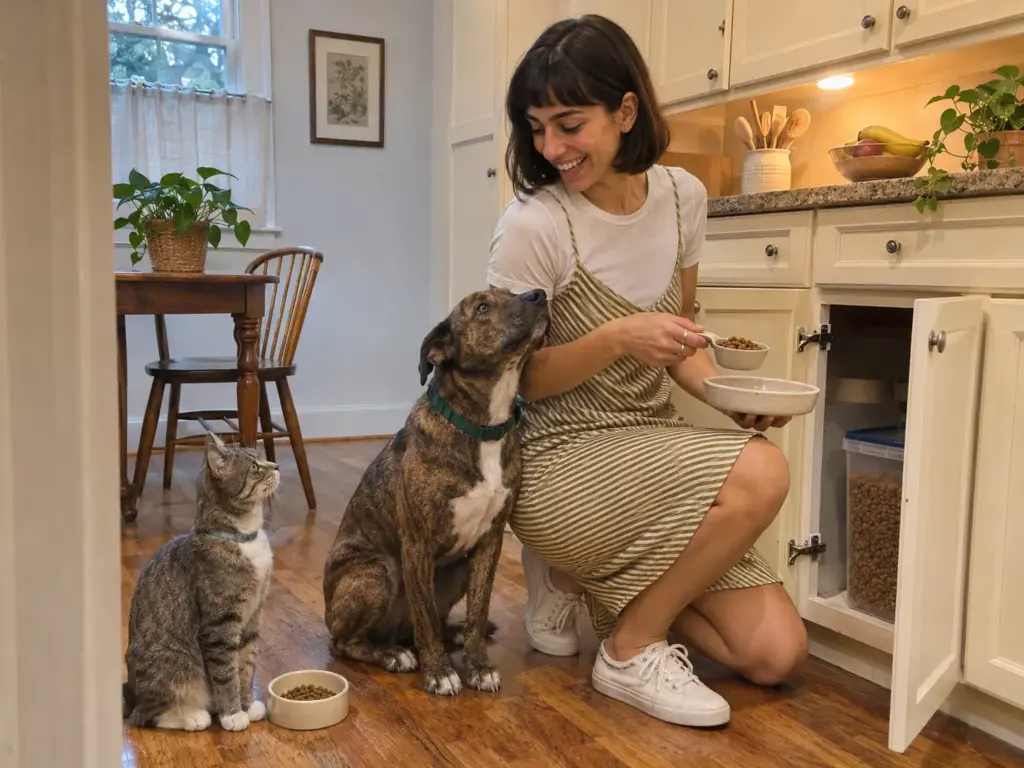
Why do dogs eat cat poop? To a dog, the litter box is a tray of snacks with a gritty topping, and a dog eats cat poop even with a full bowl at home. Cat food packs more protein and fat than dog food, some of that value leaves the cat unused, and the stool keeps a smell the dog reads as dinner. Everything outside the tray (routes, bowls, which rooms stay shut) belongs to setting up a small home for a cat and a dog together, so this guide stays with the box.
What the Dog Is Actually Getting
The draw is food value, not a vitamin. VCA’s veterinary behavior guidance on coprophagia says the smell, texture and taste of cat stool are enough to override the fact that it is waste. A dog eating cat poop is not patching a hole in his diet. He is a scavenger who found something that smells like food, at nose height, in a room he can walk into.
And then the habit feeds itself, which is what self-rewarding behavior means. Each raid that works teaches him to come back, and the raids that work are the ones that happen when the house goes quiet, which makes that moment feasting time. A plan that depends on the dog thinking better of it loses to an open box every single time.
What Ends Up Swallowed Along With It
The dog never gets the stool alone, because litter comes along with it. What each kind of litter is made to do is worth knowing:
- Clumping cat litter is clay, often bentonite, made to set into a lump the moment it gets wet (what clumping litter is built to do when it gets wet has the mechanism).
- Crystal litter is made of silica crystals, which do not dissolve.
- Deodorizers are perfume added to the grains for a human nose.
- Nothing in the tray is a mineral the dog was missing.
The amount swallowed is what separates a bad afternoon from a vet call, and the section right after this one draws that line.
Why “Dog-Safe” Litter and Deterrent Chews Miss the Point
Dog-safe is a phrase on a label, not a standard with a test behind it. The property that matters if a dog eats litter, whether it clumps or swells, is also the property a cat’s preferred texture is built on, so a switch made for the dog can cost the cat the litter he likes. The plant-based kinds, pine pellets, walnut shell litter or tofu litter, change nothing here: a gentler-sounding material does not close the doorway. One problem is traded for another and the doorway stays open.
The chew sold as a stool eating deterrent has a different flaw. Any stool deterrent goes to the cat, every day, for as long as the dog can reach the box, and it does nothing about reaching. The day it runs out, the dog meets the same box he always did. Neither purchase touches the doorway.
When a Dog Eating Cat Litter Is a Vet Call, Before Any Furniture Moves
Before a gate comes out of the closet, settle whether this is a furniture problem at all. This part names when to call the vet and hands everything medical over to the vet.
A Small Amount, a Large Amount and the Three Signs
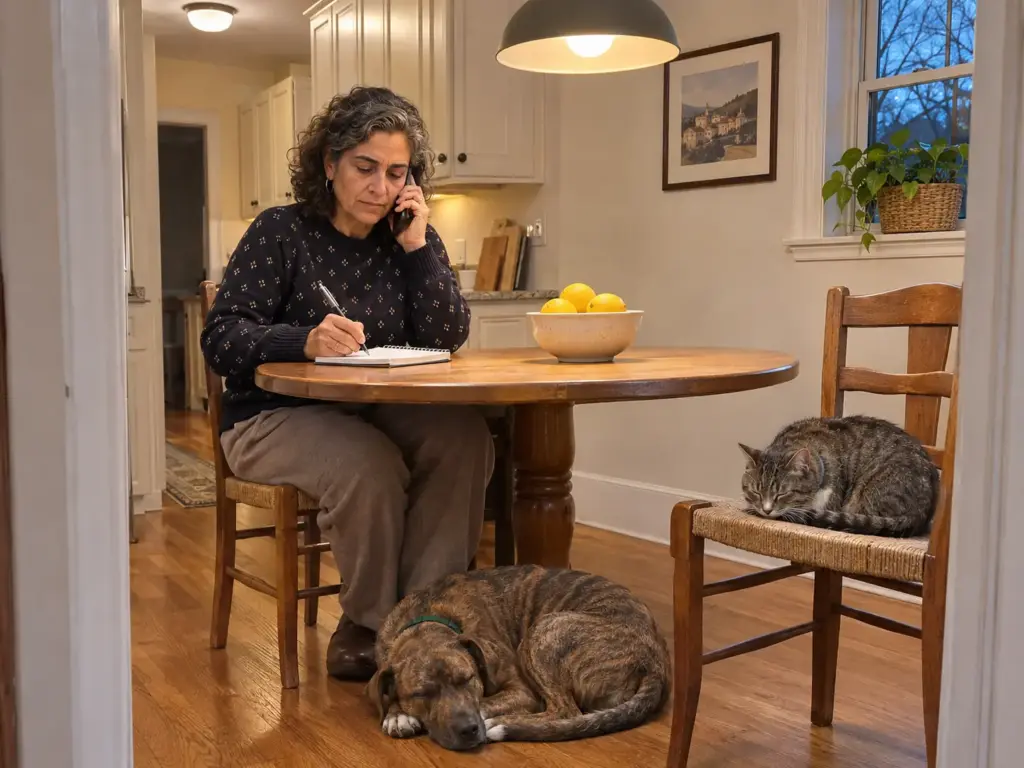
A small amount of litter usually ends as a mild stomach upset. A large amount can cause an intestinal blockage, which is uncommon but does happen, so the first thing to work out when you find a disturbed box is how much is missing from the tray.
Over the next day or two, watch for these:
- Repeated vomiting
- Not eating, or not wanting to eat
- Not passing any stools
Any one of them is a call to the vet. So is a large amount, or a dog who has gone dull and quiet, and in those cases the call happens without waiting for a sign. Nothing on this page sits in the vet’s chair.
A Sudden New Habit Is Not a Training Problem
A sudden onset in a dog who never touched the box, especially a senior dog, belongs in a vet’s office before it belongs in a training class. VCA lists medical causes to rule out before the habit is called behavioral, and which causes those are is the vet’s call to make. If the raids are one piece of a wider pattern in how he treats the cat, what to check about the dog before the cat and dog share a home is the better place to read.
What This Guide Will Not Answer
Whether a particular dog has an obstruction, how long that dog takes to get ill, whether he has pica or a nutritional deficiency, which dewormer or what dose, what bloodwork means, whether a cat’s stool is infectious for the household: all of that belongs to the vet, and the answer changes with the dog. A cat whose own habits change overnight (the cat stops using the litter box, or starts walking around it) is a vet question first and a house question second. From here the guide goes back to the box.
Why the Gate You Own Did Not Work, and Why Training Comes Second
A baby gate across a cat’s box is the usual first move, and it fails often enough that people decide the dog is the problem. Look at what the gate was measured against.
The Fix That Fails Is the One the Dog Fits Through
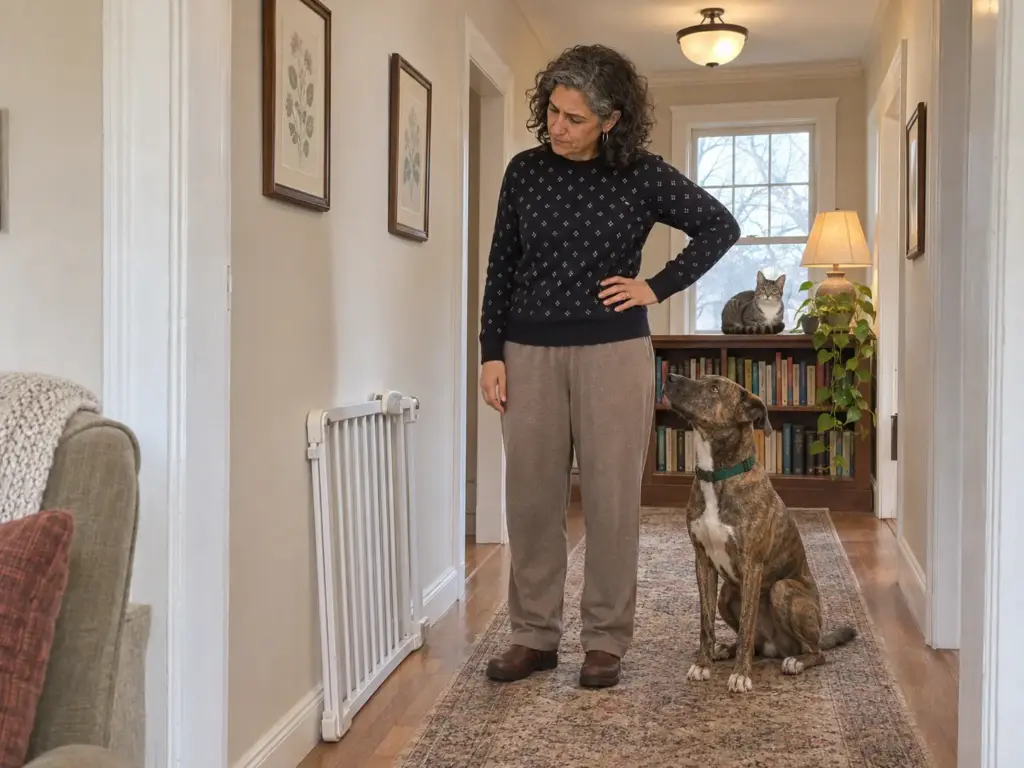
Height is rarely what fails. A fifty-pound dog goes through a gate of thin bars as if it were a curtain, and a small dog walks between the slats of a gate built for a big one. The gate was sized against a jump the dog never needed to make.
The lid fails from the other side. When the cat struggles to get in or out of a covered litter box, the lid is the first thing to go in the trash, and that is the week the dog gets in. A change made for the cat’s comfort opens the box to the dog.
Before buying anything, hold a tape across the gap the dog would push his head through, then across the cat’s shoulders. The gate or door that passes the second number and refuses the first is the one worth having.
Management Covers the Hours You Are Not There
The reward arrives when the room is empty, so the plan has to work when the room is empty. VCA’s behavior guidance puts the order in one line: “Coprophagia can best be corrected by preventing access to stools.” Teaching leave it covers the minutes you stand in the doorway, and closing the access covers the hours you do not. How a gate and the distance between the animals work in the first weeks shows the same gate doing its first job, and here it moves to the box.
Why Punishing the Dog Backfires
Scolding after the fact teaches the dog nothing about the box, and a habit driven by stress gets worse under it. The only lesson he takes is to finish before you arrive. That hides the evidence and leaves the box exactly as reachable as it was.
Block the Doorway: Gate Height, the Cat’s Opening and a Renter’s No-Cut Option
Stop the dog at the doorway and the box can stay a plain box. A dog-proof litter box is mostly litter box access shut off at the room, not a cleverer tray. Everything else in this guide, from lids to top entries, protects the box from inside, and each of those asks something of the cat. The doorway goes first, and what it costs the cat is counted at the end of this section.
Free First: The Door and the Room You Already Have
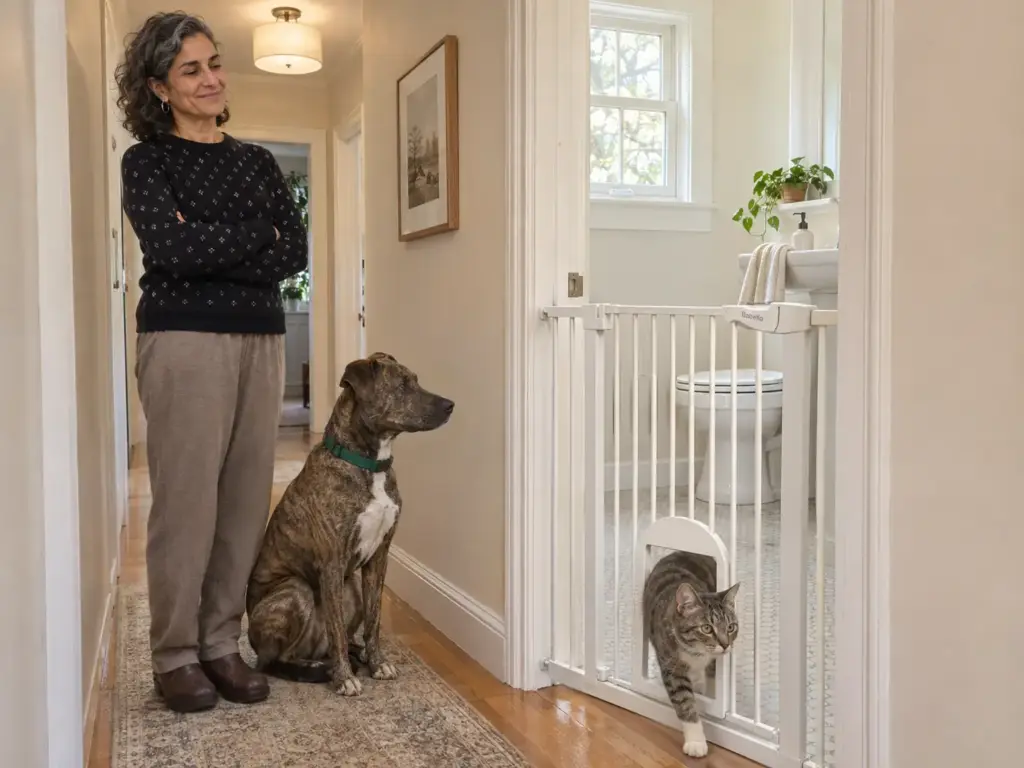
Shut the door of the room with the box and check that the cat still gets through. A cat who cannot reach his box has a bigger problem than a dog who can. A bathroom works as that room for many homes, and a litter box in the bathroom behind a door covers what goes right and wrong with it. A laundry room works the same way, and so does a litter box in a closet, as long as the cat can still get in and out.
Where there is no door, a sheet of plywood wedged into the gap between the dryer and the wall closes a corner for nothing. If you already have a baby gate, stacked baby gates, with the lower one touching the floor, stop the dog from wriggling under or clearing the pair.
A Gate With a Cat Door, Sized to the Cat’s Shoulders
The measurement that decides between a gate and a door is not the height of the dog. It is the cat’s shoulder against the dog’s head: an opening wide enough for one and too narrow for the other.
Measure a cat door’s opening with a tape against the cat’s shoulders before it goes in the cart, and test it with the cat walking through, not with the dog watching from the other side.
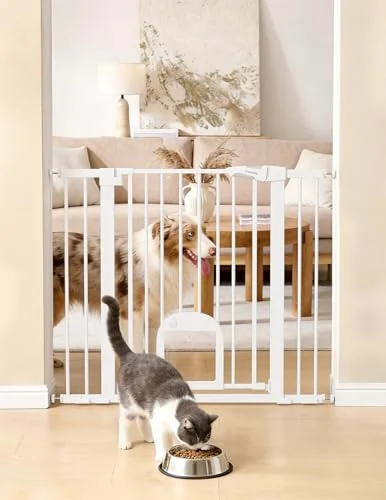
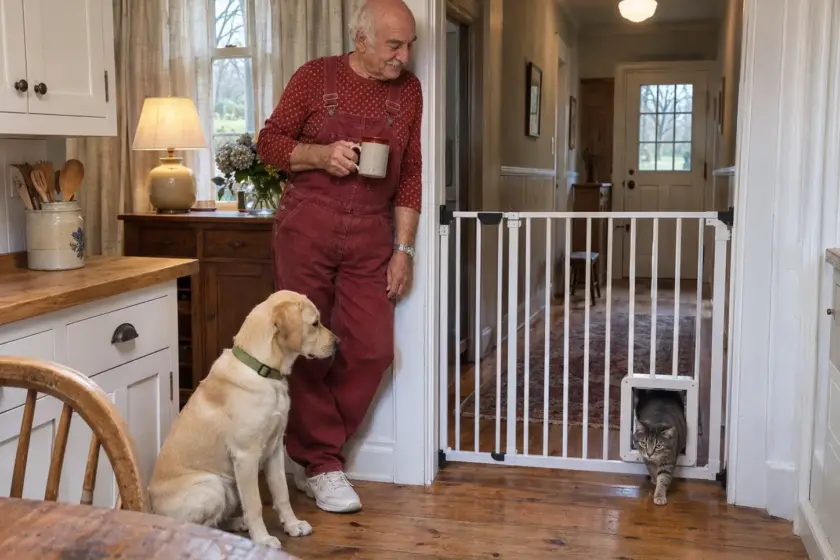
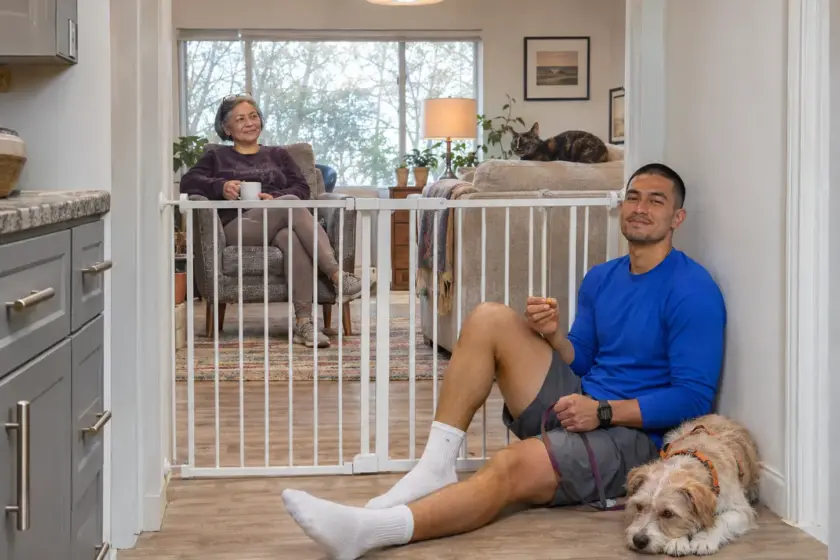
A tall gate with a cat door built in does the work of two stacked gates: the height stops the dog, and the cat walks through his own door instead of jumping. The pressure-mounted kind goes up with no holes, which matters in a rental. A freestanding 4-foot exercise pen holds most dogs too, as long as the cat has a corridor to get in.
The Renter’s Version That Cuts Nothing
A lease that bans cutting the door still allows a Door Buddy Door Prop for Cats, a latch that holds the door open between 3 and 5.5 inches: wide for a cat’s shoulders, too narrow for a dog’s head, with no flap to fight. It breaks easily, and the door can slide to its narrowest setting, so check the gap after the door has been pushed.
Where cutting is allowed, the permanent version is the Cat Door for Interior Doors XREY, a flapless interior cat door for doors 1.25 to 1.75 inches thick and cats up to 25 pounds. Size matters on the dog’s side too: a 40-pound dog has fit through one, and opinions on its value for money are split.
What Closing the Doorway Costs the Cat
Every doorway fix takes something from the cat, and it is better to count it before he does. A closed room has one opening where he had two, so he can be cornered in it. A route he used is gone, and which exits a cat loses when a door closes shows how little a small apartment can afford to lose. And a box he starts avoiding is litter box avoidance, which turns a dog problem into an elimination problem, which is why the aim is to stop the dog at the doorway and not at the box.
The Box Against the Cat’s Length and the Dog’s Reach
The box that gets used is the only box that counts. It is sized against the cat first, placed against the dog second, and a box fixed for the dog that comes up short for the cat gets abandoned.
Measure the Cat, Not the Shelf
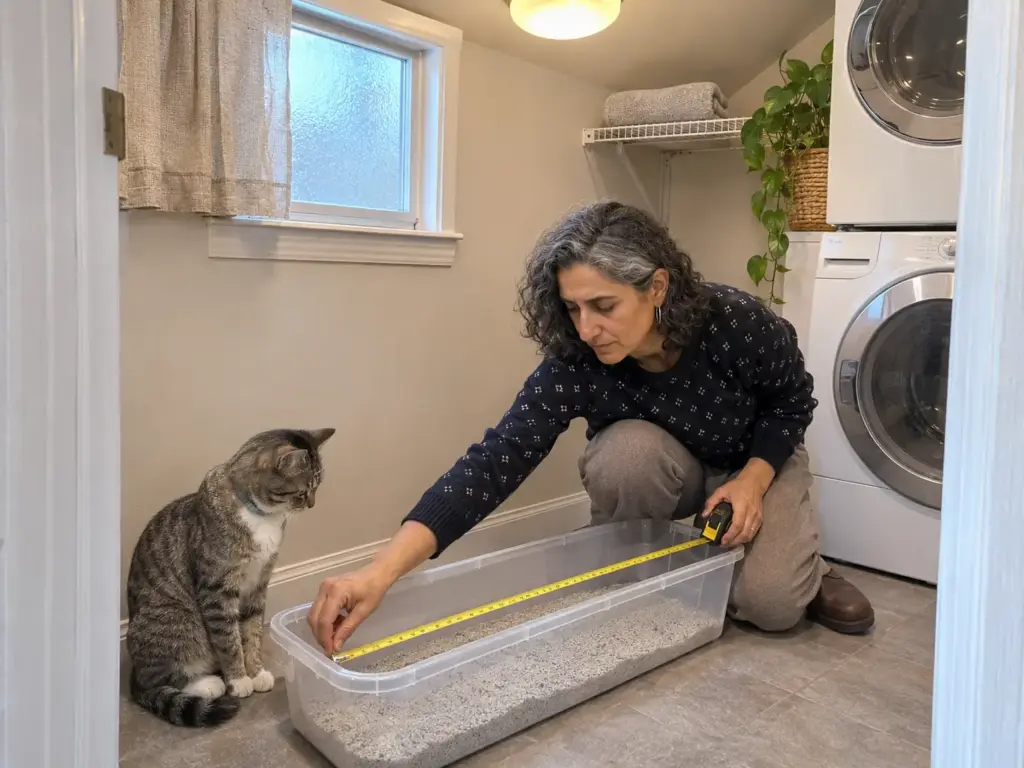
Box size comes before everything else, and the litter box dimensions that count are the inside ones. Measure the cat standing, from the nose to the base of the tail, and multiply by 1.5. A 16-inch cat needs 24 inches of floor inside the box and an 18-inch cat needs 27, while most boxes sold as “large” measure 15 to 18 inches. What size litter box a cat needs, in inches works the rule through for each size of cat.
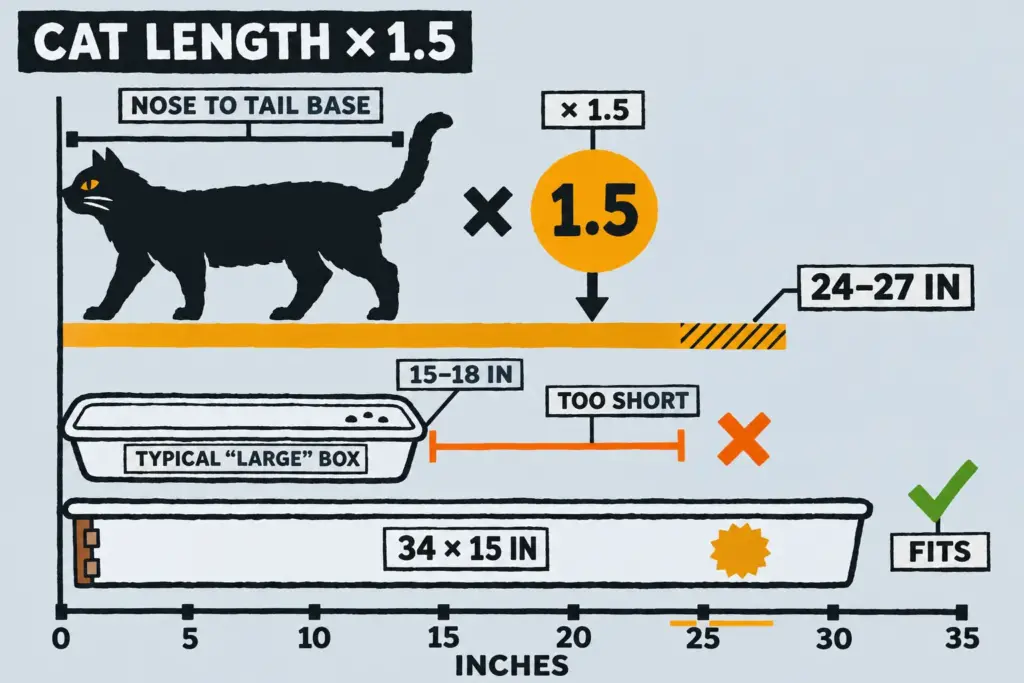
According to the 2021 AAHA/AAFP litter box guidance, “most manufactured boxes are not large enough,” and it suggests storage containers instead. In the study behind the 1.5 rule, adult cats preferred a box of 34 by 15 inches to a smaller one. The tub in the garage may beat the box in the pet aisle.
Do the multiplication before you open a single product page, then measure the box on the inside floor with a tape. The label measures the outside, and the cat only uses the inside.
Where the Box Goes Against the Dog’s Reach
A small dog cannot reach a table, and a big one reaches nearly everything at chest height. To raise the litter box onto a table is the free move, and it is the right one for the small dog. But the wall the dog cannot climb is a wall a kitten or an older cat cannot climb either: AAHA notes that box edges should not be too high for either to get in and out easily, so a raised box needs a step, not only a ledge. The same reach measurement applied to the cat’s food is a good way to see how high your own dog really goes.
Litter Depth and What the Dog Can Scoop
Two to three inches of litter suits most kinds. More than that is simply more material for a dog to dig through. Why depth beats volume for litter explains where the cat’s side of that stops.
When You Cannot Close Anything
Some apartments have no door to shut and no room to spare, and where a box fits when there is no spare room is a smaller map than most people expect. The free box for that case is a lidded plastic storage tote with a cat-sized hole cut in it: it gives the cat the length the 1.5 rule asks for, and the dog finds no way in.
For a cat who will not jump, a high-sided litter box asks less than a top entry does, and in a home with a dog who will not jump either, the IRIS USA XX Large High Sided Cat Litter Box Scatter Shield measures 30 by 20 inches on the floor, which clears the rule for a big cat, behind 14-inch walls and a curved 6.5-inch entrance. Its flaw is a limit, not a defect: as an open pan it stops a dog who cannot clear 14 inches, and nothing else.
What a Lid or a Top Entry Costs the Cat
Changing the box instead of the room is the other route, and every version asks the cat for something.
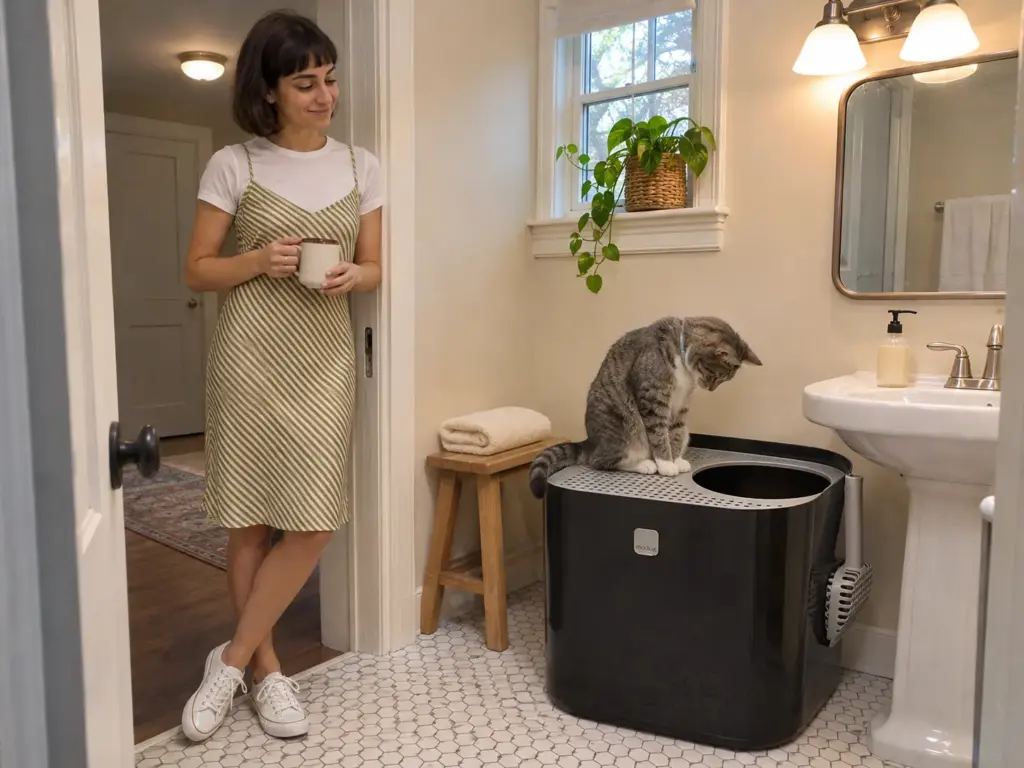
A Lid Is Not the Problem; a Small, Dirty Lid Is
A lid is not the problem by itself. In the controlled study that the American Veterinary Society of Animal Behavior summarizes, 70 percent of cats showed no preference, 15 percent chose the covered box and 15 percent the open one, with large boxes, fine clumping litter and daily scooping. Those conditions are exactly what a dog-proof box tends to break, because a retail hooded litter box is small and gets scooped less often. The study behind the covered versus uncovered question goes through the numbers.
A lid also leaves the cat one way out, a poor arrangement with a dog nearby, and a litter box enclosure makes the same trade in furniture form.
A Top Entry Asks the Cat for a Jump
A top-entry litter box drops the cat in from above, so the dog’s muzzle cannot follow. In exchange the cat gets a single exit and pays a jump in and out. That rules it out for a cat who will not jump: an older one, one with stiff joints, a big cat in a small apartment.
A taller open-topped box that the cat refuses solves nothing. It moves the problem to the rug. And a big dog fits into many top entries, while a tall one can lift the lid off.
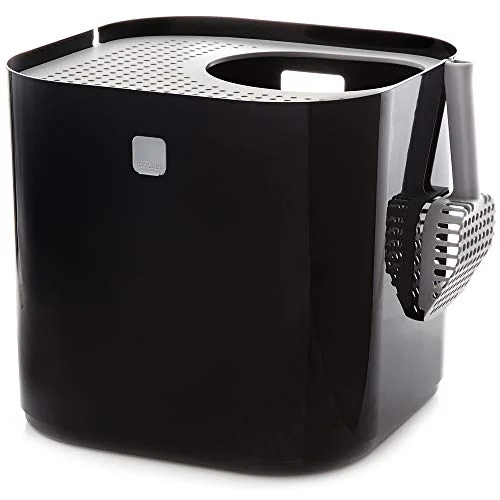
A cheaper way in is the IRIS USA Top Entry Cat Litter Box Large, with a 9 by 10.5 inch opening and a grooved lid. Outside it measures 20.75 by 16.12 by 14.62 inches, and the floor inside is small, so it suits small and medium cats and not a Maine Coon. The lid does not always stay put, and a tall dog can knock it off. How sides and entry height change what a cat will use is the page to read before a big cat meets either one.
Keep the old box next to the new one for a few days, so the cat can vote with his paws and the dog never sees the experiment.
The Three Setups Side by Side
The right setup depends on the dog, not the catalog. A small dog fits where a big one cannot, and a household that fixed its big-dog problem with cabinets can find the little dog walking straight in. A barrier at two heights solves both: a gate lifted about 6 inches off the floor for the big dog, and the box on a table for the small one.
| Setup | What stops the dog | What it asks of the cat | Works in a rental? |
|---|---|---|---|
| Tall gate with a cat door | The height of the gate | A walk through a small door | Yes, pressure-mounted |
| Closed door, cat-width opening | A gap too narrow for a head | One exit, and a route through a narrow gap | A strap, yes; cutting the door, only with permission |
| Top-entry or high-sided box | Walls or an entry above the dog’s nose | A jump, a smaller floor, one exit | Yes, nothing to install |
Scoop Before the Dog Finds It, Then Train as the Top-Up
With the doorway shut, the box still has to be worth nothing. Scooping comes second, the dog’s own nose third, and training last.
Scooping on a Schedule That Leaves Nothing to Find
Scoop after each use when you can, and scoop daily at the least, because that removes what the dog would go looking for. How often to scoop per cat per day sets the pace for the number of cats you have. A second reason for the clock: Cornell’s Feline Health Center notes that Toxoplasma oocysts need at least 24 hours in stool to sporulate and become infective, so a box emptied daily is cleared first.
When nobody is home to scoop, the Whisker Litter-Robot 4 is the one fix that removes the prize between visits instead of hiding it: it sifts after each use into a drawer the dog cannot open. It measures 27 by 24.25 by 29.5 inches and takes cats from 3 pounds. What a self-cleaning litter box does and does not fix is worth reading first, because it solves frequency and nothing about access or box count. Value for money, reliability and durability are all mixed.
Scoop right before you leave and right when you walk back in. Those are the two moments the dog is alone with the box.
Give the Same Nose Something Else to Do
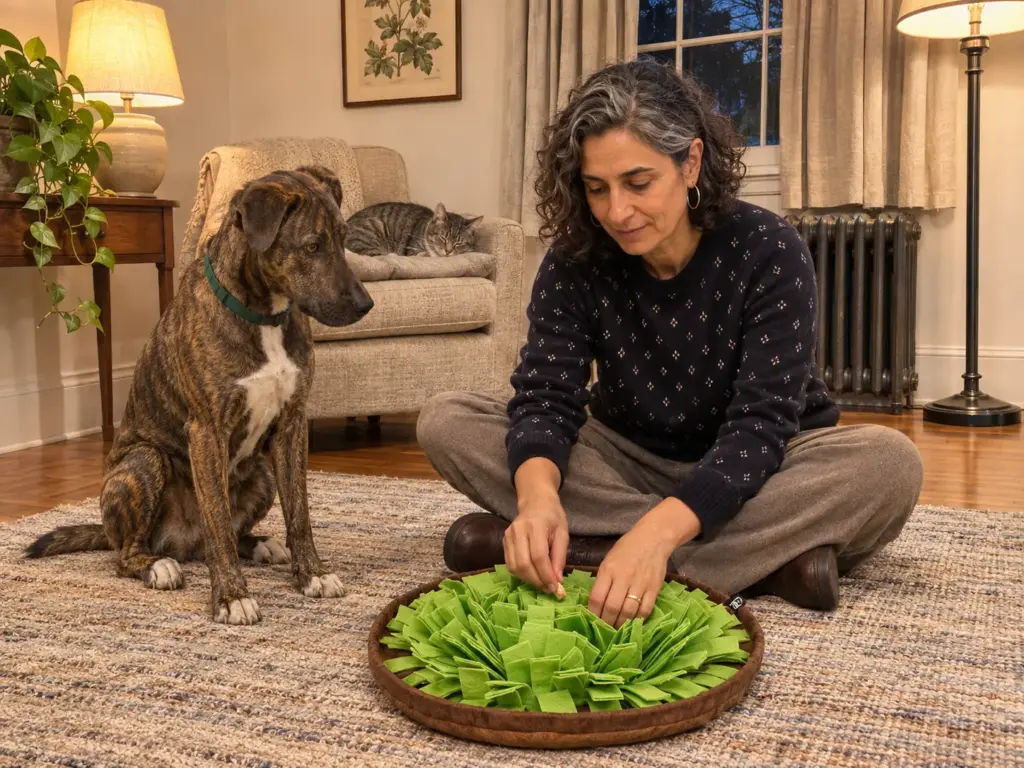
A dog who has had real exercise, a long walk and a foraging game raids less, with less boredom to spend on the box, because the nose that found the box now has a better job. Enrichment can be as plain as a puzzle feeder or a slow feeder at mealtime. The AWOOF Pet Snuffle Mat for Dogs is 18.8 inches square and folds into a bag, and it gives that nose a place to search. It tears apart quickly, and the fabric feels more like felt and paper than cloth.
“Leave It” Covers the Minutes You Are in the Room
Leave it is worth teaching, with positive reinforcement (rewards) and never with punishment. It works while you are standing there. The hours when you are not are the doorway’s, which puts it last in this order.
Food, Chews and the Vet Check Before Anyone Says “Deficiency”
A complete diet by AAFCO standards is the baseline, and a vet visit comes before a dog gets called deficient. The additive that makes the cat’s stool unpleasant goes into the cat’s food, every day, and leaves the doorway as open as before. This guide recommends no brand and no dose.
With Two Cats, the Dog Changes the Box Count
Even in a home with one cat, one box per cat plus one extra is the rule, and a dog bends it in ways the rule never mentions.
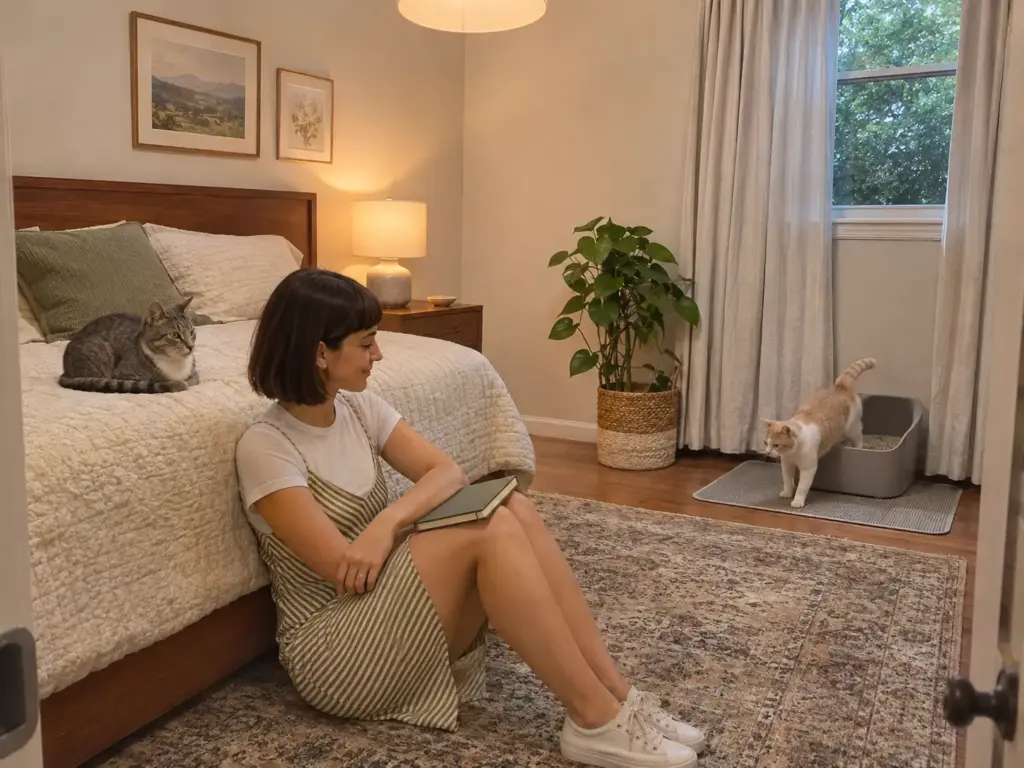
The Shut-Out Cat, the Spare Nobody Uses and the One the Dog Waits By
With two cats, the dog does not create one disputed box. He creates three problems.
The first is the cat who ends up on the wrong side of the closed door, because the opening was cut for the smaller of the two. The second is the spare box set where nobody walks, which no cat then uses. The third is the one box that stayed reachable, which the dog learns to wait beside and the cat learns to guard. Why a spare box fails in a multi-cat home explains why the spare gets skipped.
Counting Boxes the Cat Can Reach, Not Boxes on the Floor
Count the boxes from each cat’s own door. Two boxes down the same hallway count as one, because a cat who meets the dog on that hallway reaches neither, and the box count for two cats lands higher than the number on the floor.
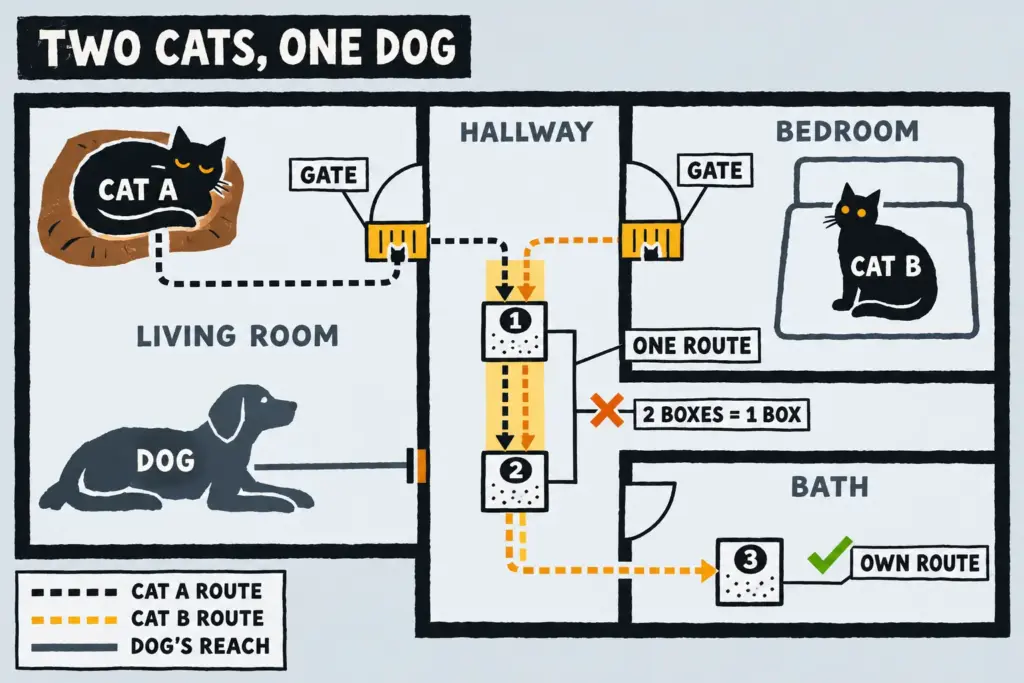
Walk each cat’s path to each box with the dog’s path drawn over it. Any box the dog’s path crosses stops counting.
Reading a Box the Cat Has Stopped Using
A box the cat leaves untouched is a box the cat has stopped using, and a sudden change in how he uses it goes to the vet before it goes to the house. If the vet finds nothing, a cat who skips the box in one room and uses another is describing the route, not himself: how a skipped room shows who is being kept out is the place to read how that looks.
Shut the Door With the Box Behind It, Then Watch the Cat for a Week
The doorway comes before the box, and the box comes before the training. Size the box to the cat, place it against the dog’s reach, scoop before the dog can find anything, and keep leave it as the top-up it is. Anything that hurts, or any habit that changes overnight in the dog or the cat, goes to the vet before it goes to the house.
Give the new setup a week, then look at two things: does the cat use the box at his usual hours, and is there litter anywhere it should not be? If he starts avoiding the box, or the dog is back at it, measure the gap in the doorway again, because that number is almost always the one that moved.
Today, close the door of the room with the box and watch the cat walk through it. If he does so without a pause, the next step is already half done.
Frequently Asked Questions
01How do I stop my dog from eating out of the cat litter box?
Close the doorway to the room with the box, using a tall gate with a cat door or a shut door with a cat-sized opening. Training comes after, as the top-up. Measure the cat’s shoulders against the dog’s head so one passes and the other does not.
02What should I do if my dog is eating cat litter?
Close off the box right away and note which litter the dog ate and roughly how much of it went missing. A large amount, repeated vomiting, no appetite or no bowel movements over the next day or two means a call to the vet, and a large amount means calling without waiting.
03How long after eating cat poop will my dog get sick?
How long a particular dog takes to get ill depends on the dog and the amount, so that answer belongs to a vet. The signs to call about are repeated vomiting, not wanting to eat and no bowel movements, watched over the next day or two. Call without waiting if the amount was large.
04What vitamin deficiency causes dogs to eat cat poop?
Usually none: a dog eating cat stool is a scavenger that found something still smelling like food, and a missing nutrient is not what draws him. If you suspect his diet, have the vet check before giving any supplement. Close the box either way.
05Is there a dog-safe cat litter?
Dog-safe is a label phrase, not a standard, and the property that matters if a dog eats litter, whether it clumps or swells, is the one a cat’s preferred texture rests on. What changes the outcome is access to the box, not a different litter.
Leave a comment