Best Interior Cat Door by Real Opening, Not Frame Size
Best interior cat door by real opening: prop gap 3-5.5 in, Meow Manor passage 6.4 x 7.8 in, Kitty Pass XL 9 in, plus the PetSafe flap and chip options

Alfredo RamsesFounder · November 10, 2026 · 23 min read

On this page10 sections
- 1The Best Interior Cat Door Starts With a Gap, and Often Ends There
- 2Measure the Dog First: Head Width, Chest and What a Latch Gap Lets Through
- 3The Answer That Cuts Nothing: A Door Prop, a Strap or a Gate Set Low
- 4The Cat's Opening Is Chest Width and Shoulder Height, Not the Weight on the Box
- 5Why a Cat Ignores a Flap That Fits: Whiskers, the Click and the Quiet Hallway
- 6No-Flap Portals: The Frame Is Bigger Than the Hole
- 7Cutting the Door You Have: Hollow Core, Thickness, Hinge Side and Who Has to Say Yes
- 8One Door, Two Cats: What a Microchip Lock Does and Does Not Do
- 9Measure the Dog's Head Today, Then Give the Cat a Week at the Gap
- 10Frequently Asked Questions
The litter room door is either open, so the dog walks in, or shut, so the cat stands outside it studying the wood. You bought what looked like the answer, a door latch or a cat flap, and the cat still avoids the gap or the dog still gets through it.
The cat has the better argument: a calm room is a real need, and the purchase was made in the reverse of the order that decides whether it works. The best interior cat door is chosen from the opening outward, by measuring the dog’s head first, the cat’s real passage second and the door you already have last, and the winner is often a prop that cuts nothing. This guide runs in that order, from the dog to the flap, the portal, the saw and a gap that two cats share.
Five setups cover almost every interior door, from a door strap to an electronic cat door that reads a microchip, and the columns are the questions that decide between them.
| Setup | Gap it gives the cat | Stops the dog? | Door cut? | Rental-safe? |
|---|---|---|---|---|
| Prop, strap or latch | 1.5 to 6 in, set by the hardware | Only if his head is wider than the gap | No | Yes |
| Door with a flap | Flaps run about 5.75 to 7 in across | When locked; a free flap depends on the dog | Yes | With a spare door |
| No-flap portal | 6.4 to 9 in wide, by model; the frame is bigger | No, a hole is a hole to a head that fits | Yes | With a spare door |
| Corner hinge kit | A 6 by 6 in corner cut | Depends on the dog | Yes, one corner | With a spare door |
| Microchip door | A flap that opens only for enrolled chips | Yes, it ignores any chip not enrolled | Yes | With a spare door |
The Best Interior Cat Door Starts With a Gap, and Often Ends There
Every interior door sorts two animals of different sizes, and the model name on the carton tells you the least about how it will go. What counts is the cat’s hip width and chest width, the width of the dog’s head at the ears, the opening size you can leave and the door thickness hanging in your hallway. A cat door for interior doors is a small decision with a measuring tape behind it. The frame size and the weight range printed on the box are labels.
Why the door you bought either stays open or locks the cat out
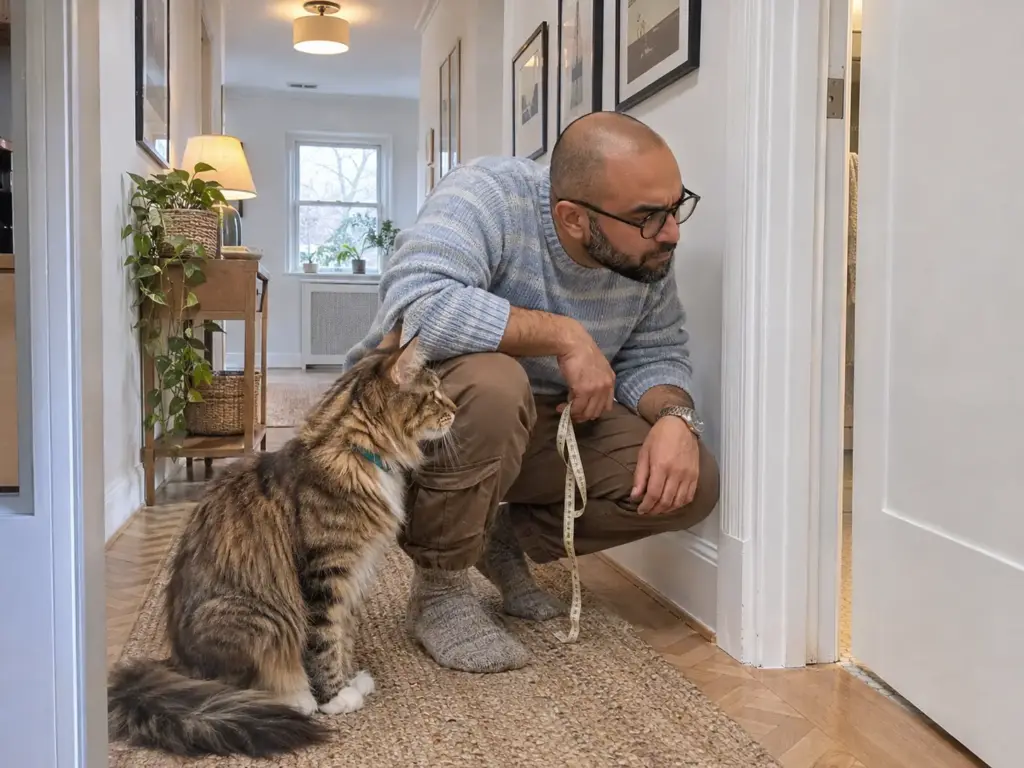
A shut door is shut for the dog and for the cat, and the box or the bowl in the feeding room sits on the far side of it. Leave it open and the dog drifts in; close it and the cat waits, scratches or finds another corner of the apartment. The room only works if the cat can use it undisturbed, and Ohio State’s Indoor Pet Initiative puts it in one line: “Cats need quiet and privacy when using their litter box.” A gap the dog crosses at will, or a route the cat avoids because it feels exposed, leaves the room unused.
Both extremes fail for the same reason. The need is a hole of the right size, and a tape measure answers that faster than a product name does. An interior door lets the household down in one of these places:
- The door is shut, and the cat is on the wrong side of it with the box or the bowl out of reach.
- The gap is open, and the dog’s head fits through it.
- The opening fits the cat on paper, and the cat will not walk through it.
The order the purchase fails in
The usual purchase starts with the cat: weigh him, read the weight range on the carton, pick a door. That is the last step of a sequence that runs dog, cat, door.
The dog’s head sets the ceiling of the gap, the cat’s chest and shoulder set its floor, and only then does the door in your hallway decide what can be installed in between. A purchase that starts with the cat finds the dog’s head at the worst moment, after the hole is cut. Rooms, routes and feeding for a cat and a dog under one roof are planned in how to set up a small home for a cat and a dog sharing it; this guide buys one thing, the door.
The question before any door: does it have to be cut at all
Before a saw comes out, ask whether this door has to be cut at all. A good share of homes end up with a latch, a strap or a gate set low, and the cat goes through each of them without touching anything. The litter box room is usually the only place the box fits, whether that is a laundry room or a basement corner, and where a litter box actually fits in a small apartment shows how few alternatives exist, so closing that room off is rarely an option. A hole is permanent; a prop is not.
The answer to the cut-or-not question comes after the measurements, and the free options come before any product.
Measure the Dog First: Head Width, Chest and What a Latch Gap Lets Through
The head decides, not the height it can jump
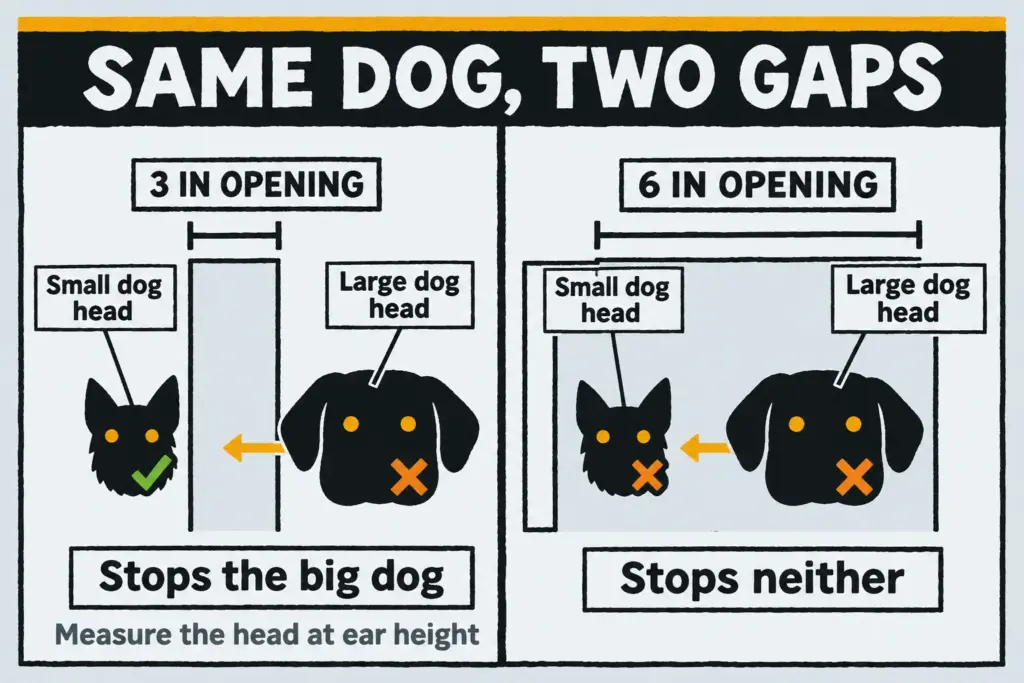
A dog goes through the gap his head goes through, and the chest follows. How high he can jump is a separate problem, and a dog gate handles it.
What you are after is to keep the dog out of the litter box room, and the head width is what decides that. For a latch or a prop the gap is the whole argument: a prop that holds the door open 3 to 5.5 inches sits beside latches that open 2.5 to 6 inches and 1.5 to 6 inches. A 3-inch opening stops the shoulders of a Labrador and does not stop the head of a Jack Russell, so the same number answers yes for one dog and no for the other.
This guide also assumes the dog has already passed the test of sharing a floor with the cat, and how to judge the dog before it shares a floor with a cat is where that judgment is made. Nothing here reopens it. What it adds is arithmetic: the cat holds the better claim on the room, and the dog’s head is what the room has to be defended against.
How to measure the dog at the ears and the chest
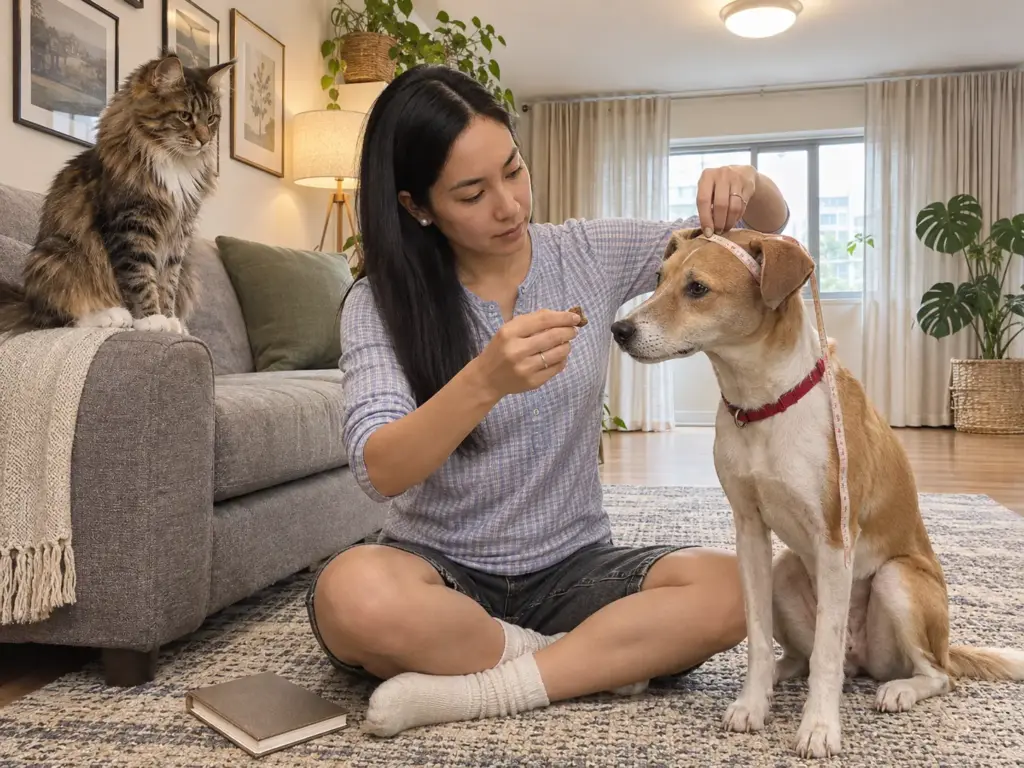
Take a soft tape and read three numbers off the dog: the width of the head at the ears, the depth of the chest behind the front legs and the height at the shoulder. Then hold the tape across the real gap, with the door hanging as it hangs, and compare. If the shoulder sits below the top edge of the opening, what you have is a dog door with a cat painted on it. Writing those numbers down before reading any product page is the same habit as sizing a barrier to the dog’s reach instead of a product label at the feeding station.
- Head width at the ears, against the narrowest point of the gap.
- Chest depth behind the front legs, against the height of the opening.
- Shoulder height, against the top edge of the opening.
- All of it taken at the door as it hangs, never copied from a product page.
Write the dog’s head width on a sticky note and press it to the door. Every opening listed after that becomes a yes or a no instead of an opinion.
The nose-under test
The test takes half a minute. Open the door to the gap you are considering and put a treat on the far side. Let the dog try to get his nose in. If the muzzle goes through and the head follows, the gap is no barrier; if the nose stops at the frame, the number you measured is the one to shop against.
Run it twice, a minute apart, because a dog that fails once often tries a new angle on the second go. Measure the head, not the muzzle (the muzzle goes in first, but the skull behind the ears is what decides). It takes a tape, the door as it hangs and a treat, so it works in a rental and in a bathroom with no spare inch.
The Answer That Cuts Nothing: A Door Prop, a Strap or a Gate Set Low
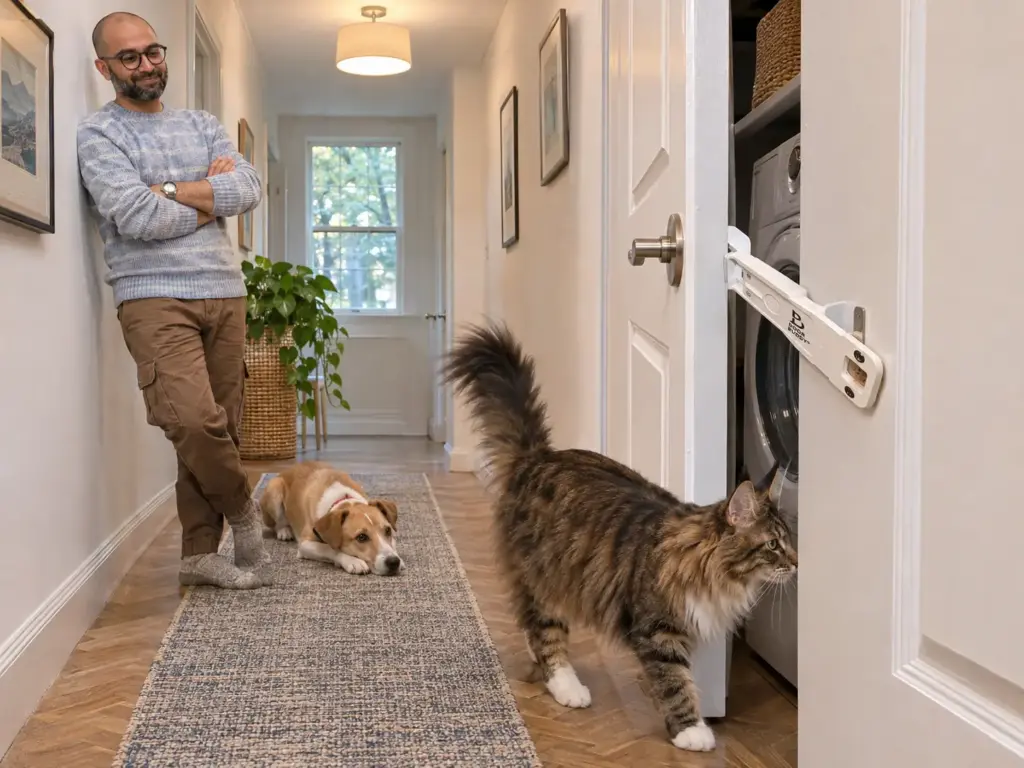
The answer that fits the most homes is not a door. It is a prop, a strap or a gate that leaves a few inches of opening, and the cat slinks through it without touching anything. In the cat’s judgment an open path beats a path with a flap, every time.
Free first: the gate you already own, set low
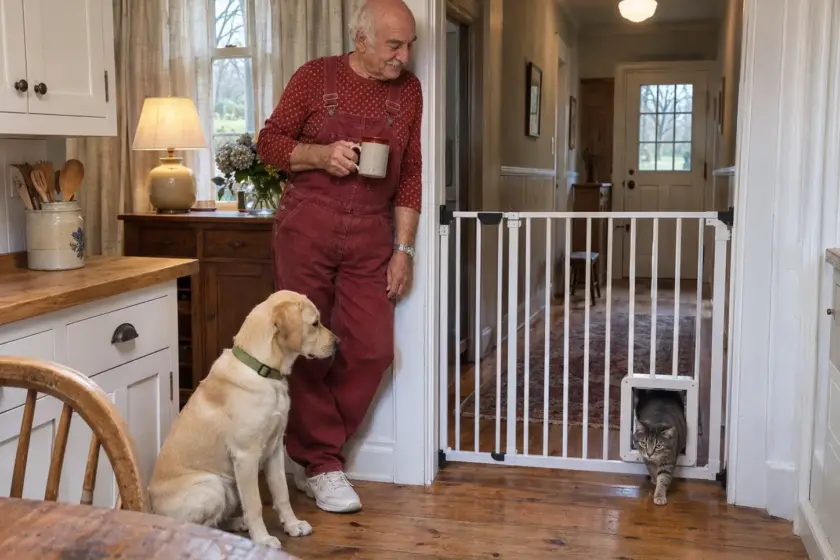
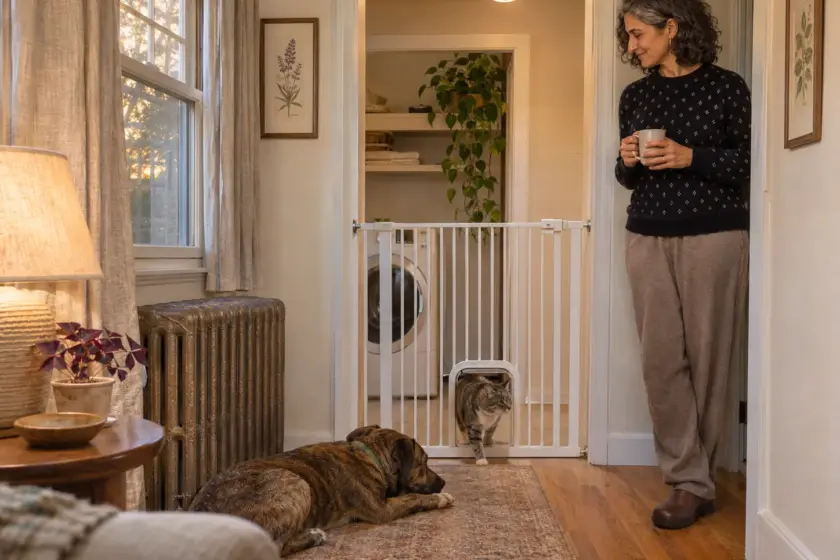
If a pressure gate is already in the house, set it about 10 inches off the floor. The cat walks under it, the dog does not, and nothing is cut. A door wedge that leaves the door ajar does a rougher version of the same job, and so does a door strap or a door latch that stops the door a few inches short of the frame. When the dog and the cat have only just met, the gate and the distances belong before any door, and the gate stages that come before any door in the first month set them out.
A prop that holds the door open a few inches
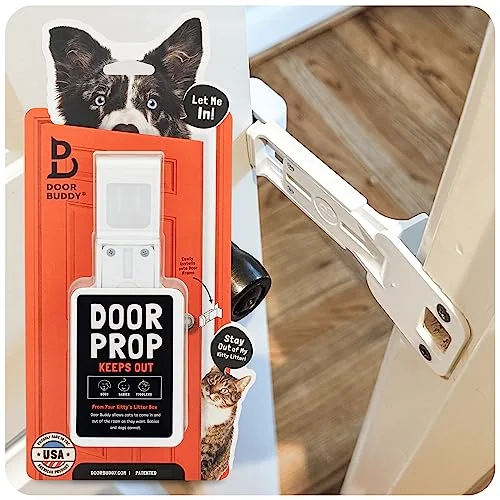
The Door Buddy Door Prop for Cats replaces the strike plate and holds the door ajar between 3 and 5.5 inches, with no cutting and no drilling, which makes it a renter-friendly, no-drill answer. The cat reads that gap as a path that touches nothing. And the door still closes at night, which a hole never will.
It suits a dog whose head is wider than the opening, a number you have in hand from the measuring above. The arm is its weak point: it can break, and the door then slides back to its narrowest setting without telling anyone.
The bathroom is the usual home for this prop, because the door has to shut when a guest is in, and the closed-door failure of a litter box in the bathroom is what happens when it shuts with the box inside. The bedroom is the other classic, and keeping the bedroom door shut at night without locking the cat out uses the same gap for a different reason. For a litter room where the dog is after the box, blocking the litter-room doorway when the dog is after the box covers what to do at the threshold.
The prop the dog learns
A dog that has met the prop learns it. He nudges the door toward its narrowest setting with his nose, and the head goes through. The advice to prop the door and walk away fails right there, and it fails as arithmetic, not as a flaw in the dog: a head slightly narrower than the widest setting will find the widest setting.
If the dog’s head measured close to the gap, the prop is the wrong answer, and a hole with a lock on it is the better call. If it measured well above the gap, set the prop to the narrowest opening the cat still clears, which is his chest width plus 1 to 2 inches.
Test the gap with the door in place after dark, and look the next morning at whether the prop has crept toward its narrowest setting. A prop that has drifted overnight has already told you how the dog will treat it.
The Cat’s Opening Is Chest Width and Shoulder Height, Not the Weight on the Box
Two numbers, taken with the cat standing
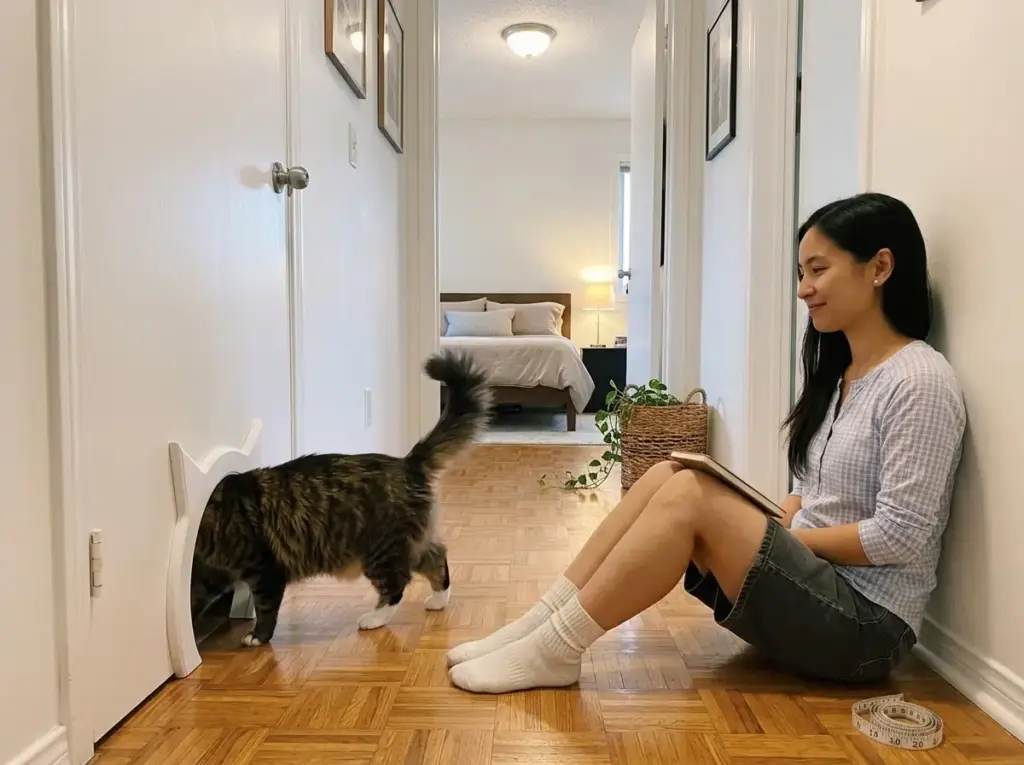
Stand the cat on all four paws on the floor, on a day he lets you. Measure his width at the widest point, which is the chest or the hips (the hip width wins on a broad cat), and add 1 to 2 inches. Then measure his height, from the top of the shoulders down to the bottom of the chest or the belly, and add 1 to 2 inches.
Those two figures are the opening size he needs, and PetSafe’s own sizing chart uses the same pair. Add an inch if he is lean. No, add two if he is broad across the hips, because the hips are the part that gets stuck.
- Width at the chest or hips, plus 1 to 2 inches: keeps his sides off the frame and off any flap.
- Height from shoulder to chest or belly, plus 1 to 2 inches: keeps his back from catching the top edge.
The bottom edge of the opening belongs at belly height, about 4 to 6 inches off the floor. Set it lower and the cat ducks on every pass; set it higher and an older cat has to step up, which is the moment he stops using the door.
Measure him standing, never sitting or held in your arms, and add the inch or two to both numbers before any model name enters the picture.
The weight on the box is a label
PetSafe’s own chart shows how little a weight range tells you: the small flap is 5.5 by 5.125 inches for cats of 1 to 15 pounds, and the small-plus flap is 7.125 by 7.5 inches for 1 to 25. Two cats of 12 pounds, one long-boned and one short-legged and round, do not need the same opening.
A box also prints three different sizes for one door, the opening, the cut-out and the outer frame, and the carton leads with the largest. The cat that lowers his head and stands there at a gap is reading a hole smaller than himself.
When the cat is bigger than the door you were sold
A long, tall cat, a Maine Coon or a cross of one, is the case that breaks the 15 to 20 pound doors. A kitten gets measured at the size he will be, not the size he is. For the large cat, The Kitty Pass XL Cat Door has an opening 9 inches wide and 8 high, is rated to 30 pounds and fits doors 1.25 to 1.75 inches thick; a 30-pound cat and a Maine Coon cross clear it, and the standard doors do not. Some units come apart at the frame after about two months, so look the frame over once that second month passes.
With two cats of different sizes the larger one sets the opening, since the smaller clears anything that fits the larger. A wider opening takes no floor space but takes more door, so confirm the door you hang it in is wide enough for the cut; the rules for cutting further down cover that.
Why a Cat Ignores a Flap That Fits: Whiskers, the Click and the Quiet Hallway
The hole fits and the flap still touches him
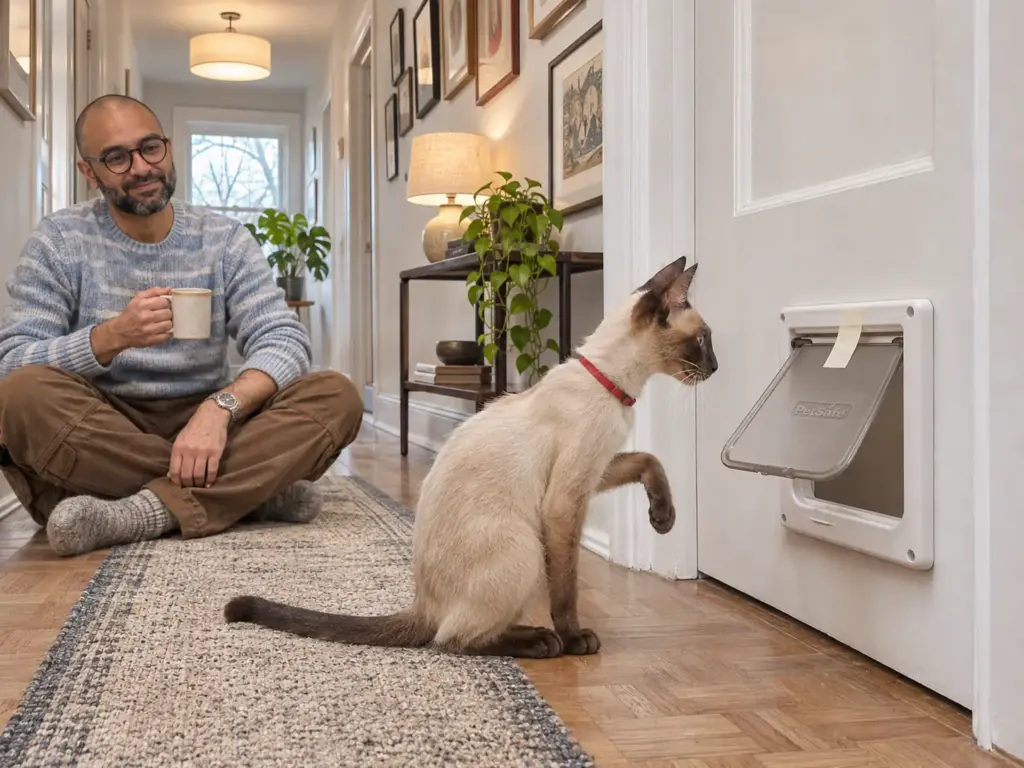
A cat’s whiskers span roughly the width of his chest and hips, and a flap that brushes his sides is felt on every pass.
A flap that drags across the neck and the back is what ends the habit, not the hole. The cat can be measured for a gap that fits, walk through it on a day the flap is taped up, and refuse it the first day it hangs free. He is solving a problem the door created, and on the contact he is right. It is the usual reason a cat won’t use a flap that fits on paper.
A hole is a route only while the cat can use it with the dog in the room, and why a door or gate is a route only while the dog is not at the hole takes that further.
The click in a quiet hallway
A flap clicks when it swings back, and in a quiet hallway that flap noise is the entire objection. PetSafe’s own guidance is to close the flap slowly by hand so the cat hears the sound before it happens. The room behind the door has to stay calm, and according to the AAFP’s house-soiling guidance, “Some cats may avoid using a litter box located in a high traffic area or near cat doors or flaps.” So the door and the box get decided together; a flap two steps from the box can turn the box into the thing the cat avoids.
The budget pick in this group is the PetSafe Interior Cat Door, 2-Way Lock: a flap of 5.75 by 5.75 inches in a cut-out of 6 9/16 by 6 13/16 inches, for doors from 1/2 to 2 inches thick and cats up to 15 pounds, with the template and hardware in the box (the Depets Large Cat Door, with a four-position lock and a 7.08 by 7.48 inch inner opening, gives a bigger cat more room). Closing its lock is a two-handed job, and the outer piece can crack within weeks.
Tape it open, then half open, then down
Training is a ladder, and each rung teaches the cat something different. Taped fully open for a week or two, the flap is only a hole, and the cat learns the route. Held half open, it brushes his neck and back, and he learns that the touch is harmless. Let down, it swings, and by then the swing is a known thing.
A cat that sails through a taped-up flap and stops the day it comes down is reacting to the rub on his neck and back, not to the hole.
The same cat may use the room happily with the plastic panel off and refuse it with the panel on, because the bathroom is the one place a cat will not be cornered. With two cats, train one at a time; the shy one takes longer. If the cat will not use the flap after two weeks of this, move to a hole with no flap in it instead of pushing.
Stay on each rung until the cat crosses without a pause. If he stops the first time the flap comes down, go back one stage instead of coaxing him through.
No-Flap Portals: The Frame Is Bigger Than the Hole
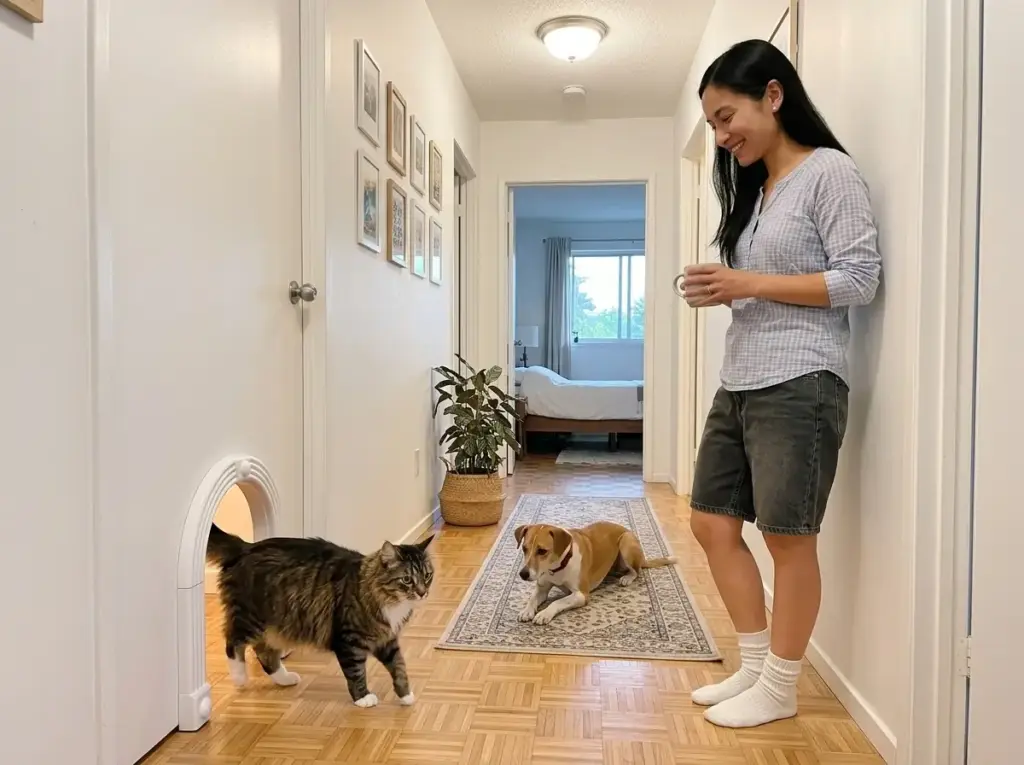
The frame you pay for and the hole the cat gets
The Purrfect Portal Meow Manor is the cat portal a cat will take on the first try, and its frame hides the raw edge of a hollow-core cut. The frame measures 9.25 by 9.33 inches. The cat’s real passage is about 6.4 by 7.8 inches, and even small cats have to duck through it. It is rated to 20 pounds and fits doors 1.25 to 1.75 inches thick.
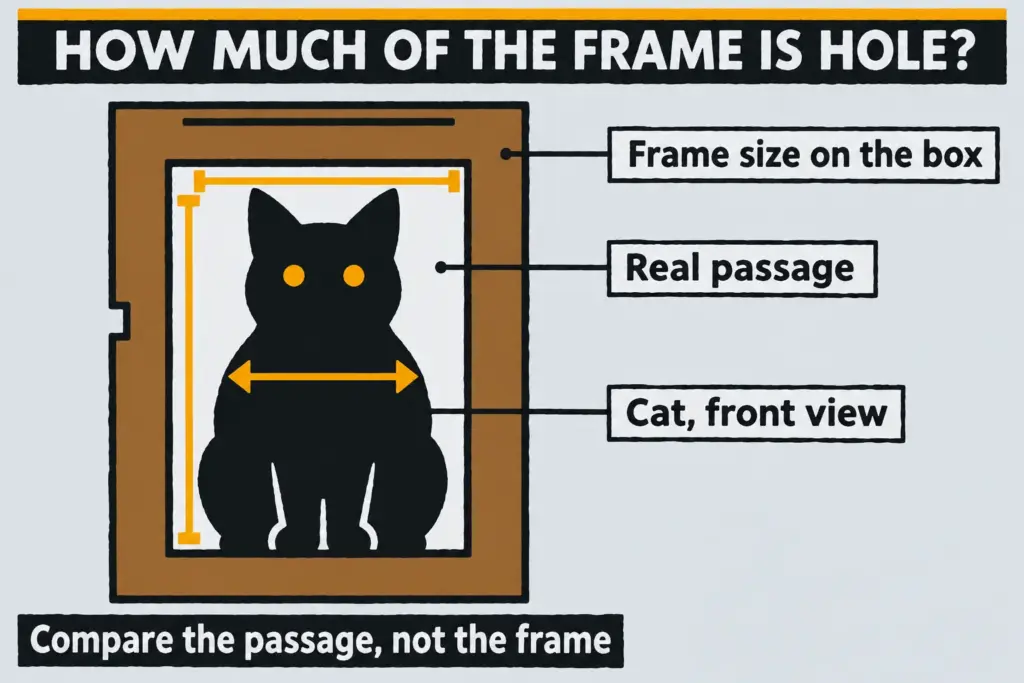
A frame is a good reason to buy a portal and a poor measure of what passes through it. Judge every portal by its passage, and let the frame be a bonus when the door is hollow.
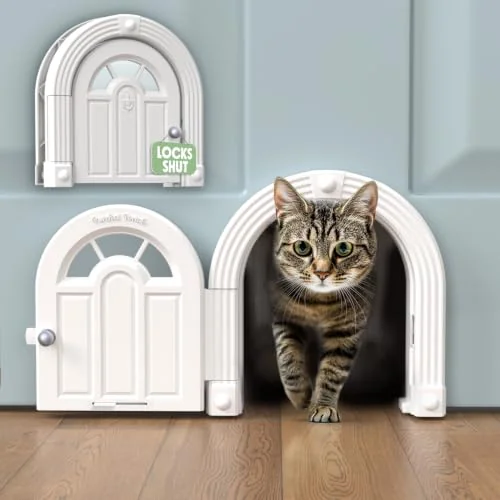
Arches and tunnels, compared by the opening
The Meow Manor is the obvious no-flap cat door, and it is the right call for a medium cat and a hollow-core door whose cut needs covering. For a broad cat its 6.4-inch width is the problem. The Kitty Pass Interior Cat Door opens 7.5 inches wide by 6.5 high, for cats up to 21 pounds and doors 1.25 to 1.75 inches thick, so it passes more cat sideways, though not more cat upward. The template cuts larger than the frame, and the adhesive is weak, so plan on screws.
The published opening decides, not the name on the carton. The PetSafe Cat Corridor for Interior Doors is a straight tunnel with the largest published opening of the group, 7 1/2 inches wide by 7 11/16 high, for cats up to 20 pounds and hollow or solid doors, and it can be painted. Its closure is a mixed bag, and the opening can run larger than a home wants.
What a no-flap portal does about the dog
Nothing. It is an open pass-through, a hole. A no-flap portal stops no dog whose head fits through it, which is why the dog gets measured first.
In a household where the dog never tries, it is the quietest answer in the guide: no flap to touch, no click, no wait. With two cats it is the best of the group, and with a determined dog it is the worst. A portal also needs the door cut, so a rental takes the spare-door route in the rules below, and the prop stays the answer that cuts nothing.
Lay the cat’s two numbers next to each model’s published passage, not its frame, and strike out every model the cat does not clear with his inch or two to spare.
Cutting the Door You Have: Hollow Core, Thickness, Hinge Side and Who Has to Say Yes
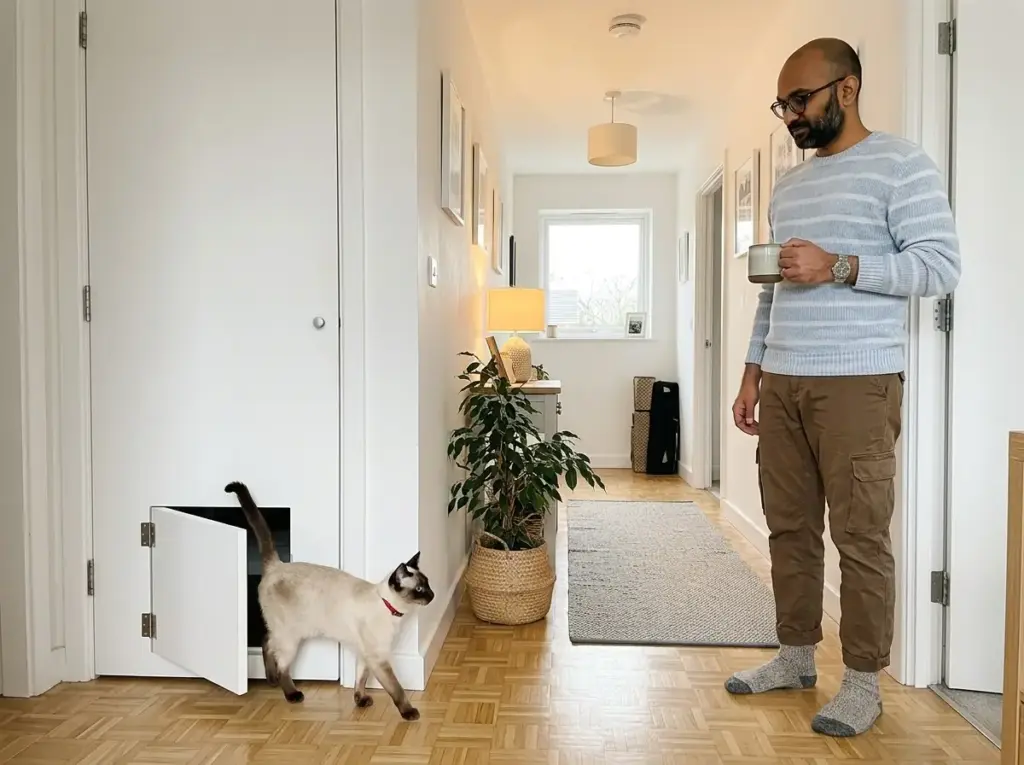
Hollow or solid, and how thick
A hollow-core door has a solid rail about 30 mm deep along the bottom; cut above it with a jigsaw and a fine blade, slowly. A reciprocating saw shakes the skin off the honeycomb. The cut edge is cardboard honeycomb that snags a paw, so it has to be framed or packed, which is the whole pitch of a portal with a frame. A solid-core door has no honeycomb to frame, and the PetSafe Cat Corridor is listed for hollow or solid doors.
Installation starts with the template in the box, laid on the door where the bottom edge of the opening will sit. An interior door is usually 1⅜ inches (35 mm) thick, and the consumer doors in this guide take 1.25 to 1.75 inches (the PetSafe two-way takes 1/2 to 2). Measure the door thickness at the edge before you order anything. Cutting a door for a cat is the same job as cutting the entry of a homemade litter-box enclosure, and the cuts that decide how a homemade litter-box enclosure works for a cat show the same craft in furniture.
The corner kit has a hand
Corner hinge kits have a hinge side, left or right. Buy the wrong hand and the door swings into the wall. The MouMouPurr Cat Door Adjustable Hinge Kit ships both hands in one box, so the cut cannot come out backward, and it is a corner-mounted cat door that takes a 6 by 6 inch corner cut with adjustable tension. A corner cut leaves the hollow core open at the corner, and without a backer glued inside, the door goes floppy within months.
A rough edge matters more with two cats, since every extra pass is another chance to graze a paw, and a cat that grazes a paw has a good reason to stop using the hole.
Before the saw: the four people who can say no
Four parties can veto a cut, and none of them is the cat.
- The door warranty: cutting can void it.
- The fire rating: a fire-rated door loses its rating when cut, and the label is on the hinge edge. If it carries one, the cut is not yours to make and the cat door goes in a different door.
- Your insurance and your local building code, both worth a look before the saw.
- The landlord, in a rental, who gets asked first.
Read the label on the hinge edge and measure the thickness of the door before any model goes in the cart. Those two checks rule out more purchases than the cat does.
The renter’s route: swap the door, store the original
A cheap hollow-core door, secondhand or from a salvage store, cut and hung on the same hinges with the same handle, protects the deposit, and it is the renter-friendly way to get a real hole. The original is stored flat and rehung at move-out. Ask the landlord first: a spare door is the version most landlords can accept, since nothing about the original changes.
Another reversible route is a panel of corrugated plastic sheet velcroed into the door frame, with the portal mounted in the panel; the door itself stays whole. And if none of that works out, the prop is still on the table.
One Door, Two Cats: What a Microchip Lock Does and Does Not Do
Who actually gets through
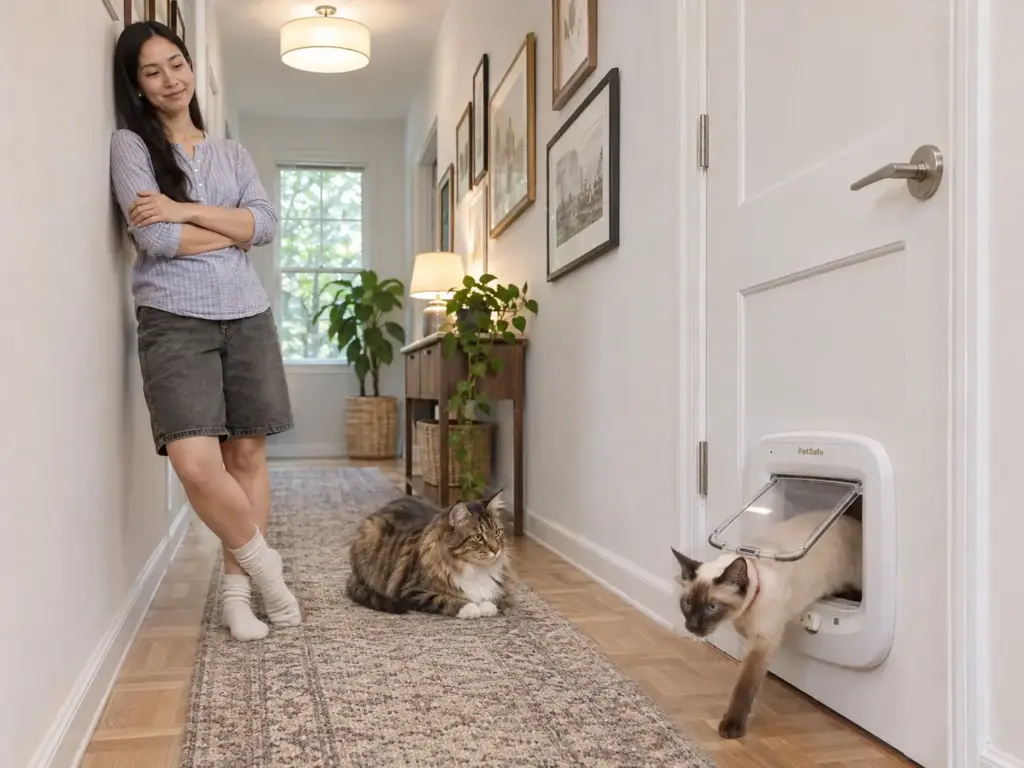
The larger cat sets the opening, and the smaller cat clears anything that fits the larger. The shy cat waits behind the other. A flap adds a wait to that, since somebody has to push it; an open gap adds none. With two cats the problem at a door is rarely size, it is who gets the room, and the cat guarding the gap is solving his own problem about territory, not misbehaving.
What a microchip door does at an interior door
The PetSafe Microchip Cat Door is an electronic cat door that reads a cat’s 15-digit FDX-B chip, stores up to 40 animals and runs a 4-way locking mechanism, in an interior or an exterior door. It is the only opening in this guide that lets one cat through and keeps the other cat and the dog out. A flap without a chip reader cannot tell the cats apart. But the lockable flap’s real job at an interior door is access control against the dog or a toddler, not dividing the cats.
It needs batteries and a close approach, and a cat whose chip is not enrolled stays out, watching the flap. It relocks about three seconds after a read, the click is loud, and a determined cat learns to work the flap.
Selective access at the bowl, and the cat left waiting behind the lid is the same decision applied to food. Separately, a cat that has used the box for years and quits overnight is a question for the vet, not a door problem; once that is handed over, the work goes back to the room.
Enroll both chips and test with fresh batteries in before the flap goes into service, and leave it propped open until you have watched each cat get through. The first evening is the wrong time to find a cat locked out.
The box still counts one per cat plus one
A door gives access to a room, not to a solved house. Boxes run one per cat plus one, and each box should be 1.5 times the cat’s nose-to-tail-base length, per the AAHA/AAFP feline life-stage guidelines on the box itself. How many boxes two cats really need works the count, and the 1.5-times rule for the box itself, in inches works the size.
That count assumes the room can hold the boxes; a room too small fails even behind the best door. And a box beside a doorway the other cat uses is the very case the AAFP says some cats avoid.
Measure the Dog’s Head Today, Then Give the Cat a Week at the Gap
The door gets chosen from the gap outward: the dog’s head sets the ceiling, the cat’s chest and shoulder set the floor, and the door in your hallway decides what can be installed between them. Often the answer is a prop that cuts nothing. The frame and the weight on the carton are not the opening, a no-flap portal stops no dog whose head fits, and two cats at one gap need the room sorted out as well as the door.
After a week with the new gap, watch two things. Does the cat cross without ducking or circling back, and does the dog stay on his side? If the cat circles back, take his two numbers again. If the dog’s head fits, return to the head measurement before buying a second door.
Today, put a soft tape around the dog’s head at the ears, write the number down, and wedge the door ajar with a folded towel. Then watch whether the cat walks in without touching the wood.
Frequently Asked Questions
01What is the best interior cat door for a large cat?
Pick the door whose opening is as wide as the cat’s chest and as tall as his shoulder-to-belly measure, plus 1 to 2 inches each. A long, tall cat usually needs a wide no-flap portal. Judge the published opening, not the frame or the weight on the carton.
02Can a dog fit through an interior cat door?
A dog fits if his head fits, so judge the gap against head width at the ears, not against his height. A 3-inch gap stops a Labrador’s shoulders but not a terrier’s head. Measure the head, hold the tape at the real gap and test it with a treat on the far side.
03How do I add a cat door to a rental without cutting the door?
Use a prop, strap or latch that leaves the door ajar, or a pressure gate set about 10 inches off the floor; neither cuts or drills anything. If you need a real hole, hang a cut spare door and store the original flat, after asking the landlord.
04Why won’t my cat use the cat door?
Usually it is the flap, not the hole: it brushes his sides, clicks in a quiet hallway or swings back mid-step. Tape it open a week or two, then half open, then down; if he still refuses, try a no-flap opening. A sudden change in his bathroom habits is a vet question.
05Is it harder to cut a cat door in a hollow-core door?
A hollow-core door cuts easily above its bottom rail, but the honeycomb edge is left exposed and needs a frame or a glued backer. Cutting can void the warranty, and a fire-rated door loses its rating, so read the label on the hinge edge first.
Leave a comment