Why Your Cat Escape Route From the Dog Is Really a Trap
Build a cat escape route from the dog in your own room: low start, short steps, a landing he can turn on, two ways down & a gate the dog can't camp.

Alfredo RamsesFounder · November 9, 2026 · 20 min read

On this page10 sections
- 1A Cat Escape Route From a Dog Is a Way Out, Not a Place to Hide
- 2What a Shelf Cannot Fix, and Who to Call Instead
- 3The Start and the Step: First Jump Low, Gaps a Panicked Cat Can Clear
- 4The Landing Needs Room to Turn Around and Sits Above the Dog's Nose
- 5The Second Exit: Why High With One Way Down Is a Siege
- 6The Chokepoint: A Gate or a Cat Door Is a Route Only While the Dog Is Not at the Hole
- 7The Exit That Ends Outside: Doggy Doors, Windows and the Front Door
- 8With Two Cats, One Route Is a Queue
- 9Trace the Route With Your Finger From the Cat's Spot
- 10Frequently Asked Questions
You put a cat tree in the corner and a shelf over the sofa, and the cat still ends up flat on the floor under the table whenever the dog walks in. He is reading the room correctly: neither piece is a cat escape route from a dog, because neither has a start he can reach in one panicked jump, a landing that puts him above the dog’s nose, or a second way down. A route is measured in inches and exits, and it fails in three places: the landing, the chokepoint where the dog can stand guard, and the opening that leads to the street. This guide builds the route from the floor up, starting with where furniture ends and the vet’s office begins, and finishes with the same route for a home with two cats.
Quick Answer
A route is a measured path with a start, a landing and two ways down. A cat that hides all the time, stops eating or limps after a chase needs a vet or a behaviorist, not furniture.
- Start the first jump 18 to 24 inches off the floor.
- Keep every gap between footholds to 12 to 18 inches.
- Land on a shelf 10 to 12 inches deep, above the dog’s nose.
- Add a second way down that avoids the first.
- Check every gate or cat door so the dog cannot camp the hole.
- Close every opening that leads outside before the cat needs it.
A Cat Escape Route From a Dog Is a Way Out, Not a Place to Hide
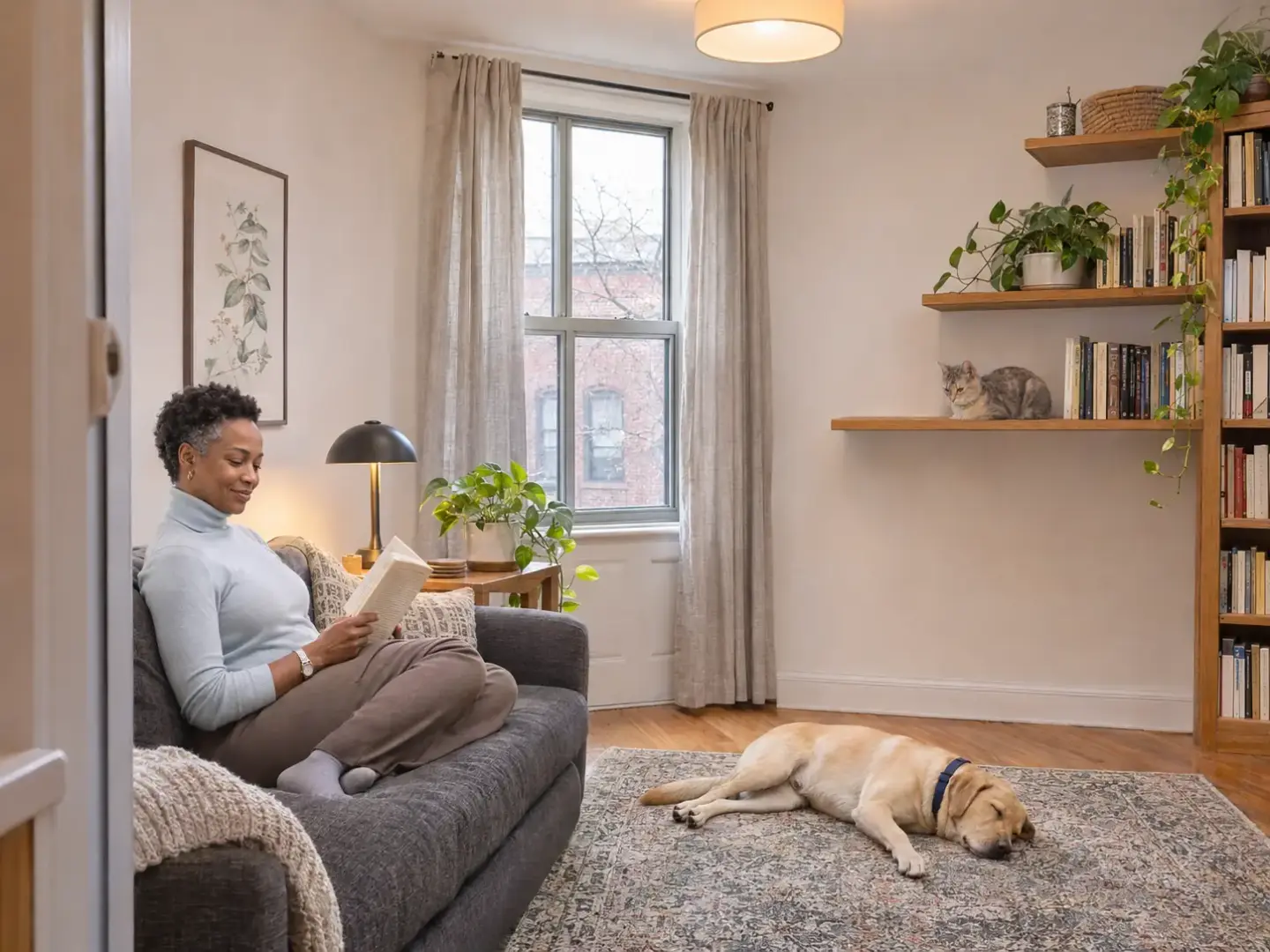
“Give the cat an escape route” fits on a sticky note, and that is the trouble with it. The sentence names a thing without saying where it starts, how far apart its footholds sit or where it ends. In this guide a route is a path the cat can walk with the dog in the room, from the first jump to the last, and walk back out of again. It differs from a hiding place (where the cat stays) and from a safe room or base camp (where his food, box and bed live), and a home with a dog needs all three.
What the Cat Needs Is Control Over the Distance
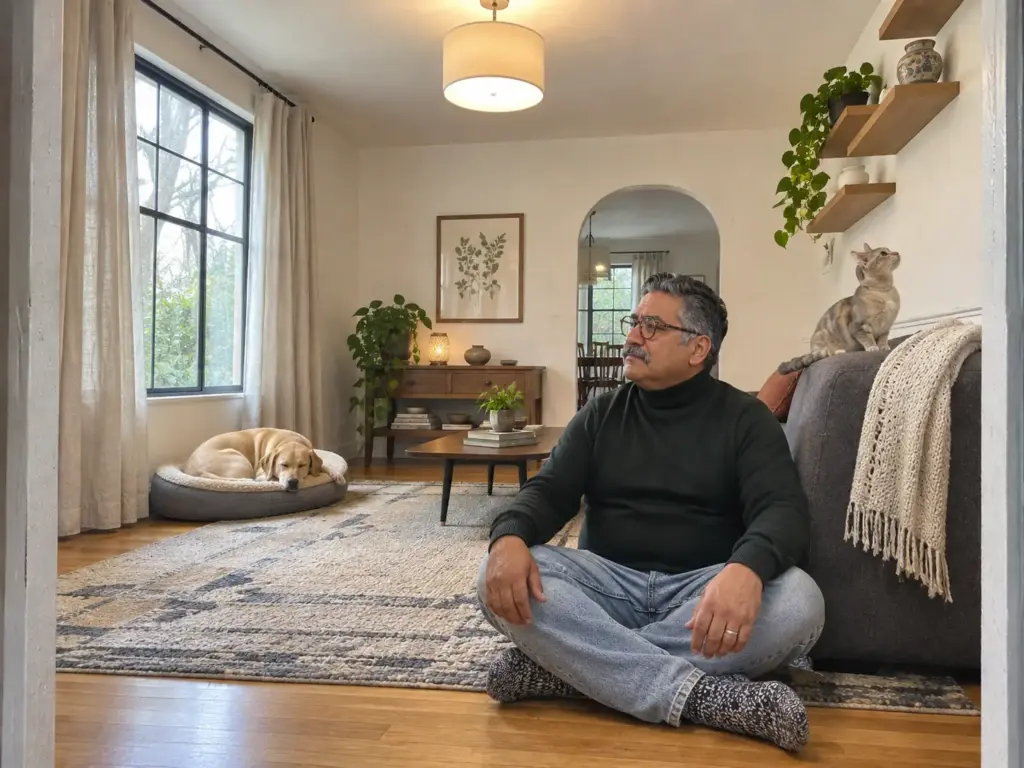
A cat sharing a home with a dog is not asking for altitude. He wants control over distance: to see the dog coming, to leave before the dog closes to his flight distance and to come back when he decides it is over. The AAFP/ISFM environmental needs guidelines build a healthy indoor environment on that kind of control, and a private place to retreat to is one of their main concepts.
In a small one-bedroom apartment you can turn this into a yardstick: the cat should rarely be far from somewhere to go. Count it in feet, not in furniture, because retreat access is measured from where he is standing. A tall bookshelf on the far side of the dog’s bed is in the room and no use to a cat who would have to cross the dog’s path to reach it.
The Tree in the Corner and the Shelf Above the Sofa Are Not Routes Yet
A tree that has stood in the corner for years, untouched, usually gets its first real use in an emergency, and it gets used as a launch pad: a place to push off from on the way out of the room, not a place to settle. The shelf over the sofa has the opposite flaw. It is a decent landing with no start, because nothing between the floor and the board is a step the cat can reach in one jump with a dog in the way.
Height is the answer that comes first, and vertical territory covers half the problem. A dog can learn a tree: a six-foot tower gets climbed, the dog jumps from the top, and the chase carries on a few feet higher. High ground the dog can learn, or high ground with a single way down, is only a taller floor.
Hiding Under the Bed Is the Cat Leaving the Room, Not Finding a Spot
Under the bed looks like a cat who found a spot. Mostly it is a cat leaving the room: he stops using the rooms the dog patrols, and the gap under the furniture is where he waits while that room is lost. Count it as a room taken off his map. A route does the opposite job, because it keeps the room in use with the dog inside it.
This route is one part of a house that has to work as a whole, and the litter, the feeding and the rest of the layout around it are laid out in the full plan for setting up a small home for a cat and a dog.
What a Shelf Cannot Fix, and Who to Call Instead
What the Layout Can Change
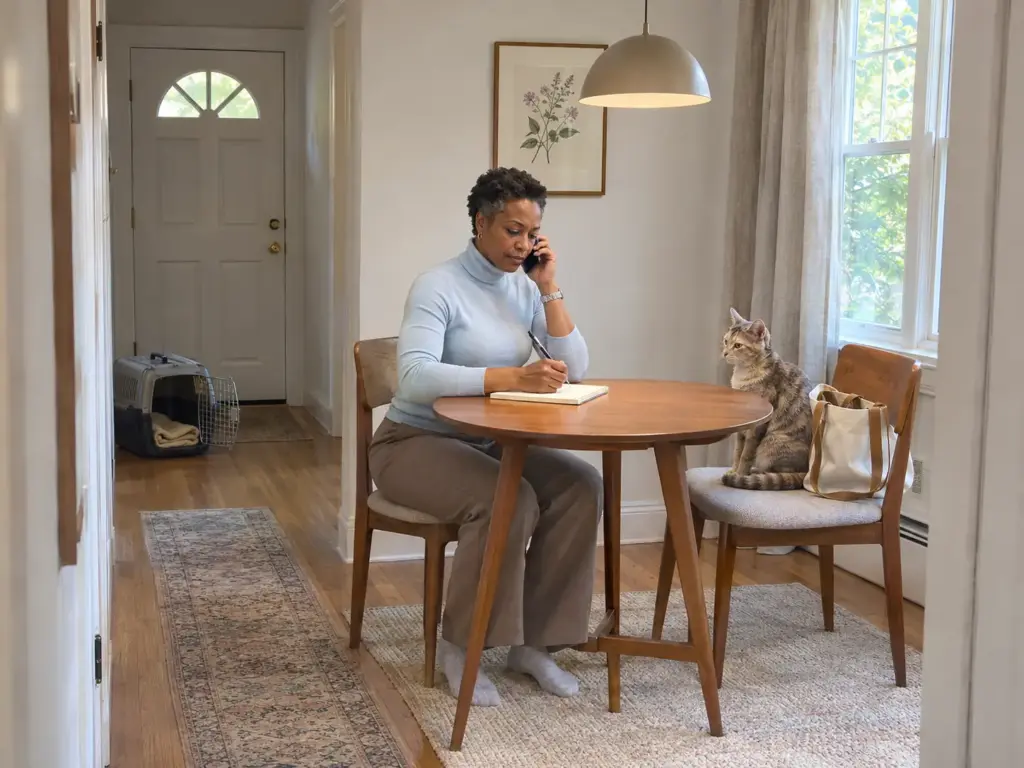
Furniture changes four things: how far the cat is from the dog, how high he can get, how many ways out he has and where the two are forced to pass each other. A route does nothing beyond those four, and every one of them is environment and prevention. A route also takes for granted that the dog can be loose in the same room; whether this particular dog can share the floor at all is worth settling first.
What Goes to a Vet or a Certified Behaviorist
A cat who stops eating, who hides all the time, who limps or breathes with difficulty after a chase, or a dog who keeps chasing after being corrected, gets a call to the vet or to a certified behaviorist before you move another piece of furniture, and a bite or a scratch that breaks the skin goes to the vet as well. This guide does not explain those signs or try to treat them; that short list is when to call the vet, and a vet visit comes before any shelf. A route also does not promise that the two animals are safe together; supervision stays whatever you build. Everything from here on is the part the room can do.
The Start and the Step: First Jump Low, Gaps a Panicked Cat Can Clear
Free First: The Furniture Already in the Room
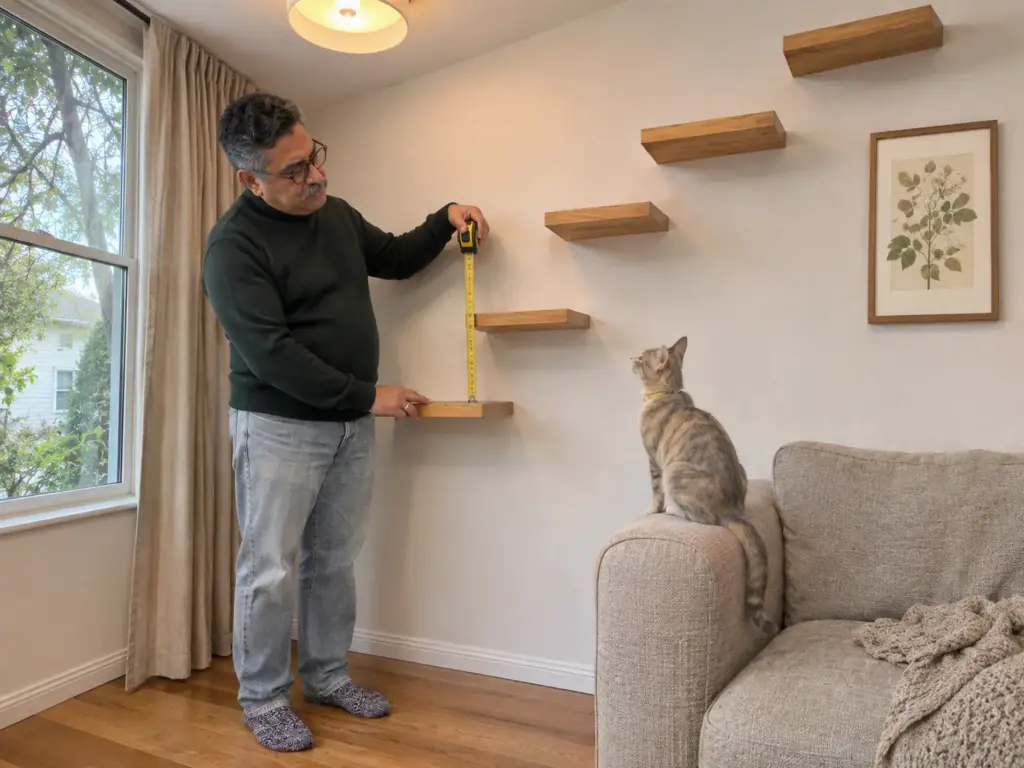
Think back to where the cat was the last time the dog came into the room. On the floor, and the usual reason is that the first jump was too high. A chase does not use the route you drew on paper; it uses the shortest gap the cat can clear in a single panicked jump, so the job is to measure gaps, not staircases.
Begin with the room as it is: the arm of the sofa, the sofa back, a low table, a bookcase the dog cannot shift. None of it needs buying, and all of it needs checking from the cat’s eye level, one jump at a time. A dining chair does not count if the dog can move it (a step that slides is not a step).
Start 18 to 24 Inches Off the Floor
The start point is the first move off the floor, and it is the one that fails in a chase, because the dog is already there. A first step 18 to 24 inches up lets the cat commit before the dog closes the distance, and from there the rise can climb gradually to five or six feet. A healthy adult’s jump height is about five feet from a standstill, roughly six times his shoulder height, and six feet is the working ceiling of an indoor route.
Steps of 12 to 18 Inches, Shorter for Seniors and Short Legs
Between footholds, 12 to 18 inches suits an adult cat, and 8 to 12 inches suits a senior cat or a kitten. The five-foot jump belongs to a healthy adult in good shape. A nine-year-old or a chunky cat is a different animal on the same route, and the gap that was easy at three years old becomes the one he skips.
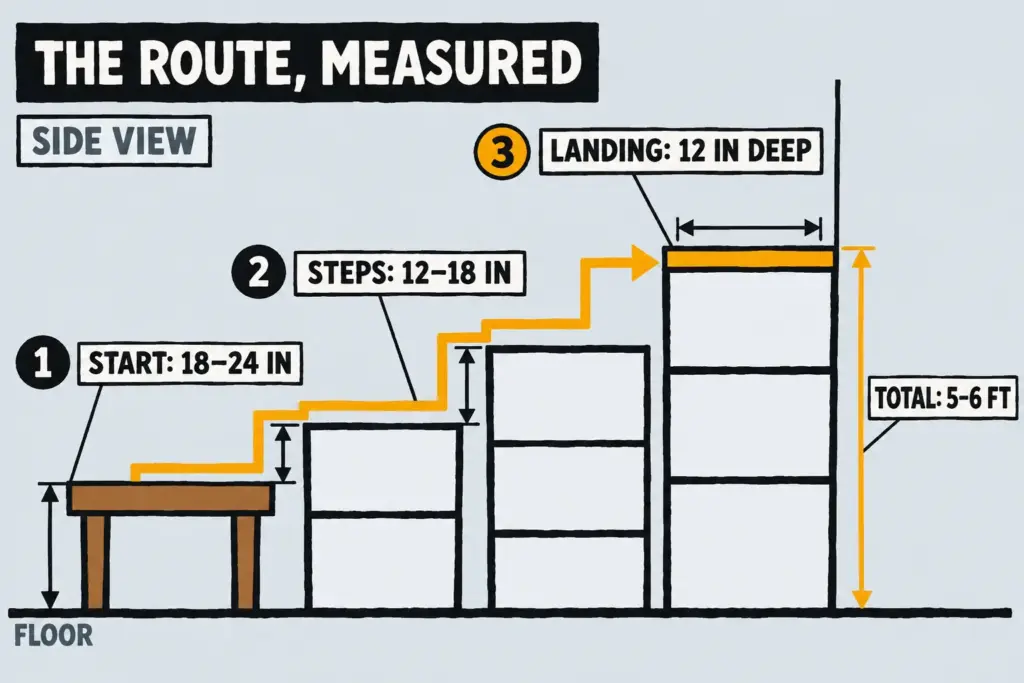
Both sets of numbers get tested in the cat’s room, not on paper. In a staged introduction of the two animals, the stage where the cat is loose with a way out only works if every gap above is short enough to clear in a hurry.
Crouch to the cat’s eye level and count each jump from the floor to the landing. The longest gap decides whether the route exists, so shorten that one first.
The Landing Needs Room to Turn Around and Sits Above the Dog’s Nose
Deep Enough to Arrive and Turn, Wide Enough to Rest
A landing is two movements, arriving and turning around. A board that is too narrow gives the arrival and denies the turn, so the cat comes down early. Shelf depth is the first number: 10 inches is the working minimum, 12 for a cat over 14 pounds, and a shelf under 8 inches gets stepped on once and ignored.
Width comes next, at least 14 inches for a cat to rest and 18 for one that sleeps curled in a loaf, with about 16 by 20 inches for the destination perch where the route ends. The biggest cat in the house sets the size, so measure him from nose to tail base: that length tells you how much of him hangs off a short board.
A shelf the cat only crosses can be shallower than one he stops on, and around 7 inches is common for a walking shelf. Two depths on a single route are therefore not a mistake. The shelf he has to stop on cannot be narrow.
Above Where the Dog Reaches
A landing the dog can reach is a step, not an exit. The reference point is the dog’s standing reach: his nose when he stands on his hind legs and when he stretches along the back of the sofa, and the landing has to sit above both. A cat’s practical jump tops out at five to six feet, so a landing set lower than that has an easy answer waiting under it: the dog lies down beneath the shelf and waits.
Sit on the floor at the dog’s eye level and look up at the landing. If you can see the cat’s belly from there, the dog’s nose can reach it, so raise the shelf or move it out of line with the sofa.
No Floor Space: A Window Perch and a Tree in the Corner
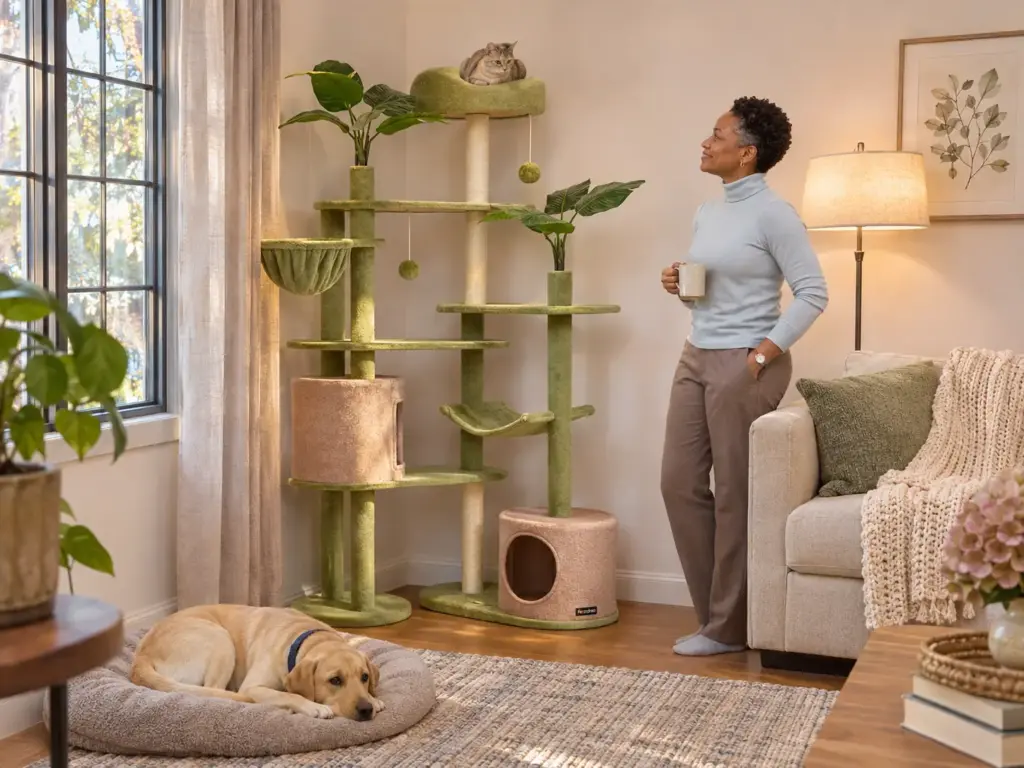
In a small apartment, height is the one thing there is plenty of. Wall shelves over the sofa work where the brackets can reach studs, which a lease often rules out. The no-drill choice is a free corner for a tall tree or a window for a perch.
For the corner, the Feandrea Cat Tree 68.1 in is an L-shaped tower 68.1 inches tall, so its top perch sits at the upper end of the five-to-six-foot band, above a dog’s nose when he stands at the base. The base measures 44.4 inches long by 13.8 wide, which is more floor than a corner looks like, and some units arrive with the bases misaligned, so check the fit before you commit the corner to it. And a tree in a corner brings the next problem with it: a single way up.
With no corner and no right to drill, the K&H EZ Mount Kitty Sill is a 23 by 12 inch perch that presses onto a pane 27 inches wide and 23 tall with suction cups. It takes no floor and no screws, and you pick its height by where you press it. The suction is the weak point, since on some windows the sill does not stay on the glass, so test it with your hand before the cat’s weight goes on.
The Second Exit: Why High With One Way Down Is a Siege
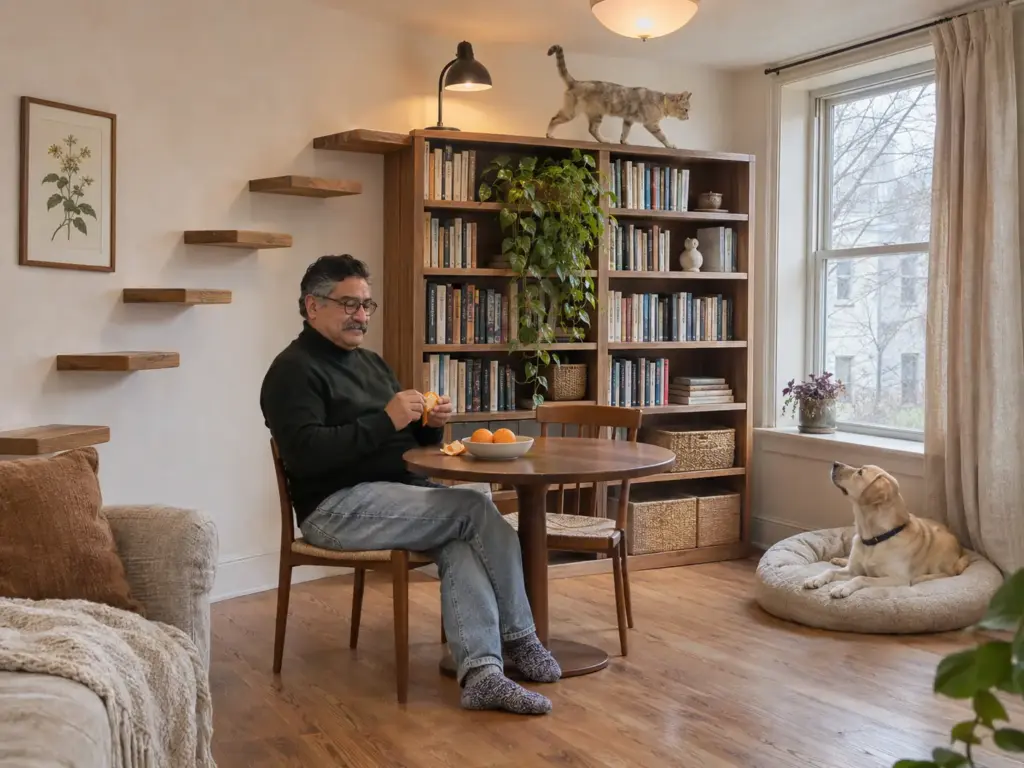
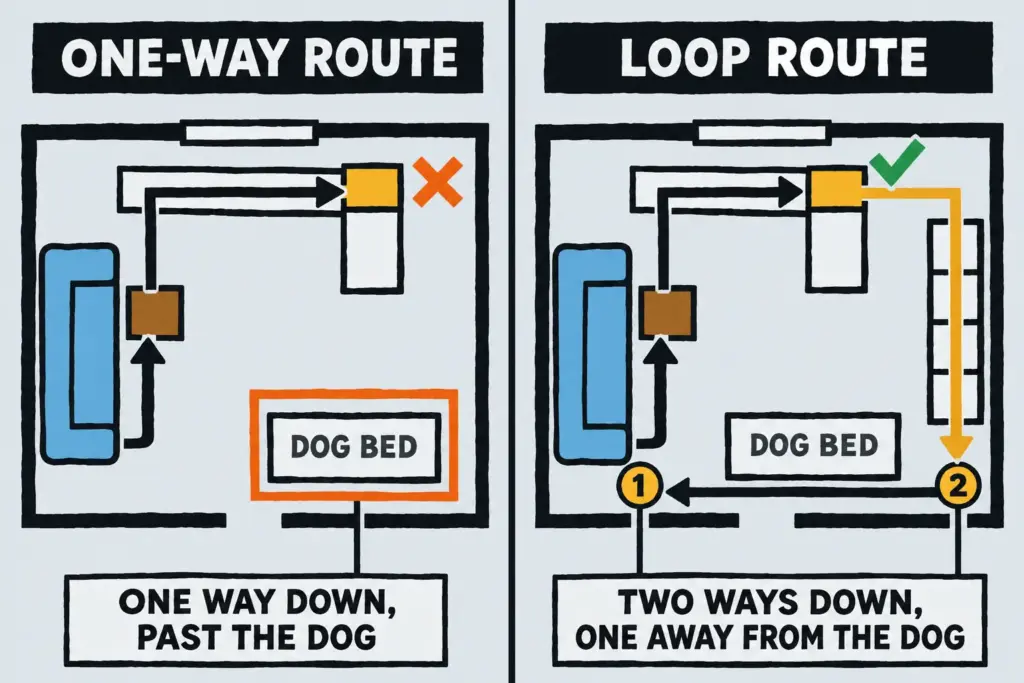
A Landing With One Way Down Is a Dead End
The cat on top of the wardrobe is not relaxed if the wardrobe is the only way down. From his side of it he has been put up there with the dog waiting at the foot of the one exit, and cat people have a word for the result: “treed,” stuck up high and afraid to come down with a dog below. That is a siege, not a refuge, and a route closed at one end is a trap with a good view.
The veterinary guidelines make the same point about safe places. According to VCA’s summary of the five pillars of a healthy feline environment, “If you have multiple cats, consider using safe spaces with multiple entryways so that one cat can’t be trapped by another.” Put a dog in place of the second cat and the rule survives: a retreat with a single entry is one the dog can close off.
The Second Exit, Built From What Is Already There
The second exit usually comes out of the room, not out of a catalog. From the top of the wardrobe to the top of a bookcase, from the bookcase to the top of the fridge or the window frame, from there down to the floor on the side farthest from the dog: that is a circuit, a loop the cat can run in either direction, so he cannot be cornered on it. Cat people call connected shelves above the floor a cat highway, and the useful version is a loop rather than a line.
A tree needs the same treatment. Its single way in is also its single way out, so give it another foothold at one side (a bookcase or a sill within a jump) and the tower becomes one stop on a circuit.
How to Check It From the Floor
In a small apartment, count the exits of the room and where each one ends: a dead-end corner, a hallway, the kitchen. The route only counts as finished when both ways down end somewhere the cat can keep going. The longer version of this exercise is counting the exits, loops and dead ends of a small apartment, and the route you build should come out of that count.
Judge the exits from the landing down, not from the floor up. A route that looks open on the way up often closes on the way down, because the dog’s bed or the sofa sits at the foot of it.
The Chokepoint: A Gate or a Cat Door Is a Route Only While the Dog Is Not at the Hole
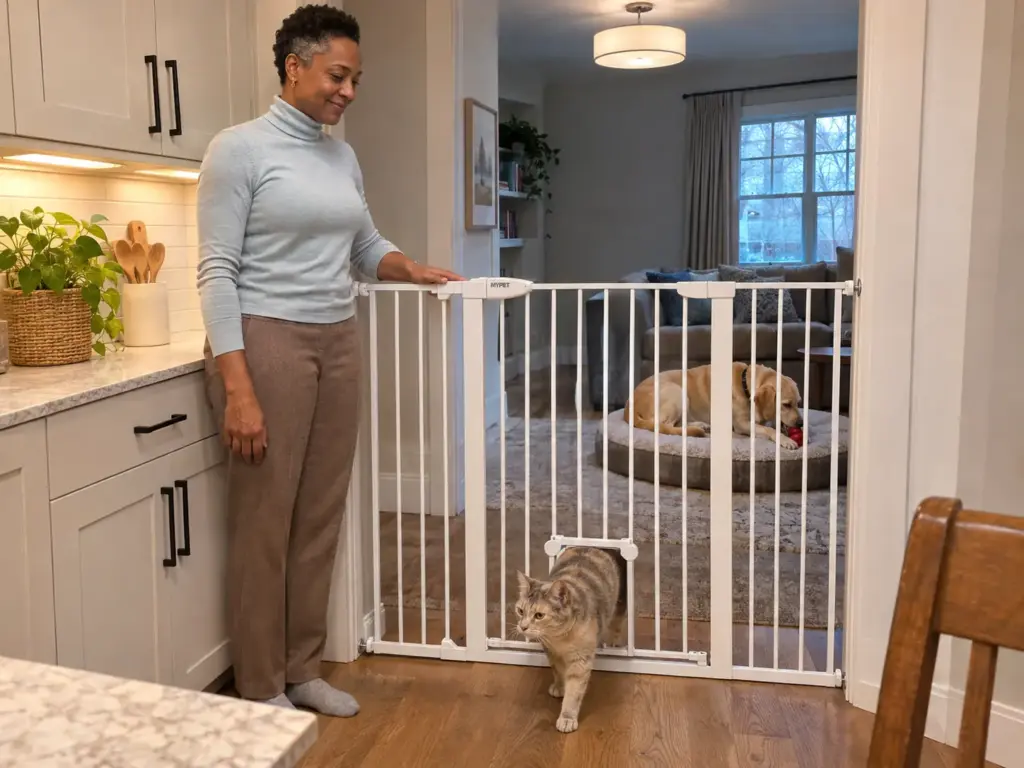
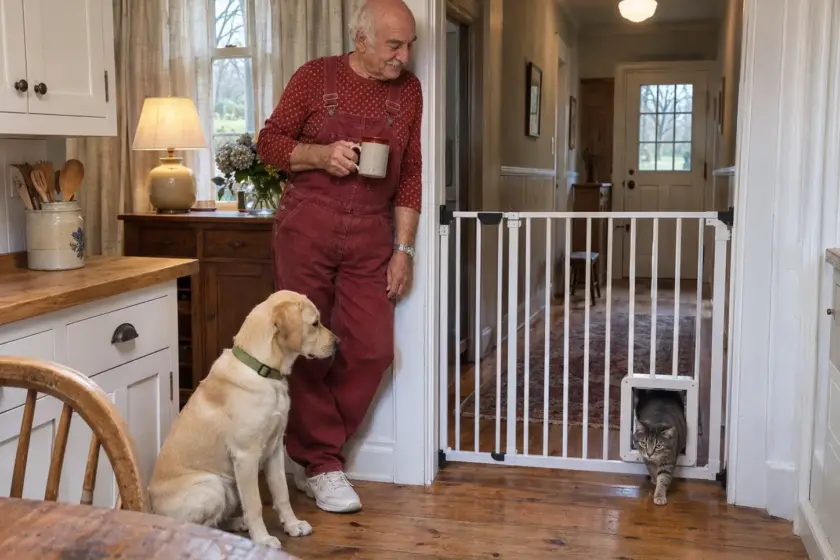
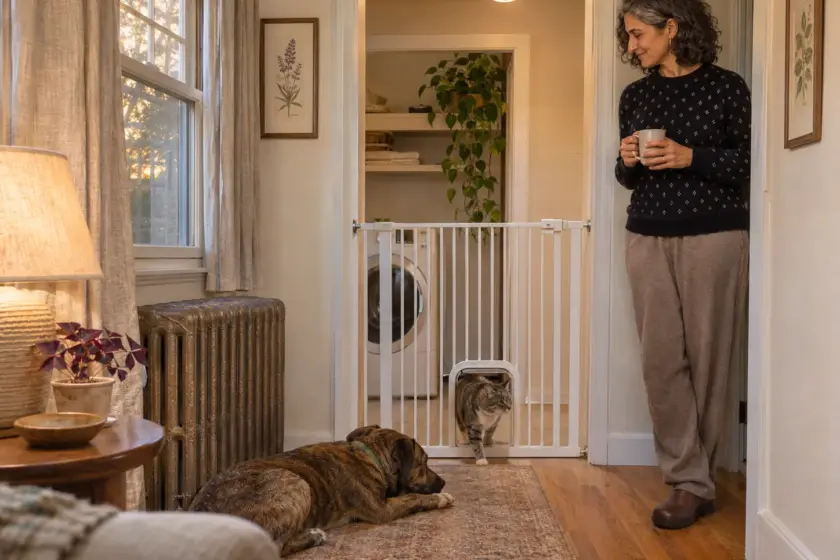
A baby gate with a cat door is a good idea until the dog sits down in front of the flap. Then the route is gone, and the cat has to walk past the dog to use it. The weak point is the hole, not the height.
The Cat’s Opening and the Dog’s Reach
Opening width is the number that matters, so test the hole against the cat’s chest, not his head. A cat can slip through a gap about as wide as his head, which tells you whether he might fit and not whether he will go through at speed with a dog behind him. An opening smaller than his chest ends the route at the flap, and the cat turns around in front of the dog. The flap is also a weak point from the other side: a 40-pound dog can push through the flap of an interior cat door.
Gate height is decided by the dog. The 36-inch figure everyone quotes stops a large dog, not one that jumps, because the moment his front paws reach the top rail the gate stops being a wall. At 41 inches the same dog needs a much better reason to try.
Try the opening with the chest of the biggest cat, not his head. If he gets in but has to twist his shoulders to do it, the hole is short and the route ends in front of the dog.
A Gate the Cat Walks Through, and a Door Held Open Instead
Free comes first here too. A door in the apartment, the bedroom door for instance, held open 2 to 6 inches with a wedge lets a cat through and holds back most dogs, and the doorway already exists, so the only decision is how wide. A tension-mounted gate (the pressure kind) is the renter-friendly one, because it leaves the frame untouched, while a hardware-mounted gate screws into it.
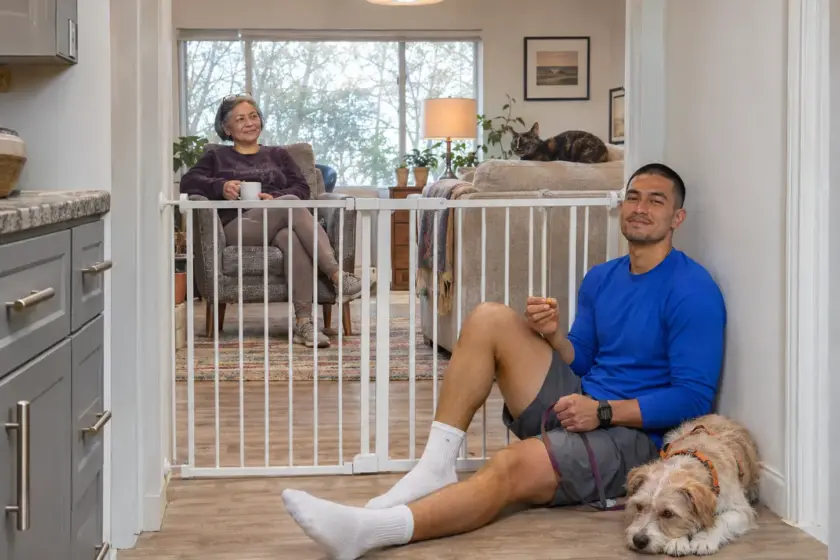
A gate earns its place at the foot of the stairs, where the cat clears it and the dog does not. The reverse design, a gate the cat has to walk through, becomes the spot where the two meet. What makes a gate a good route is what sits behind it: the litter box, the food and a bed, so the gated side is a whole apartment and not a corridor, and the litter box route never crosses the dog. A cat often spends the first days on the far side and then starts crossing on his own, with the gate barely closed any more.
When the dog jumps, the taller pet gate with a cat door is the one to use. The MYPET EasyPass Extra Tall & Wide 41 in stands 41 inches high, fits openings from 29.75 to 52 inches wide and has a cat door you can set at 5, 6.5 or 8 inches high, so a large cat is not squeezing through the smallest hole. The latch does not close well on some units and parts crack easily, so check the lock the day it goes up.
For a standard doorway, the Carlson 36 in Extra Tall Walk-Through with Small Pet Door is the plain version: 36 inches tall, 29 to 36.5 inches wide and a pet door of 7.5 by 7.75 inches. The walk-through door a person uses is only 16.5 inches wide, and some units have broken inside two months. Against a jumper it gives away five inches of height to the MYPET.
The renter’s version has no gate at all. The Door Buddy Pet Door Latch holds a door open 2 to 6 inches on a 3M adhesive, so nothing is cut or drilled and one door in the apartment becomes the cat’s. The adhesive is the weak spot: it can lift off some door frames and the strap can split, so press it on firmly and test it before relying on it.
The Dog’s Side of the Hole
A dog who fixes on the opening, stalking the flap, needs something else to look at. A folding privacy screen on the cat’s side cuts the sightline, and a portable pen a few feet in front of the opening helps when the dog is wound up. Leash walks on a harness through the adjustment weeks, a solid “leave it” and a recall cue do the rest. A dog punished for looking at the cat tends to stay tense, and a chase that does not ease belongs with a certified behaviorist.
The same doorway pays off a second time as the doorway that keeps a dog away from the litter box. How far the dog reaches also decides what else the cat gets behind it, down to a feeding station sized to the dog’s reach.
If the apartment allows cutting an interior door, the Depets Large Cat Door publishes the hole you need to plan around: an inner opening of 7.08 by 7.48 inches, a cut-out of 7.7 by 8.3 inches and a limit of about 17.6 pounds. A four-position lock lets you shut it at night. The lock is stiff to work, and the plastic flap can break off and the magnets fall out.
The Exit That Ends Outside: Doggy Doors, Windows and the Front Door
The Doggy Door Is the Nearest Hole
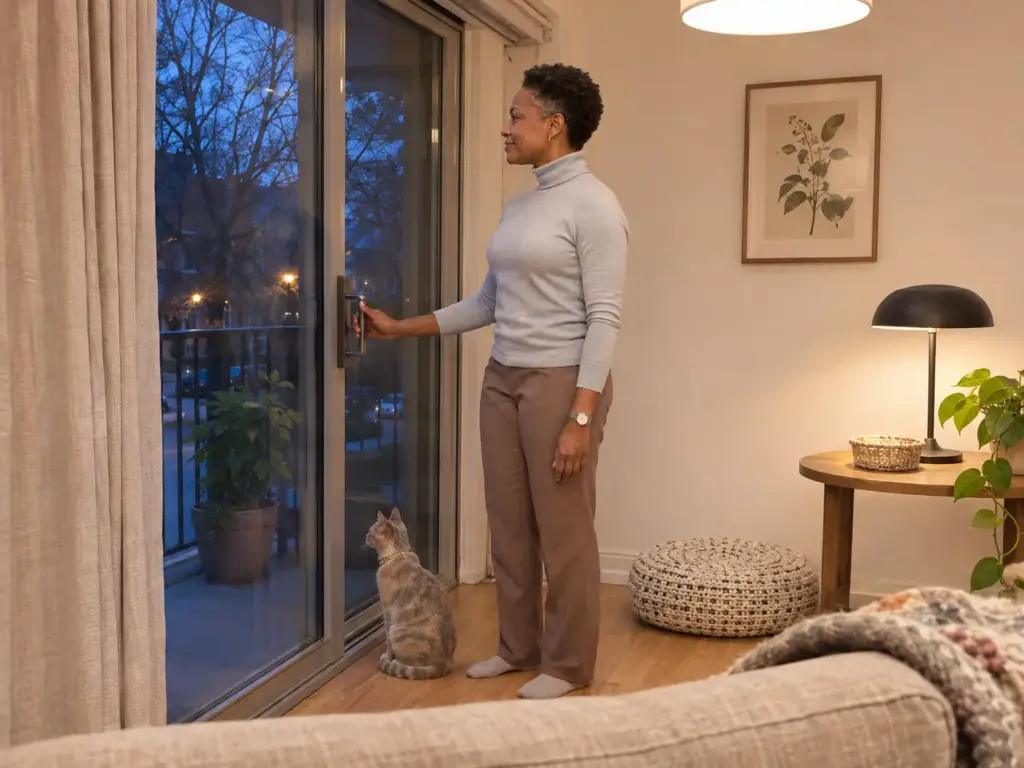
If the dog already has a door to the yard, this is your section. A frightened cat takes the nearest hole, and in that house the nearest hole is the one that ends outside; door dashing is the name for bolting through any opening the moment it is wide enough. A route that ends outside is the failure mode, not the fix, so that opening is the first to close.
A microchip dog door, one that opens only for the dog’s tag, keeps the cat in. A flap that opens for anything is an exit to the street.
Windows, Screens and the Balcony
A firm window screen, a window restrictor that lets it open only a few inches and a stop in the track turn a window from an exit into a view. A balcony without netting is not a place a bolting cat should be able to reach, so shut that door during any introduction or any day the dog is wound up.
The Front Door and the Foyer
The front door threshold is where a lot of escapes happen, because a person is coming in with their hands full. The dog and the cat should not meet there. A gate or a closed door between the entry and the rest of the apartment gives the person a place to put the bags down first.
If a cat has already gotten out, that is a search and not a route: tell the shelters nearby and your vet.
Before leaving the cat with a loose dog, walk the apartment as the cat would and count every opening to the outside. Any you cannot close with a person standing there gets a gate or a door.
With Two Cats, One Route Is a Queue
One Landing Is a Queue
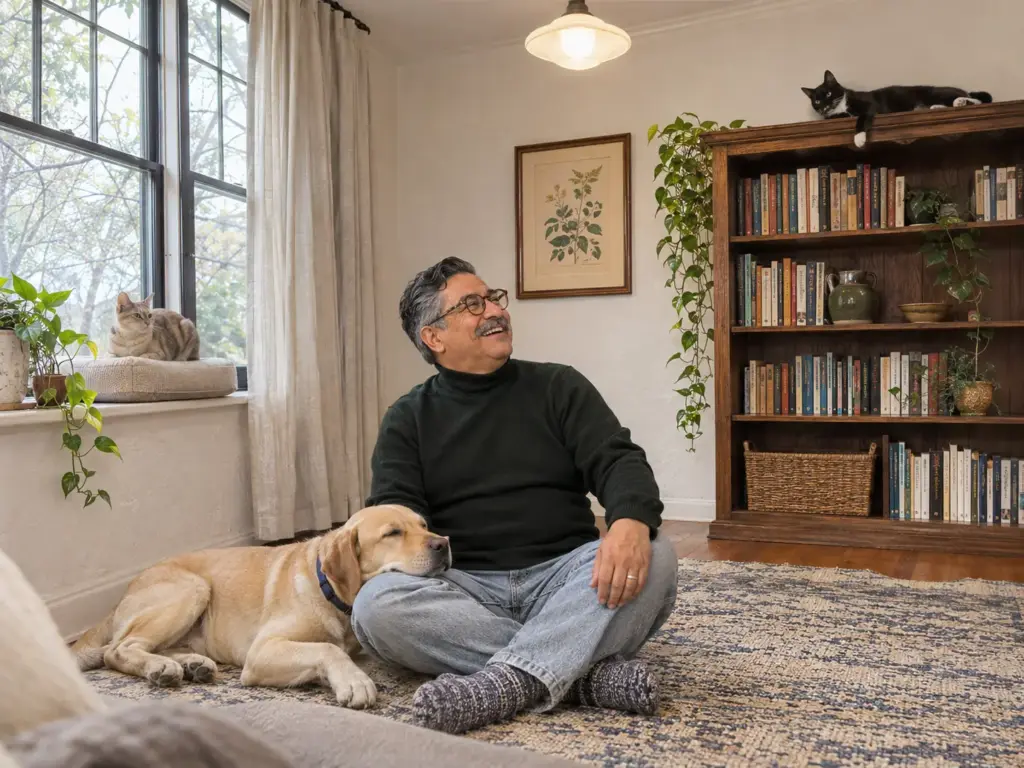
With two cats, a single landing works like a line, and the cat who loses the race is the one the dog reaches. The veterinary guidelines ask for at least as many safe places as cats, each able to hold one cat, and more than one way in. It is the same resource distribution arithmetic as litter boxes (the 1+1 rule: one per cat, plus one) and food bowls, and why a spare resource rarely fixes a house with two cats applies to a landing as much as to a box.
Two Landings and More Than One Way In
Plan two shelves per cat and two ways onto each, with no dead ends. Size the landing for the bigger cat (12 inches deep) and the steps for the smaller or older one (8 to 12 inches); a route that suits only one of them is a route for one cat. And keep their paths from crossing at the chokepoint, which means two holes, not one.
When One Cat Is Using the Route to Avoid the Other
Sometimes the route is being used to get away from the other cat, not the dog. A cat who drops the rooms the other cat uses has a problem a shelf cannot fix: that is tension between the two cats, and the rooms a bullied cat stops walking into show what it looks like. If it does not ease, the vet or a certified behaviorist is the next stop.
Trace the Route With Your Finger From the Cat’s Spot
A cat escape route is a path with parts you can measure, not a sentence on a sticky note. It starts low enough to jump in a hurry, climbs in steps the smallest cat can clear, ends on a landing deep enough to turn on and above the dog’s nose, and leaves by a second way down. The chokepoint is where it breaks, because a dog can camp the hole, and the opening that leads outside is the first one to close.
Watch the first few days. The sign that it works is the cat taking the route by himself, with the dog in the room and nobody calling him up; wherever he skips a jump, shorten that gap and look again. If he stops eating, hides for most of the day or limps after a chase, the next call goes to the vet or a certified behaviorist, not to a furniture store.
Tonight, sit on the floor at the cat’s level, trace the path with your finger from the place he usually ends up to the highest spot he can reach, and confirm there are two ways down. Move the furniture that is already there before you add anything new.
Frequently Asked Questions
01How high should a cat’s escape route from a dog be?
The landing should sit above the dog’s nose, which for a healthy adult cat means roughly 5 to 6 feet, the limit of a standing jump. Seniors, kittens and short-legged cats need steps of 8 to 12 inches to reach the same spot.
02How many escape routes does a cat need when there is a dog in the house?
At least two different ways down from the landing, and with two cats, one safe place per cat with more than one entry. A single way up and down turns the route into a siege.
03Can a cat use a pet gate with a cat door to get away from a dog?
Yes, as long as the opening is bigger than the cat’s chest and the dog cannot sit in front of it; the Carlson gate’s door is 7.5 by 7.75 inches. Put the litter box, the food and a bed behind the gate so that side is a whole apartment.
04What is the 3-3-3 rule for cats?
It is a rough adjustment pattern for a new home: about 3 days to settle, 3 weeks to learn the routine and 3 months to feel at home, different for every cat. A cat that stops eating or hides constantly in that window is a conversation for the vet.
05Will a cat come back if it got out through the doggy door?
A lost-cat search is a different job from building a route, and whether a cat returns depends on the cat and the neighborhood, not on any page. Close the opening before the cat needs it. If the cat is already out, call local shelters and your vet.
Leave a comment