Can a Cat and Dog Live Together? Test the Dog First
Can a cat and dog live together in your apartment? Run the dog test, count the cat's escape routes and set a pass mark you can reach & keep.

Alfredo RamsesFounder · November 9, 2026 · 19 min read

On this page8 sections
- 1Can a Cat and Dog Live Together? What Decides It Before They Meet
- 2What "Safe" Means When One Animal Outweighs the Other Five to Seven Times
- 3Age and History Move the Odds More Than Breed Does
- 4Your Apartment Is the Third Animal: Count the Cat's Routes Before the Dog Arrives
- 5The Pass Mark: Tolerance on the Same Floor Counts as a Yes
- 6When the Honest Answer Is No, and What a No Costs
- 7The Verdict Is Mostly Written Before the Cat Meets the Dog
- 8Frequently Asked Questions
You are standing at a kennel door, or on a friend’s living room rug, looking at a dog who seems wonderful, while the cat waiting at home weighs about 10 pounds against the dog’s 50 to 70. Can a cat and dog live together? Often, yes, and “it depends” has a test behind it: what that particular dog does when the cat is out of reach, and how many ways out the cat keeps in your apartment.
The cat gets the casting vote on both, because he is the one who has to live under whatever the dog turns out to be. What follows runs the test, puts the weight gap in numbers, weighs age and history, counts the routes, sets a realistic pass mark and says what to do when the answer is no.
Quick Answer
Yes. Many cats and dogs share an apartment, and the verdict belongs to the two animals and the floor plan, not to the species. Two things decide it: what the dog does when the cat is out of reach, and how many routes the cat keeps once the dog arrives. The realistic pass mark is tolerance, not friendship.
Can a Cat and Dog Live Together? What Decides It Before They Meet
By the time a dog is trotting down your hallway, most of the verdict is already written. It gets decided earlier, in a few minutes of watching the dog near a cat he cannot reach, and nothing about that test needs your own cat in the room: a shelter’s resident cat behind glass, a foster’s cat or a friend’s will do, with a barrier or a leash always in between. The home setup and the first month are laid out in how to set up the apartment for both animals; this is the part that comes before any of it.
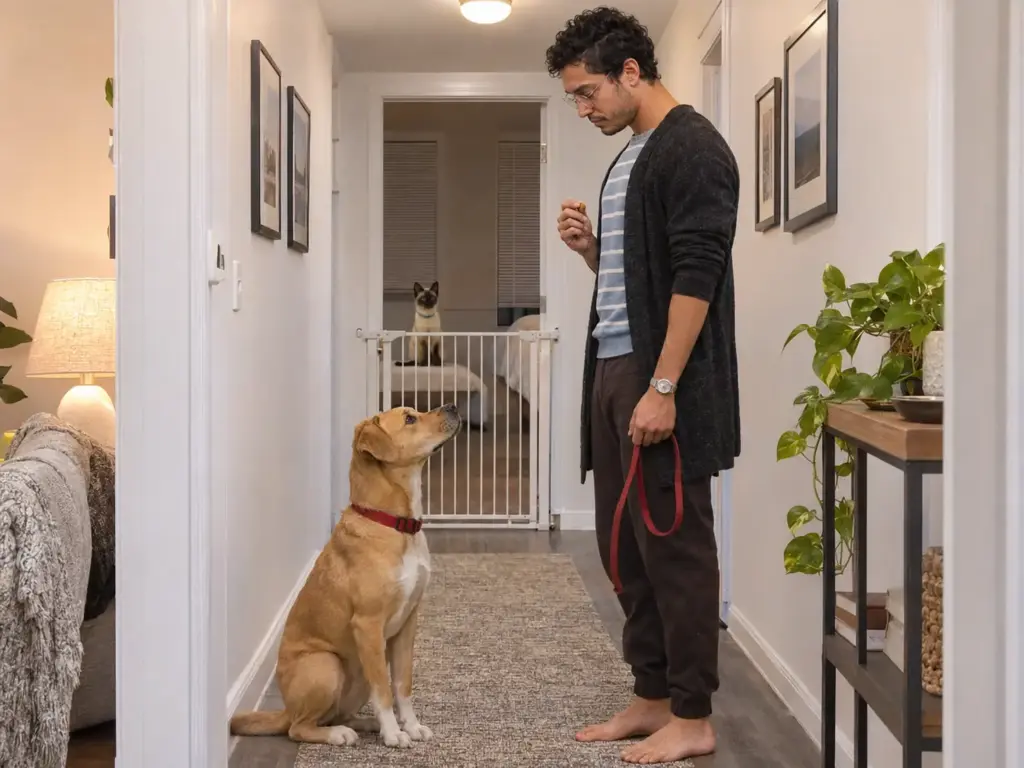
The dog carries most of the weight in the verdict. His prey drive, the urge to stalk, chase and pin something small that runs, gets assessed, never assumed and never guaranteed, and the assessment happens with the cat out of reach.
Three Screens You Can Run Without Putting Your Own Cat at Risk
Each screen asks a different question, and each can be run through a baby gate, a glass door (a shelter’s cat room often has one) or on a slack leash with the cat behind a barrier.
The first is fixation. A dog with high prey drive goes rigid, stares at the cat without blinking and may bark or whine, and a dog in that state will not take a treat. According to Best Friends Animal Society on what a dog does with his posture and eyes around a cat, “If you see these signs, do not let your dog near the cat.”
A loose, wiggly dog who glances at the cat and moves on is the yes. A dog who goes still and silent, locked onto the cat, is the answer that ends the search.
The second is what happens when the path is cut. With the leash on, let the dog pull toward the cat, then stop the forward progress. What counts is control, not interest, because nearly every dog is interested. A cat test run on a slack lead scores whether the dog settles after being stopped or winds up further, and whether the frustration lands on the person holding the lead.
A dog who can be stopped mid-pull and take a reward is a different prospect from one who only gets hotter.
The third is the return. Give the cue you will really use, something like “look at me” or “leave it,” while the cat stays in view behind the barrier. Does the dog bring his eyes back to you and take the reward, or stay on the cat? A dog who cannot return yet is not a permanent no, but he arrives with a managed household attached: gates, leashes and closed doors in place of a dog loose in the apartment.
Run the screens on an ordinary, restless day, not straight after a long walk. A worn-out dog shows you less than the dog who will be in your apartment on a dull afternoon with nothing to do.
Why a Shelter’s “Good With Cats” Label Is Only a Starting Point
A kennel has no hallway, no sofa to launch from and no cat who bolts when the doorbell rings, and prey behavior depends on exactly that kind of context. Richard Polsky, PhD, an applied animal behaviorist, has written that no standard temperament test detects predatory aggression. That makes a shelter’s cat test a weak predictor and a “good with cats” card a place to start.
Read the card for detail: what the dog did, around which cat and for how long. “Fine with cats” with nothing behind it adds very little. And a dog who already chases cats along the sidewalk will not lose the habit by moving into an apartment.
What Each Result Means: Odds, Not Promises
A dog who clears all three screens has better odds, and that is all he has earned. He still needs a slow introduction and supervision until the pair has proved they need less of it. A dog who stalls on the second screen comes with gates and a leash for the long haul. A dog who fails the first is a no for this cat, and no gate, perch or schedule changes that; he belongs with a certified trainer or a behavior specialist, and the search starts again.
What “Safe” Means When One Animal Outweighs the Other Five to Seven Times
A calm dog today proves little. Safe means the dog can be trusted at the moment the cat runs, because a running cat is the trigger, and a mild-mannered dog who has never watched one bolt has never been tested on it.
The Weight Gap Runs One Way
Cornell Feline Health Center’s figure for an average cat is about 10 pounds. A dog of 50 to 70 pounds is five to seven times that, and a 2-pound kitten facing a 50-pound dog is 25 to 1.
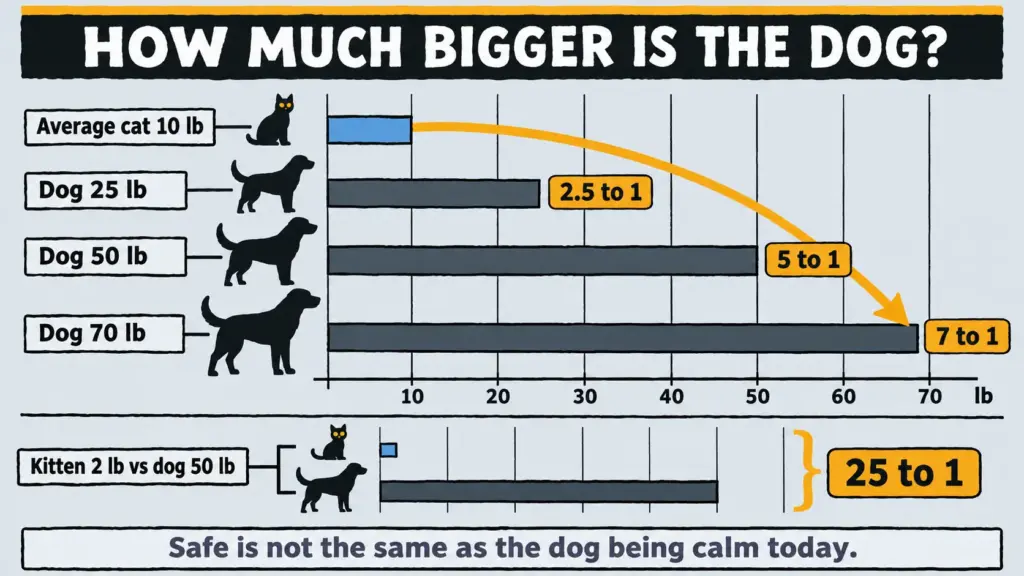
Most dogs who chase never do physical harm, though the chase alone frightens the cat. The San Francisco SPCA separates the two: the dogs who do serious harm are highly predatory and recognizable in advance, and the rest are a stress problem more than an injury problem.
The risk runs in one direction. The cat has nothing that evens the weight, so his defense is height and distance, and an apartment with neither has no defense in it.
Picture a 60-pound dog dropping into a play bow, an invitation in dog language, and landing both front paws where the cat was standing. The dog meant a game. The cat reads a landing.
A Doorway That Passes the Cat and Stops the Dog
The free answer comes first: a closed door, a leash and the dog in another room beat anything you can order.
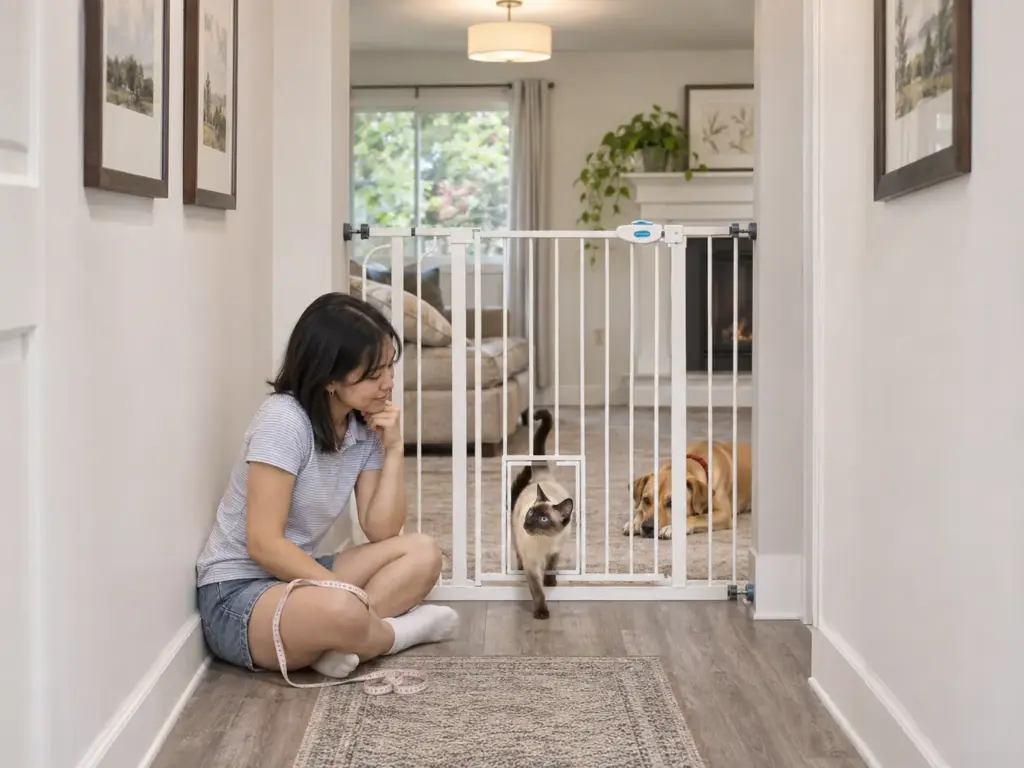
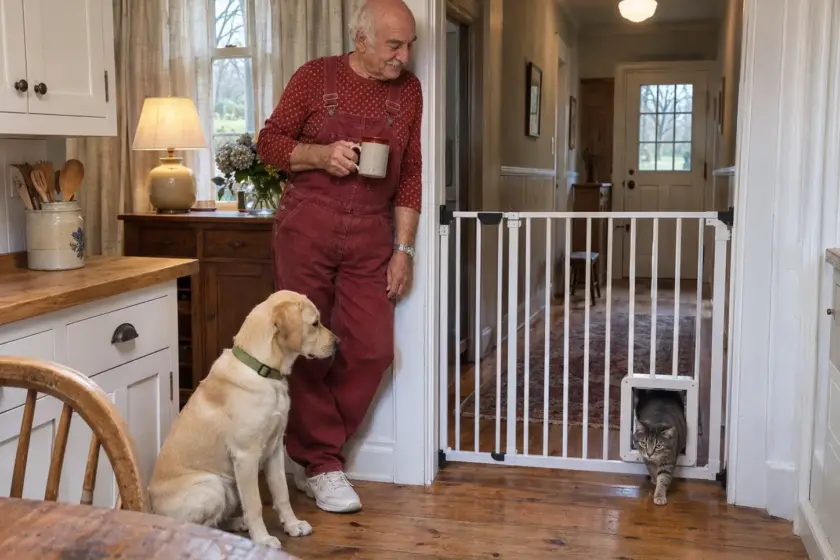
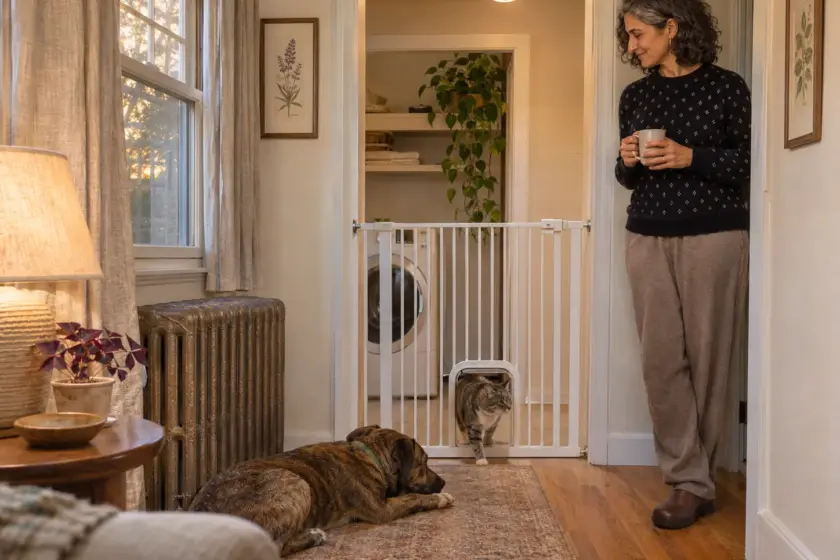
When the cat has to move through a doorway the dog must not use, the tool is a gate with a pet door, and the sizing runs on two measurements. Measure the dog standing, across the shoulders, and the cat crouched, at his widest point behind the shoulder blades. Do the dog first, since his number is the one that cannot change. The cat’s number has to fit through the pet door and the dog’s must not.
The Carlson Extra Tall Walk-Through Pet Gate with Small Pet Door is 36 inches tall, fits openings from 29 to 36.5 inches and has a 7.5 by 7.75 inch pet door. It presses into the frame with no drilling, and the cat walks through while a large dog who does not jump has to stay put. The pet door is small for a big cat, and some units have broken inside two months.
Teach the cat the pet door while the dog is somewhere else, with a treat waiting on the far side. The first time he uses it should not be the first time he needs it.
For a dog who clears 36 inches, or an opening wider than 36.5, the MYPET EasyPass Extra Tall & Wide Walk-Thru Pet Gate stands 41 inches tall and spans 29.75 to 52 inches, with the pass-through set at 5, 6.5 or 8 inches. It also goes in under pressure, so a rental survives it. The latch does not always close well and pieces snap easily. Test the latch every time before you leave the two animals apart.
Where This Stops Being a Furniture Question
Gates and perches change where the two animals meet. They cannot answer a question about either animal’s health or behavior, so the line goes here, early, before any more furniture moves.
Call a vet or a specialist when you see any of these:
- The cat stops eating
- The cat stops using the litter box
- The cat hides for days at a stretch
- Either animal has a bite or scratch that breaks the skin (a vet visit that same day)
- The dog freezes, stares at the cat and cannot be drawn off the stare (a certified trainer or a behavior specialist, and every introduction step stops)
Nothing here explains those signs. That is the vet’s work, and no gate or perch stands in for it. If the visit comes back clear, the rest of this article is the next step; if it does not, the rest waits.
Age and History Move the Odds More Than Breed Does
Terriers, sighthounds and herding breeds carry the reputation as chasers, and a breed list is the first thing a worried person reaches for. It loses to a much better question: what has this particular dog done around a cat?
A Dog’s Cat History Beats Its Breed Label
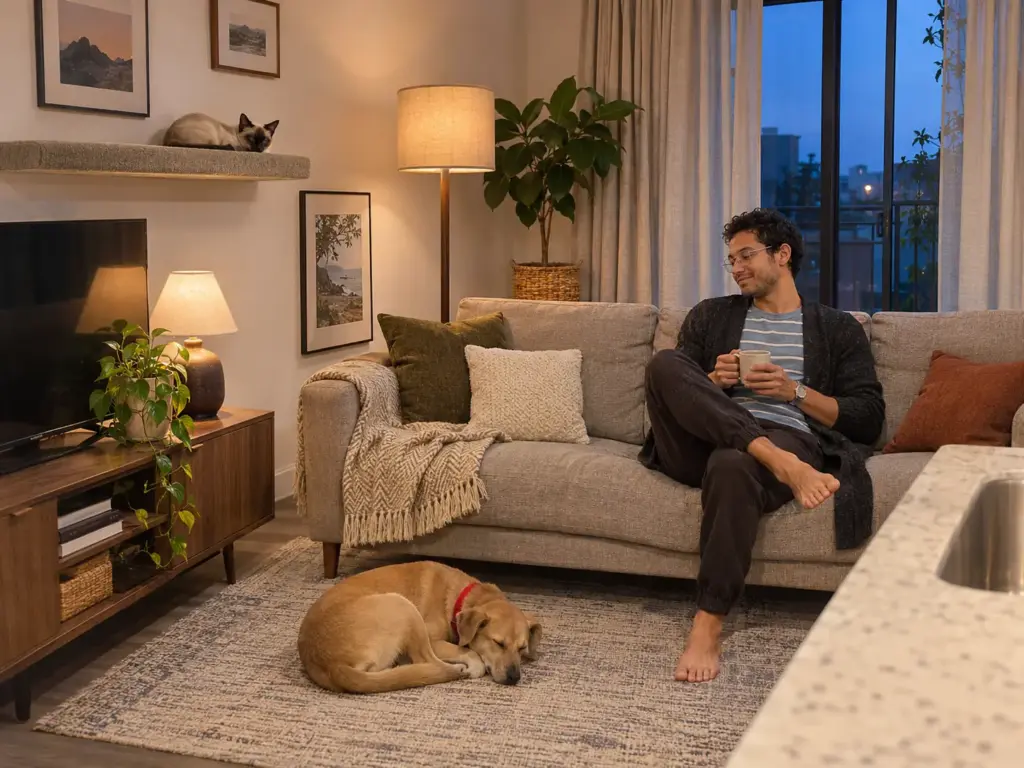
A dog with a documented history of living with a cat, who turns his head toward the person when the cat moves, is better evidence than any breed chart. A rescue’s or foster’s written notes count; a bare “he’s fine with cats” does not. And history is not a vaccine. A dog who was easy with the cat for a year can change, and a chase that starts out of nowhere is the signal to go back a step, covered under the pass mark below.
Puppy and Kitten, Adult Cat and Adult Dog, Older Cat With No Dog History
A puppy with a kitten is the easiest pair and still not an easy one: the puppy chases to explore and has to be taught not to, and a kitten under a couple of pounds against a growing dog is the 25-to-1 sum from above. An adult cat with an adult dog of high energy is the hardest pairing. An older cat with no history of dogs needs more routes and more time, never fewer.
One Cat or Two: The Dog Gets Two Animals to Fixate On
With two cats the dog has two animals to watch, and the cats can end up competing for the single exit that is left. Each cat needs his own way out, which is why one spare of everything is not enough with two cats: the spare has to sit out of sight of the first.
Your Apartment Is the Third Animal: Count the Cat’s Routes Before the Dog Arrives
Most advice for a dog and cat sharing space starts with a room of his own, as if every apartment had one to spare. A one-bedroom has a bed, a bathroom and a living room, and the dog will be in two of them. Before counting animals, count routes.
Two Ways Out of Every Room, One of Them Off the Floor
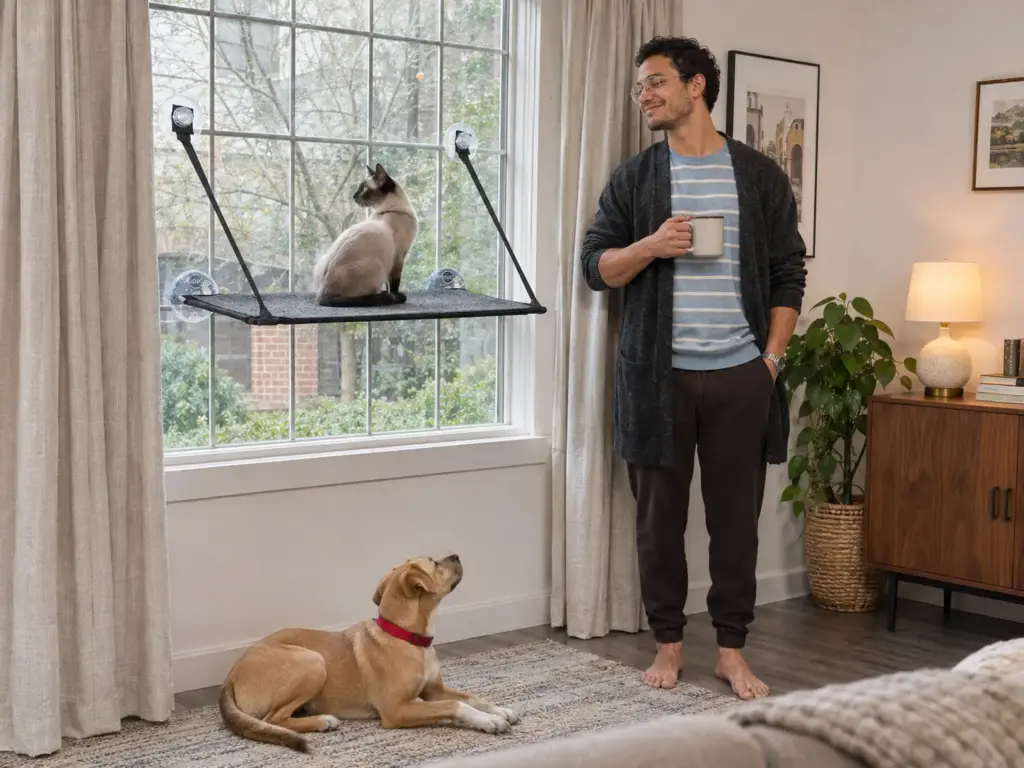
A route is a way out of a zone that the dog cannot close. The AAFP’s list of what a cat needs to feel secure asks for a safe place the cat can enter and leave from at least two sides, with key resources kept apart so no animal can be blocked from them. A box with one opening is a trap with a cat inside.
Free fixes come first. Drag a chair to a shelf, open the gap behind the sofa, clear a way up to a surface the dog cannot reach. Those moves are free, and they are often enough to carry an apartment.
The One-Bedroom Count: When Only One Route Survives
Walk the apartment room by room and put the dog in each one. In every room, how many routes does the cat still have? In a one-bedroom the honest count is often one. When a route is contested it turns into no man’s land, a hallway neither animal will cross, each living in his own half of the apartment in a kind of double life.
That hallway is the mark of a pair stuck on the second step of the pass mark below, not a success. The counting of exits and loops is laid out in how a small apartment comes down to exits.
One surviving route is a managed household for good. That can be the right verdict, but it has to be chosen in advance, not discovered in month four.
Without a second room or a drill, the Door Buddy Pet Door Latch for Cats is a 5.2 by 0.6 by 9.3 inch strap that holds a door open a cat’s width, wide enough for the cat and too narrow for the dog. Its 3M adhesive is not permanent and results vary with the paint and surface, and the maker’s own listing says not to put it on drywall (check the wall before you order).
Sketch the floor plan, stand the dog in each room on paper and draw every cat route as a line he can still walk. A room where every line crosses the dog’s spot is a room with no route.
If the opening is wider than 36.5 inches, the Babelio 36 in Tall Pet Gate with Cat Door, CatPrivilege III spans 29 to 43 inches at 36 inches tall, with a 7 by 5.5 inch cat door that sits in two positions. The extension pieces do not lock properly, so fit the extension, then lean on it before you trust it.
Height and Resources: Perch, Tree, Bowls and Box
Height does the work of a second exit. A chair that leads to a bookshelf is the free version. For a cat with no such surface, the Yaheetech 54 inch Cat Tree stands 54 inches tall on a 19.5 by 19.5 inch footprint, a refuge the dog cannot reach in an apartment with no room to spare. The hanging ball comes apart and the tower wobbles even anchored to the wall, so anchor it anyway and test the wobble before the cat has to use it in a hurry.
Either one only works if the path from the floor to it stays clear. When floor space is the problem, the K&H Cat Window Perch EZ Mount Kitty Sill is a 12 by 23 inch perch that mounts on suction cups, holds 50 pounds and needs neither a drill nor floor space. Its cups can stop gripping the glass, so retest the grip and the weight before relying on it.
Resources follow the same logic. Food and water belong where the dog cannot reach, which means a height or a gate, as in a feeding station sized to the dog’s reach. The litter box belongs in a spot the dog cannot enter, and where a litter box really fits in a small apartment works through the one-bedroom options. A litter box and the dog’s bowl in the same corner is a recurring way for this to go wrong.
The Pass Mark: Tolerance on the Same Floor Counts as a Yes
The picture most of us carry as the happy ending is a cat and a dog asleep against each other. It happens, and it is a bonus. The pass mark that holds up in an apartment is lower and far more reachable: both animals going about their day on the same floor without either one losing ground.

Three Tiers: Same Room, Shared Routes, Shared Surface
Place the pair on one of three steps. On the first, both animals share a room calmly, with no fixed stare from the dog and no cat frozen against a wall. On the second, they share routes without a fight: each avoids the other along a path of his own choosing, and a hallway that neither will cross is a failure of this step, not a success. The third is choosing to share a surface, the sofa or a rug, within a foot of each other, and it is a rarity to hope for, not wait for.
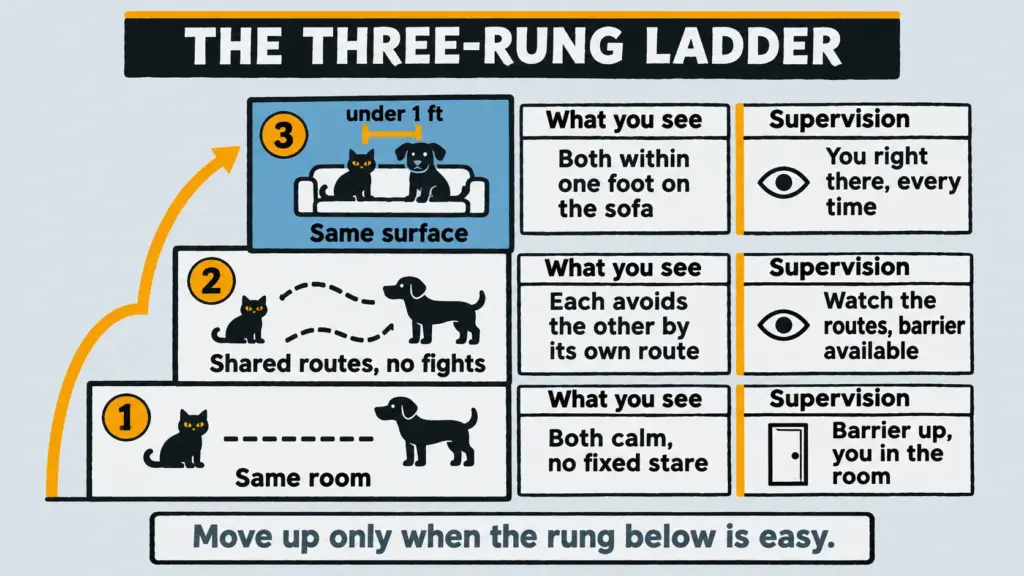
Supervision follows the step. Until there is proof, the two are supervised.
On the first step they are never left alone together. On the second, every route stays free and the gate goes up whenever nobody is home. On the third, the clock still does not get skipped. The method for getting there, doors before faces, then scent, a barrier and a leash, sits in the stage-by-stage method for introductions.
The Timeline in Weeks, Not “Weeks or Months”
A pair that clicks early may share a floor within weeks. Others spend about three months behind stacked gates before the animals see each other’s faces. Some need close to eight months before anyone trusts the dog not to start a chase, and a few are still running two zones behind a barrier at the two-year mark. “Weeks or months” is the optimistic tail of that range, not the range itself, and no date can be promised for a specific pair.
The clock is set by the gate, not by the calendar: a stage ends when the animals behave calmly at the barrier, not when a number of days has passed. That is the idea behind how the gate test sets the timeline, not the calendar.
The Checkpoint That Sends You Back a Step
Go back a step when a chase starts before the person can stop it, or when the gate goes back up after a bad evening. Those are regression days. They do not erase what came before; the clock resets to the previous stage, not to zero. But a dog who changes when the cat runs is the reason nobody relaxes at the third step, because a dog who was easy for a year can start the chase the moment the cat bolts.
Keep a one-line log: which routes the cat used today, and whether the dog turned his head toward you when the cat moved. A bad evening reads differently against ten good ones.
When the Honest Answer Is No, and What a No Costs
“They will get used to it” is the hope that keeps a bad match going, because a no sounds like failure. It is not one. A no said early is the cheapest decision for both animals, and the cat is the one describing the constraint while the person describes a preference.

Management Forever: Two Lives in One Apartment, One Behind a Gate
Management forever means two animals in one apartment, one of them behind a barrier, with the one remaining route shared by turns. Gates stay up, doors stay shut and a schedule decides who is where. It is a valid verdict, and some households live it well, but it has to be chosen with the cost in view. A household that discovers it in month four has already paid in the cat’s routes.
Why Rehoming Is Easier to Decide Before They Meet
Choosing against one particular dog before he has met the cat costs a disappointment. Choosing after the cat has stopped using his routes costs the cat. Cats are naturally solitary animals, and plenty of them prefer to be the only pet in the home, so a no to a dog is sometimes a yes to the cat who already lives there.
The sign that the cat is losing rather than adapting is a cat who stops using his routes, his box or his bowl. Nothing gets interpreted here: a change like that is the vet’s to explain, so the vet comes first and the apartment comes after.
Who to Call, and in What Order
For a dog who fixes on the cat or chases, the first call is a Certified Professional Dog Trainer (CPDT). When a trainer is not enough, the next is a Certified Applied Animal Behaviorist (CAAB) or a veterinary behaviorist, a vet with the Dip ACVB credential. A cat whose habits changed suddenly goes to his own vet before either.
Telling a slow pair from a failing one helps with the decision to stop. A slow pair shows progress at the gate and its setback days stay short; a failing pair shows the cat giving up routes and the dog’s fixation coming back, and what failing looks like between sessions lays out the contrast. What changes with the hour, the room or the door belongs to the apartment. What changes suddenly in the cat’s health belongs to a vet.
The Verdict Is Mostly Written Before the Cat Meets the Dog
Two tools decide it: the screens that show what the dog does when the cat is out of reach, and the room-by-room count of routes the cat keeps. The pass mark is tolerance on the same floor, and friendship, if it comes, is a bonus. An apartment with one surviving route is a managed household, and that is a verdict to choose in advance. A bite that breaks the skin, a cat who stops eating or using the box, a cat who hides for days: those go to a vet first, whatever the floor plan says.
Once the dog is home, look once a week at which routes the cat still uses and whether the dog turns his head toward you when the cat moves. After any bad evening, let the clock slide back one stage, not to zero.
Today’s step needs a pencil and no purchase: walk the apartment room by room, mark where the dog would stand and count the routes the cat keeps. Leave at least one genuinely free before any purchase.
Frequently Asked Questions
01Is it safe for cats and dogs to live together?
Yes, when the dog can be trusted at the moment the cat runs, not just when the dog is calm today. Screen the dog with the cat out of reach and keep a route open that the dog cannot use. A bite or scratch that breaks the skin is a same-day vet visit.
02How long does it take for a dog to accept a cat?
A pair that clicks early may share a floor within weeks, while others spend about three months behind gates before the animals see each other’s faces. Some need close to eight months before the dog can be trusted not to start a chase, and a few are still managed at two years. No date can be promised for a specific pair.
03Do cats enjoy living with dogs?
Some do, and many simply tolerate it; the realistic goal is a cat who is comfortable on the same floor, not a friend to the dog. A cat who cannot dodge the dog by any route is losing, however happy the dog looks.
04What is the 3-3-3 rule for cats?
It is the rule of three days, three weeks and three months for a cat settling into a new home. Those are time to decompress, then to learn the routine, then to feel at home. With a dog in the picture the clock runs longer, and the first stages belong to the cat who already lives there.
05Can a cat and dog live together in a one-bedroom apartment?
Yes, as long as at least one route survives that the dog cannot use and the room-by-room count is honest. One route is a managed household, which is a valid verdict. Without a drill, a door strap, a window perch and a gate with a pet door give the cat a path the dog cannot take.
Leave a comment