Best Cat Calming Spray for Two Cats, and Where It Goes
Best cat calming spray for two cats: FELIWAY gives 8-10 sprays, about 50 per 60 mL, 4-5 hours. 3 sprays compared + the one spot that matters ➜

Alfredo RamsesFounder · November 3, 2026 · 13 min read

On this page7 sections
- 1Three Different Bottles Sold as One Calming Spray
- 2When Tense Cats Are a Vet Question Before They Are a Spray Question
- 3Why a Calming Spray Works for One Cat and Not the Next
- 4Where the Spray Goes in a Two-Cat Home, and When
- 5The Three Sprays, Told Apart by Their Limits
- 6Choose the Spot and the Hour, Then the Bottle
- 7Frequently Asked Questions
Two cats meet at the kitchen doorway and neither will take the next step. One sits and stares, the other loops back toward the sofa, and by the time you reach for something in a bottle you have decided it is a mood. It is territory: that doorway is the only way through, and each cat has a fair claim to it.
The best cat calming spray is a small tool for that exact spot and that exact moment, it helps some cats and not others, and it will not stop a fight or settle a house. This guide separates three bottles sold under one name, says when a change in a cat belongs with a vet before any bottle, and ends with which spray to buy and where it goes. Every figure comes from the maker or from a study done with cats.
So, do they work? For some cats, in one place and at one time, yes. For the pair squaring off in your hallway, not on their own. Here are the three kinds of product that get sold as one thing:
| What you buy | Where it acts | What it is good for |
|---|---|---|
| Pheromone spray | One object or one carrier; the maker gives 4 to 5 hours | A known trigger in a known spot |
| Pheromone diffuser | One room, from a plug-in | A steady mood across a room, covered in its own guide |
| “Calming” scratch deterrent or catnip mist | The furniture, or the cat’s interest in it | Not calming at all |
Three Different Bottles Sold as One Calming Spray
The label on the shelf says “calming” and the three bottles look alike. They do three different jobs, and the one you grab decides whether the cat gets anything at all.
A Pheromone Spray Copies a Scent the Cat Already Makes
A spray like FELIWAY Classic is a synthetic pheromone: a copy of the feline facial pheromone (called F3), the scent a cat leaves when he rubs his cheeks along a door frame, a sofa corner or your shin. The message is “this place is familiar”, not “go to sleep”. It is not a sedative: the cat stays as awake as before.
It is also a general-comfort scent. The pheromone built for tension between cats is a different one, the appeasing pheromone, and according to a 2018 review in the *Journal of Feline Medicine and Surgery* it comes as a diffuser, not a spray. For two cats that keep meeting at the same gap, that is the detail the packaging leaves out.
A Scent Spray Is Not a Pheromone Spray
Nature’s Miracle sells a calming spray built on “soothing scents” and names no pheromone. A scent spray asks the cat to like a smell. A pheromone spray copies a message cats already send each other. Both can sit under the word “calming” and only one of them is trying to speak the cats’ language.
The Comfort Zone spray is harder to place: its label says unscented, it talks about scratch control, and it does not say which pheromone it carries. A label that stays silent on that point cannot be ranked against the others by how it works.
A Scratch Deterrent or Catnip Mist Is Not Calming at All
A deterrent changes how appealing a piece of furniture is. A catnip mist makes a spot interesting, which is nearly the opposite of quiet. Neither one lowers anything. If the product page talks about keeping cats off a sofa, it belongs to a different problem.
Small apartment, rental lease, no outlet near the trouble spot? A spray is the one calming product that needs no plug and no drill, and it moves with the problem. That portability is its real advantage. What actually ends a standoff is giving each cat its own routes and places, which is the work of how to stop cats fighting when there is no second room.
Find the word “pheromone” on the label before the bottle goes in the cart. If the front only says calming scents, or the label never says which pheromone, treat it as a scent product and judge it by the cat’s reaction in the first few days, not by the promise.
When Tense Cats Are a Vet Question Before They Are a Spray Question
A spray is something you leave in a room. It cannot tell you why a cat changed, and nothing on this page tries to. The question that comes before any purchase is short.
A Sudden Change Goes to the Vet First
If one of the two cats is different from last week, whatever the difference is, the first appointment is with the vet and the bottle waits. That is said once here and it holds for the rest of the page.
When the change is recent and the house changed too (new furniture, a different schedule, a cat appearing at the window), a house that changed in the last six weeks is the place to look next, after the vet has seen the cat.
New Marking, Eating Less or Hiding All Day Goes to the Vet
New urine on walls or outside the box, eating less, hiding for most of the day, a wound on either cat: each of these goes to a vet, and this section stops there. It offers no cause and no guess, because a guess from a page is worth less than ten minutes in an exam room.
Anything swallowed or prescribed also stays with the vet: supplements, chews, a travel sedative, any dose. This page covers a bottle that lives in the house, not a treatment.
What a Bottle on the Shelf Can Answer
What the home can answer is smaller and more useful than it sounds: where the standoff starts, at what hour, and which cat is in the way when it does. If you are still unsure it is a fight at all, seven days of watching will tell play from a real fight better than any product.
Jot down, for a few days, where each standoff happens, what time it is and which cat is in the way. If an appointment turns out to be needed, those notes are the first thing the vet will want, and if it does not, they tell you exactly where the spray would go.
Why a Calming Spray Works for One Cat and Not the Next
The usual story is a spray that settled one cat on one trip and did nothing the next time. That is not a defective bottle. It is a tool that depends on the cat in front of it.
The Cat Who Arrives Already Tense Is the One It Helps
The best test of a facial-pheromone spray is a randomized, placebo-controlled pilot in 150 cats: 75 got the product, 75 got a placebo, the carrier was sprayed, and each cat was put in it 15 minutes later. The treated cats showed less curling up, less freezing and less meowing during the ride, but only the ones that started the trip with the highest tension scores. A calm cat had nothing to lower.
So the spray helps a tense cat through situational stress with a clear start and end, like a carrier ride. The study says nothing about two cats sharing a hallway.
The Review Calls the Evidence Mixed
According to a 2018 review in the *Journal of Feline Medicine and Surgery*, “results on the success of the F3 analogue in decreasing cat stress levels have been mixed.” The closest test in a multi-cat setting, a diffuser version of the same pheromone in shelter rooms holding several cats, found no significant effect on stress scores.
A bottle is a fair thing to try. It is not a proven fix for a home.
Two Cats in a Standoff Need More Than a Scent
The spray carries the general-comfort pheromone, not the appeasing one, so it is the wrong tool for the tension between your two. The room-wide option exists in diffuser form, and pheromone diffusers compared for introducing cats covers it without promising more than the evidence allows.
And a spray cannot cut off a fight in progress. Ending one takes a barrier instead of a hand, put between the cats before anything else happens.
Give a spray one clean week: same spot, same hour, nothing else changed. If the cats behave exactly as before, stop adding bottles. The next move is the spot itself, a second path or a moved bowl, not a second product.
Where the Spray Goes in a Two-Cat Home, and When
A spray earns its place when it goes on one object, at one hour, ahead of one trigger. Spread across a room or timed at the worst moment, it does close to nothing.
Free First: Change the Spot Before You Spray It
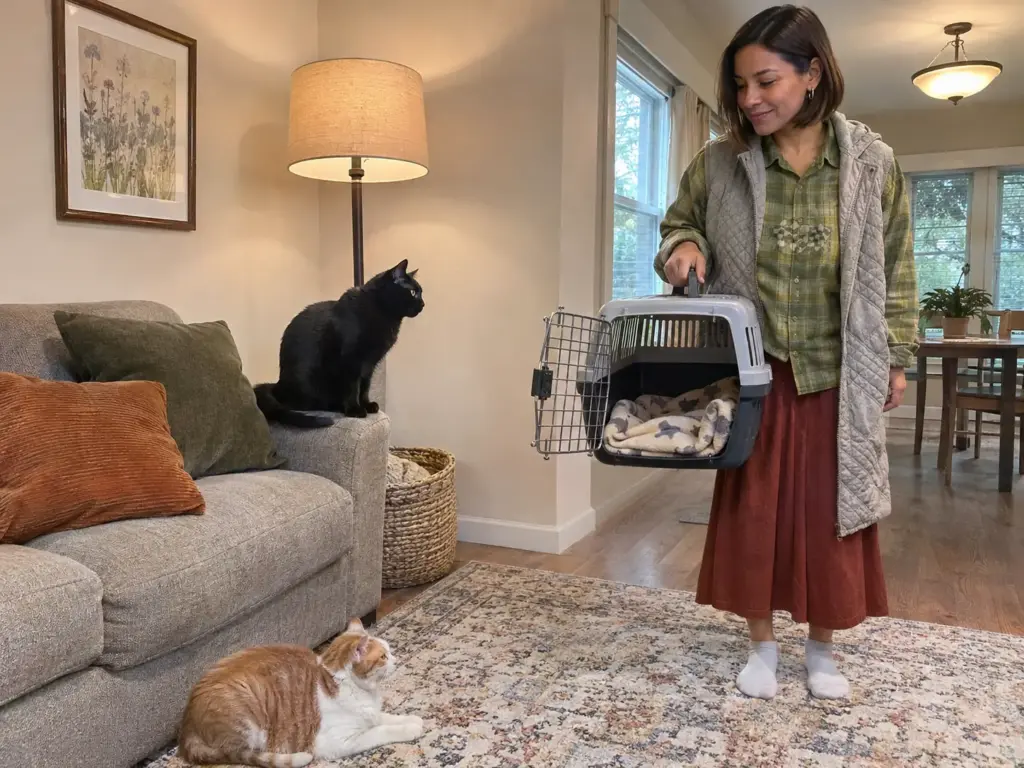
Start with the carrier. If it lives in a closet and only appears on the way to the vet, take it out, leave the door open in the living room and put a blanket of the cat’s inside. A carrier that sits in plain sight stops being an event.
Then look at the gap the two cats keep fighting for. Moving the sofa a hand’s width off the wall, or moving the feeding station away from the kitchen door, opens a second path for whichever cat gets stuck. Both can be done in a minute and the cats can test them the same day. A bottle comes after them.
The Spot Where the Standoff Starts
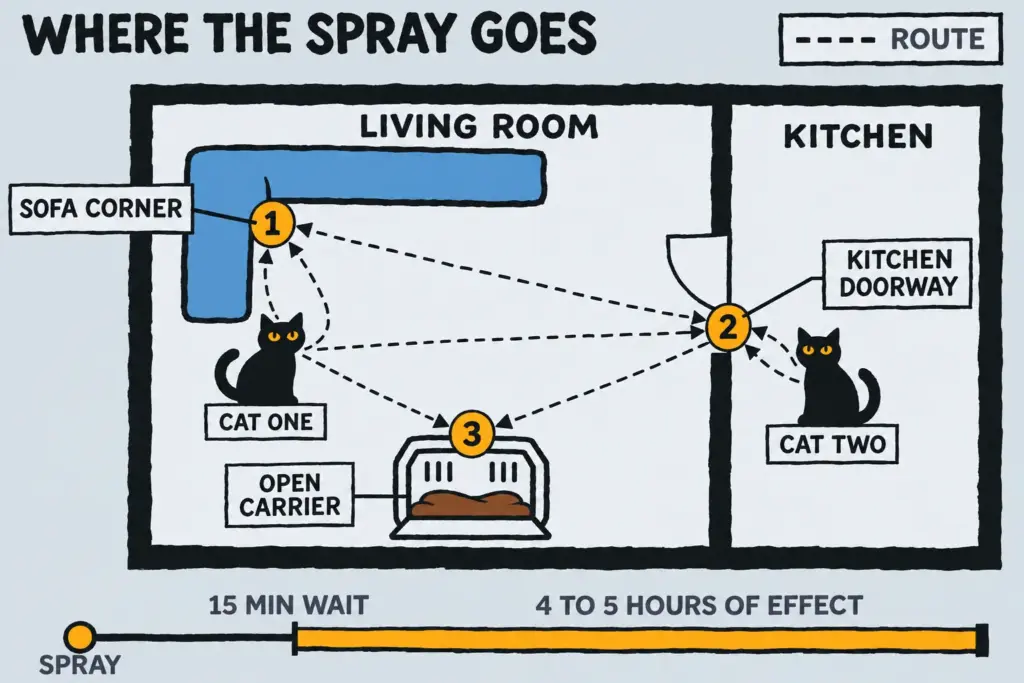
Pick the object the cats rub or mark, or the corner where the standoff begins. The maker’s figure is 8 to 10 sprays per application, and a 60 mL bottle holds about 50 sprays. That is five applications and a little more. Count spots, not days: three spots take most of a bottle in two rounds.
The spray goes on objects and around the house, never on a cat, never on a carrier with a cat inside, and never on a scratching post, which the maker warns it will put the cat off. The spot is where the trouble starts, not the middle of the room.
If one of the two has already stopped using a room, the room matters more than the bottle. The list in the rooms the bullied cat has quietly given up is what the spray cannot fix. And in a home with one hallway, a spray changes nothing about both cats having to pass through the same gap.
Spray the carrier in a room with fresh air, with the door open and no cat in sight, and let it air during the 15-minute wait. A strong smell at the carrier door on the way in is a new problem you just added.
Fifteen Minutes Before, and Never During
Wait 15 minutes before a cat goes near the sprayed spot. The effect lasts 4 to 5 hours, and on a long trip the maker says to reapply inside that window. So the spray goes on ahead of a known trigger: the trip to the vet, the visitor at the door, the hour the cats usually meet at the gap.
During a standoff there is no 15 minutes. The scent has not had time to do anything and your attention belongs on putting something between the cats.
Write the time you sprayed on a sticky note by the door. On a long drive, the second application has to land inside the 4 to 5 hours, and that is easy to lose track of when someone is driving.
When the Smell Starts Meaning the Trip
The usual advice is to spray the carrier before every vet visit, and for a cat that travels once a year that is fine. For a cat that only ever meets that smell right before the carrier door closes, it can go the other way: cats learn what predicts what, and a smell that shows up only before the trip becomes the first part of the trip. The calm it was meant to lend turns into a warning.
The remedy is to give the smell other jobs. Use it on other days, in other spots, with no trip attached, so it is not only the announcement. Smell is a signal to a cat, and a signal can mean the opposite of what you intended, a point why a swapped scent can backfire makes in a different setting.
The Three Sprays, Told Apart by Their Limits
Free changes first, bottle second. If you still want one, here are the three that cover the field, each with what it cannot do.
The Pheromone Spray With a Maker Who Gives Its Own Limits
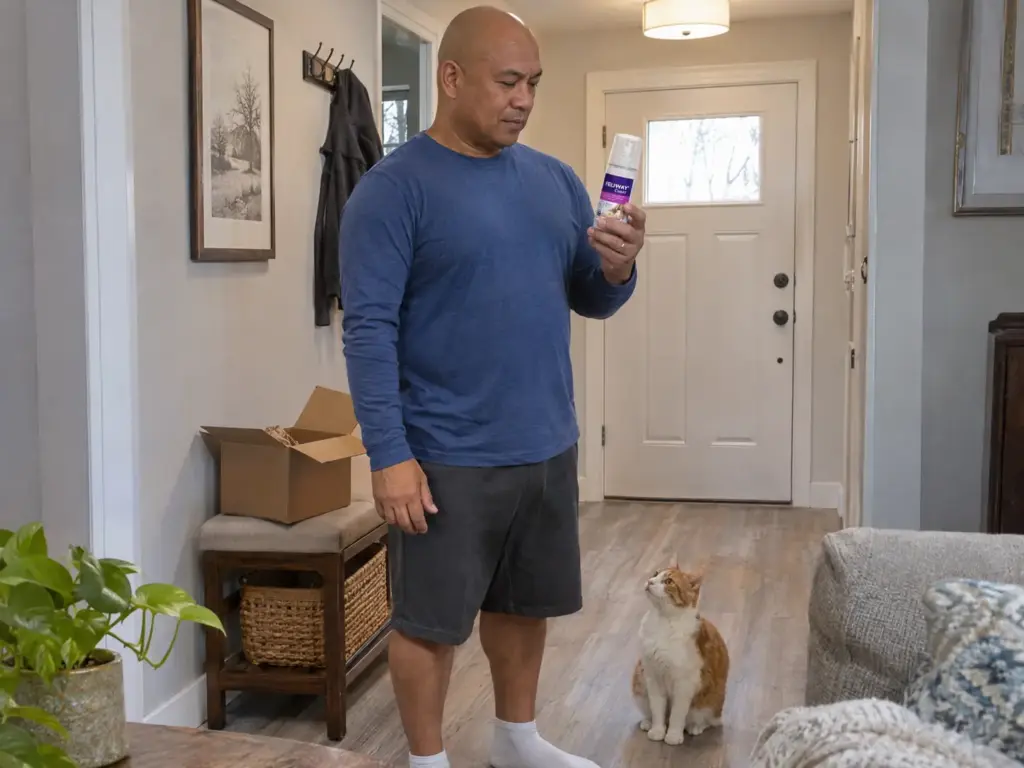
FELIWAY Classic Cat Calming Spray, 60 mL is the best-known of the three, and the maker publishes the numbers that matter: 8 to 10 sprays per application, about 50 per bottle, 4 to 5 hours of effect. It is the one to start with if you want a pheromone spray. Its limit is the clock, since a long trip needs a repeat, and the evidence on this pheromone is mixed.
The obvious pick is also the wrong tool for the tension between your two, because the pheromone built for that comes as a diffuser. Treat it as a spot tool for the carrier and the gap.
The Cheaper Spray Whose Label Does Not Name the Pheromone
Comfort Zone Spray & Scratch Control, 2 x 2 oz comes as two bottles, 4 oz in total, which is more liquid in the box than the 60 mL bottle above. The label says unscented and mentions scratch control. It never says which pheromone it carries, so it cannot be compared with the others by how it works, and that is its limit.
The Scent Spray Without a Pheromone
Nature’s Miracle Cat Calming Spray, Stress-Reducing Formula, 8 oz is the one scent-based option: soothing scents, no pheromone. It is the fit for someone who wants a fragrance and not a copy of a cat’s own mark. Its listing promises fast results, a claim with no test behind it.
None of the three outweighs the spot and the barrier for two cats in a standoff. If neither the spot nor the bottle changes anything, the signs that an introduction is failing are the next place to look.
Choose the Spot and the Hour, Then the Bottle
A spray helps some cats at one moment and in one place; it does not settle a house and it does not stop a fight. Anything that hurts, and any sudden change in either cat, goes to the vet before any bottle goes in the cart. The spot and the hour get decided first, and the spray comes only once the spot is already working.
After a week of spraying the same place at the same hour, watch whether both cats cross the gap without stopping. If they do, keep the routine; if they stop at the same spot as before, the change belongs to the room, not the bottle. Days, not months, is the clock here.
For today, with no purchase attached: bring the carrier out, leave it open in the living room with a blanket of the cat’s inside, and open a second path around whatever corner holds one of them back. Tomorrow, notice whether either cat walks past it as if it were furniture.
Frequently Asked Questions
01Do cat calming sprays really work?
A pheromone spray can help some cats in a particular situation, but it does not work for every cat and it does not fix a whole home. The best placebo-controlled test sprayed a carrier and helped only the cats that were already most tense.
02What calms a cat down immediately?
A spray is not instant: the maker of the pheromone spray asks for a 15-minute wait before the cat goes near the sprayed object. A sudden change, new urine outside the box or eating less is a call to the vet, not a purchase.
03What cat calming products actually work?
None works for every cat, and the three kinds of spray differ in what they do more than in how much they promise. A pheromone spray copies a facial scent, a scent spray offers a fragrance, and a scratch or catnip mist does not calm at all.
04What do vets recommend for calming cats?
That question belongs to your own vet, who can examine the cat; this guide covers only what the home can answer: the spot, the hour and the bottle.
05Can I spray calming spray on my cat?
No, the maker says to spray objects and areas around the home, never the cat itself, and never a carrier while the cat is inside it. Let the sprayed spot sit 15 minutes first.

Leave a comment