Teaching Kids to Handle Cats With One Hand and a Plush Cat
Teaching kids to handle cats: a 15-inch plush, one flat hand for 3 seconds, a 38.9-inch wand (no hands as toys) and a perch above the child's reach.

Alfredo RamsesFounder · Updated November 17, 2026 · 21 min read

On this page10 sections
- 1Teaching Kids to Handle Cats Is a Motor Skill the Hand Does Not Have Yet
- 2A Scratch That Breaks the Skin Is a Doctor's Call, and a Cat Who Stops Being Touched Is the Vet's
- 3One Hand, Three Seconds, and the Places a Small Hand Is Allowed
- 4The Signals That Come Before the Hiss, Said Out Loud by the Adult
- 5Why the Cat Arrives on a Seated Lap and Nobody Carries It
- 6Play Without Hands: One Wand for the Adult, One a Small Hand Can Hold
- 7No Spare Room: A Gate With a Cat Door and a Perch Above the Fingertips
- 8One Cat Is Not Two: The Tolerant Cat Teaches the Wrong Lesson
- 9The Plush Before the Cat, the Tape Before the Tree
- 10Frequently Asked Questions
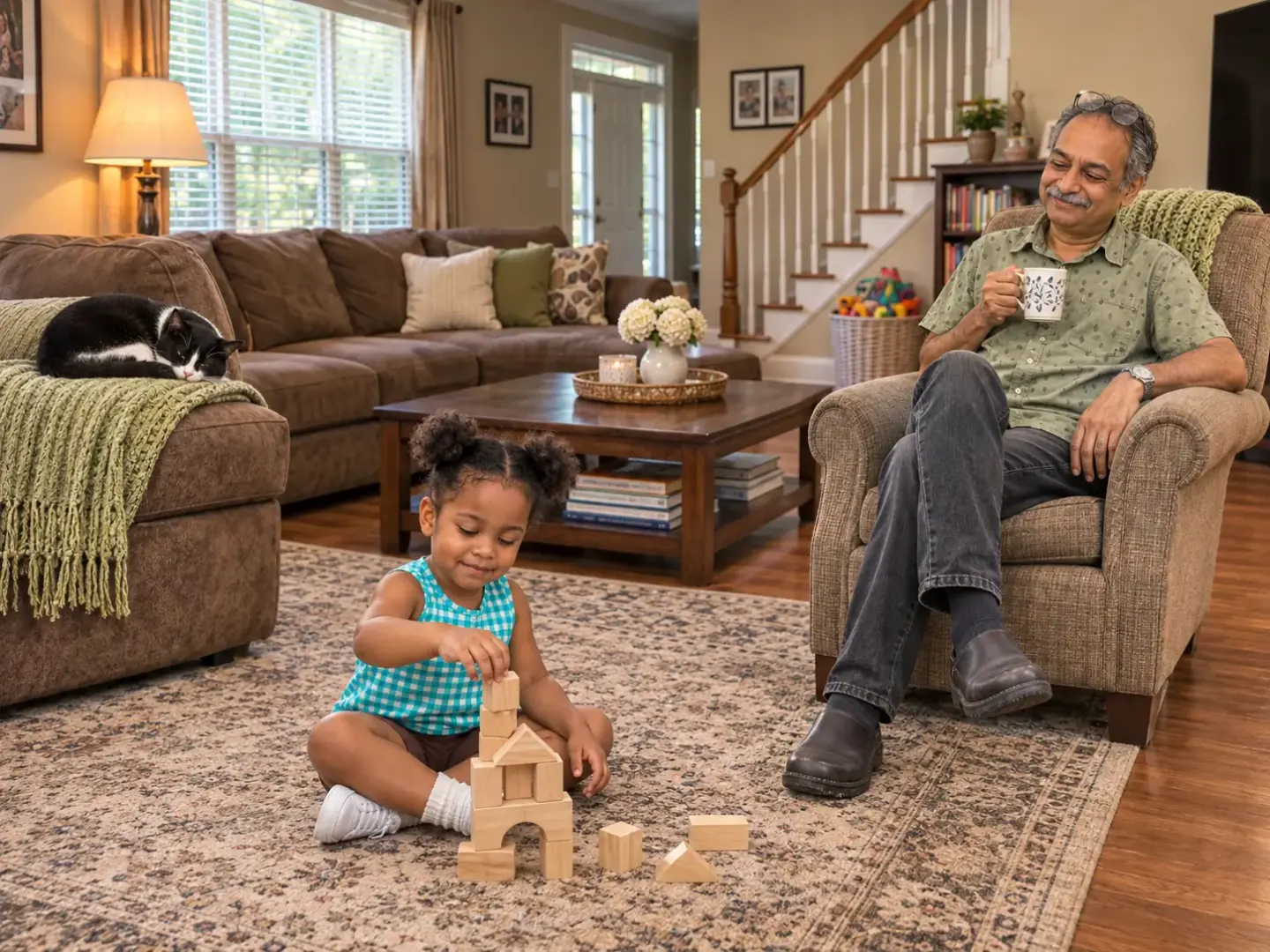
Your three-year-old can say gentle the second you ask and still close a fist around the tail when the cat strolls past. Nobody here is defying anybody: a rule the mouth knows and a hand that can obey it are separate skills, and only one has arrived. Teaching kids to handle cats is a motor lesson, so it gets taught like one, with rehearsal on a plush, a handful of moves repeated for months and a room rearranged so the cat never pays for the practice. The sections below cover why the lesson collapses, the two moments that belong to a doctor or a vet, one hand and three seconds, the signals that come before the hiss, why nobody carries the cat, play without hands, an apartment with no spare room and what changes with two cats.
Quick Answer
A rule a child can recite is not yet a hand that can obey it, so the lesson is practice for the hand plus a room that gives the cat an exit. A bite that breaks the skin is a call to the doctor today, and a cat who suddenly will not be touched is a call to the vet.
- Sit the child on the floor and let the cat choose to come over.
- Pet with one flat hand for three seconds, then lift it away and watch.
- Rehearse the stroke on a plush the length of a real cat first.
- Say the cat’s early signal out loud and take the hand away together.
- Keep hands out of play and use a wand instead.
- Give the cat a perch above the child’s reach and a way out.
Teaching Kids to Handle Cats Is a Motor Skill the Hand Does Not Have Yet
The other half of the work for kids and cats is the apartment itself: the reach line, the doors, the timetable. That half lives in a piece on how a small apartment is shared between a cat and a child, and this one stays with the hand.
A Three-Year-Old Is Not Disobeying
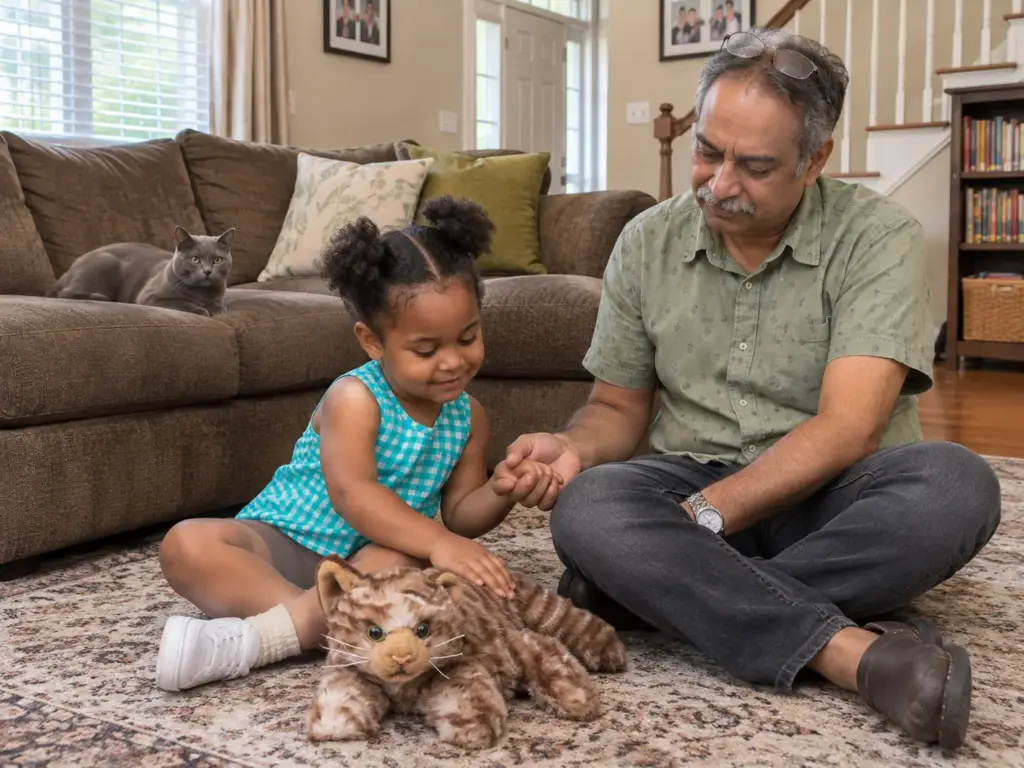
A toddler who has heard gentle two hundred times and still grabs the tail is not testing you. The grab happens before the rule can: the hand closes at the exact moment the child wants to touch, and a three-year-old’s grip has no dial yet for an animal that will not hold still. The laugh when the cat complains belongs to the same missing skill, because the child has no scale for what a grab costs the animal at the other end.
Motor skills get taught with one small move, repeated in the same place, with an adult doing it alongside, and a lecture is none of those. So the free version comes first, and it builds gentle hands before the cat is even in the room. Curl one of your fingers inside the child’s palm so the fist cannot close on fur, say gentle every time a stroke lands until the word turns from a correction into a cue the child starts saying alone, and when the hand grabs anyway, lift the child out of the room for 30 to 60 seconds with no telling-off. All of it repeats for months, not one good afternoon.
In cat handling for children the adult is the role model and the person responsible. The child copies how the cat gets touched, and the child is never alone with her.
“Toddler Gentle” and “Cat Gentle” Are Two Different Amounts of Pressure
A child who pats a grandmother’s arm softly is using the only scale the hand has learned. Cat gentle is lighter, slower and shorter, so it has to be taught as a second scale instead of being assumed from the first. Then there is the file the child keeps the cat in: a cat that looks and feels like a big stuffed toy gets handled like one, squeezed, dragged, hoisted by the middle, and that filing is where the grabbing starts, not temper.
Praise the stroke the moment it lands right, which is positive reinforcement for the child, but the reward is never permission to hold the cat. Three good seconds earn three more, or the chance to sit still while the cat decides to come over, because a prize of holding teaches the exact thing the lesson is meant to prevent.
Run the finger curl and the word through whole sessions with the cat out of reach, on the plush or on a sofa cushion, before the real cat joins in. When she wanders over by choice, the habit is already in the child’s hand and the adult’s only job is to keep it there.
Rehearse on a Plush the Length of a Real Cat
Before a child handling a cat touches fur, the hand needs somewhere to be wrong. A plush cat of real-cat length gives the child the route of a soft stroke, shoulder to back and then hands back in the lap, and gives the adult a front-row view of which hands curl into fists, all on something that cannot be hurt.
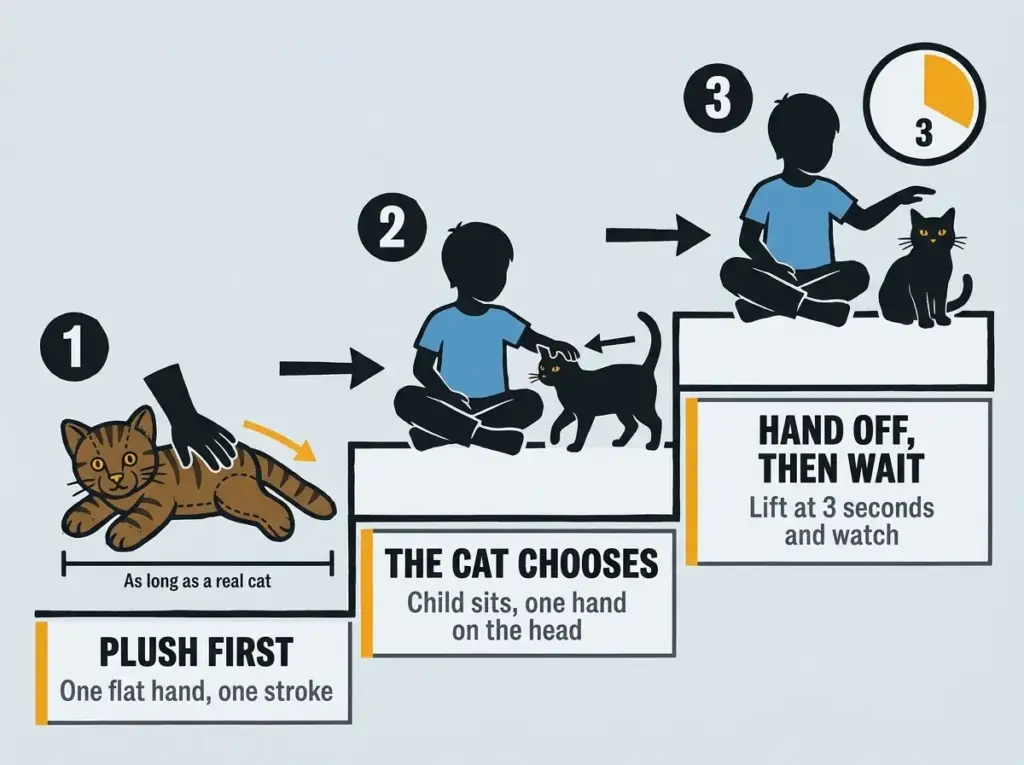
Keep each session short and the instruction singular: one stroke, one word, hands in the lap. When the stroke on the plush is slow and the fingers stay open, the real cat gets a turn, with the cat choosing to come over and the adult’s hand over the child’s.
A long stuffed toy from the toy box does the job if it is close to cat length, so check that first. The purpose-built option is the Bearington Louie realistic cat stuffed animal, 15 inches long, about the length of a small adult cat (a big cat runs longer), so the hand learns the distance of a stroke before it meets the real thing. It arrives smaller than the listing makes it look and runs expensive for the size. If that stings, the 9.5-inch Bearington Lil’ Socks has a soft beanbag build and works for a first practice, with a shorter route for the hand to learn.
A Scratch That Breaks the Skin Is a Doctor’s Call, and a Cat Who Stops Being Touched Is the Vet’s
Two situations leave this lesson entirely, and both get named here, early, and handed over.
A Bite or Scratch That Breaks the Skin
A bite or scratch that breaks the skin is a call to the child’s doctor today. This article does not say what such a wound needs or what it means, because that belongs to the doctor, and the phone call comes before anything else written here.
A Cat Who Suddenly Will Not Be Touched
A cat who abruptly refuses a touch she used to accept, or who starts hiding when she used to sit nearby, gets a call to the vet before any change to the room. Nothing in these pages tries to explain a shift like that. The vet is the one who can.
A great deal of what looks like a cat problem is a house problem: the cat who defends herself because nobody left her an exit, the child who lands on her face because her face sits at the child’s eye level. Those are what the rest of the article changes, through the hand, the signals, the height and the door.
One Hand, Three Seconds, and the Places a Small Hand Is Allowed
The Child Sits, the Cat Decides
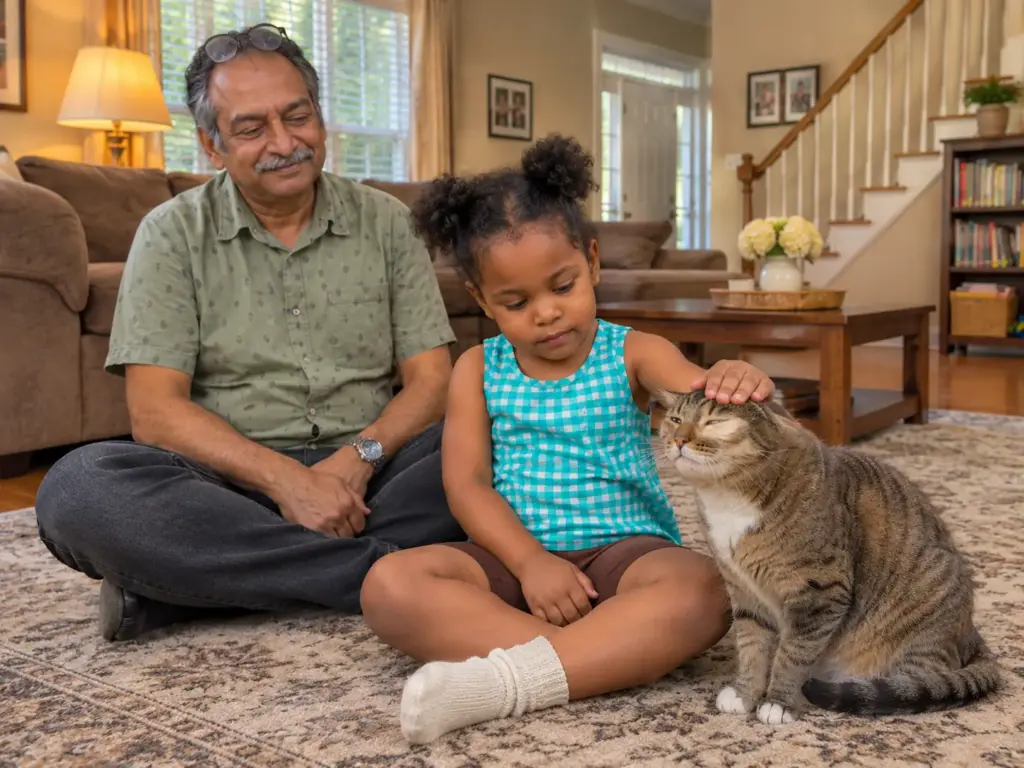
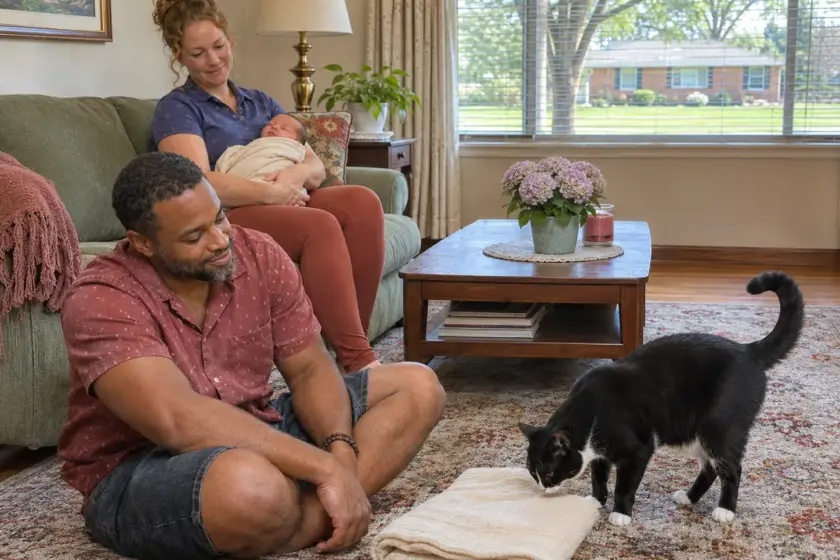
Start with the floor. A seated child cannot chase, cannot loom over the cat and cannot drop her from standing height, and humane societies that write for families ask for children to be seated whenever they touch or hold a cat. Let the cat approach: she picks whether to come over. A single finger held out for her to sniff is an invitation to be sniffed, not permission to touch; the yes is her leaning into the hand.
And a hand never comes at her face head-on while the child stares. To a cat that reads as a threat.
A Flat Hand, One Hand, Three Seconds
According to Connecticut Humane, “One hand’s enough, two hands are too rough.” The second hand is what turns a stroke into a hold, and a hold is what a cat defends herself against. So it is an open hand, a flat palm, there is one of it, and it moves the way the fur grows.
Then the clock. According to International Cat Care, the rule is to “touch for 3 seconds, then pause to see if the cat wants more.” Count the three out loud with the child, take the hand away, and watch.
The pause is the consent test, not the stroke: a cat who leans back into the hand has said yes again, and a cat who stays put or edges off has said no, and the hand goes back to the lap. A cat who has had too much petting is heading for overstimulation, and the pause is what catches it. Of everything on this page, the three second rule is the one a small child can hold first.
Green Zones on the Head, and Why the Back Is Second
International Cat Care sorts a cat into three zones: cheeks, chin and head are green; the trunk and the tail are amber; legs, belly and the base of the tail are red. In a small hand’s terms, the green zone is the top of the head, behind the ears and under the chin, the amber zone is for later, and a child can hold the red zone as four short rules: no belly, no paws, no tail, no face. The back is where good sources disagree, since the Governing Council of the Cat Fancy lists it among the places to touch and International Cat Care leaves it in amber. So the working order is head first, back second, and the cat’s own lean decides each time.
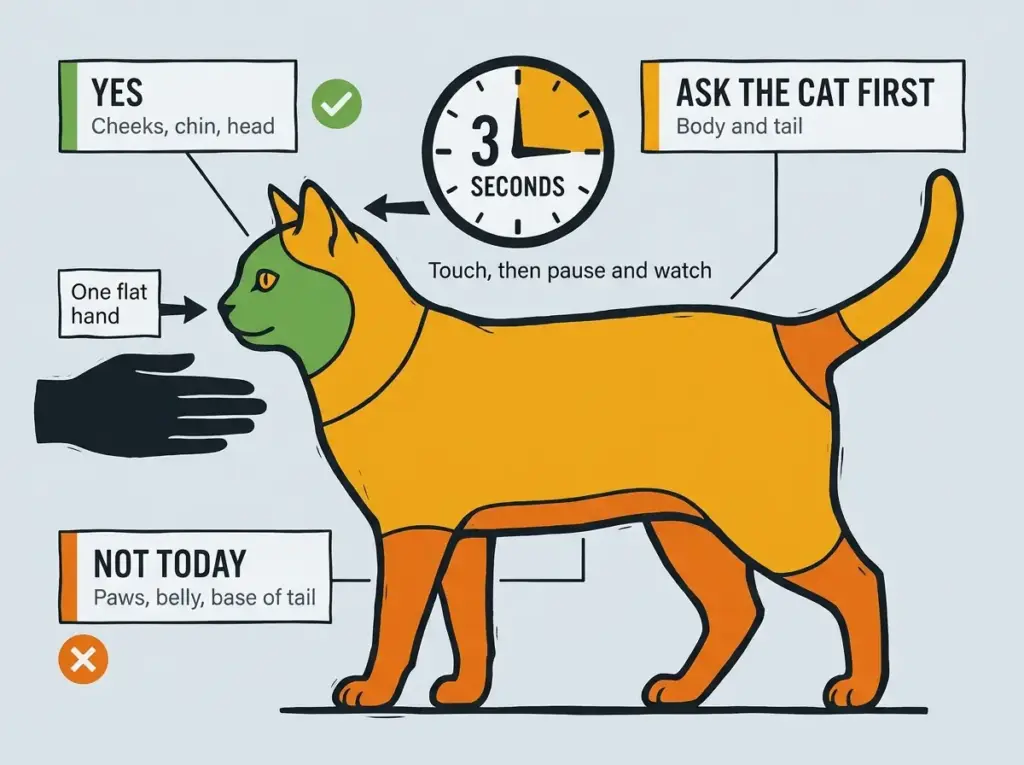
What gets repeated as stroke from head to tail describes the direction of the stroke, with the way the fur grows. It is not a license to run a hand down the spine and over the tail, and a hand that starts on the head and lifts away at three seconds never gets that far.
Why the Hand Goes to the Tail and the Face First
The head is the highest thing on the cat, so for a small child it is the last thing reached. The tail swings at a toddler’s eye level, and ears and whiskers hand a closing fist more to hold than a smooth head does. The first thing a toddler’s hand finds is often the thing on the list that is off it.
One trick helps: do the first strokes on the back of the plush, and move to the head only once the fingers stay open there. The cat gets the version of the lesson where the hand already knows where to stop.
The Signals That Come Before the Hiss, Said Out Loud by the Adult
The hiss is the end of a body language conversation the cat has been having for a while, in a voice small enough that adults miss it and children never hear.
The Early Signs That Come Before the Hiss
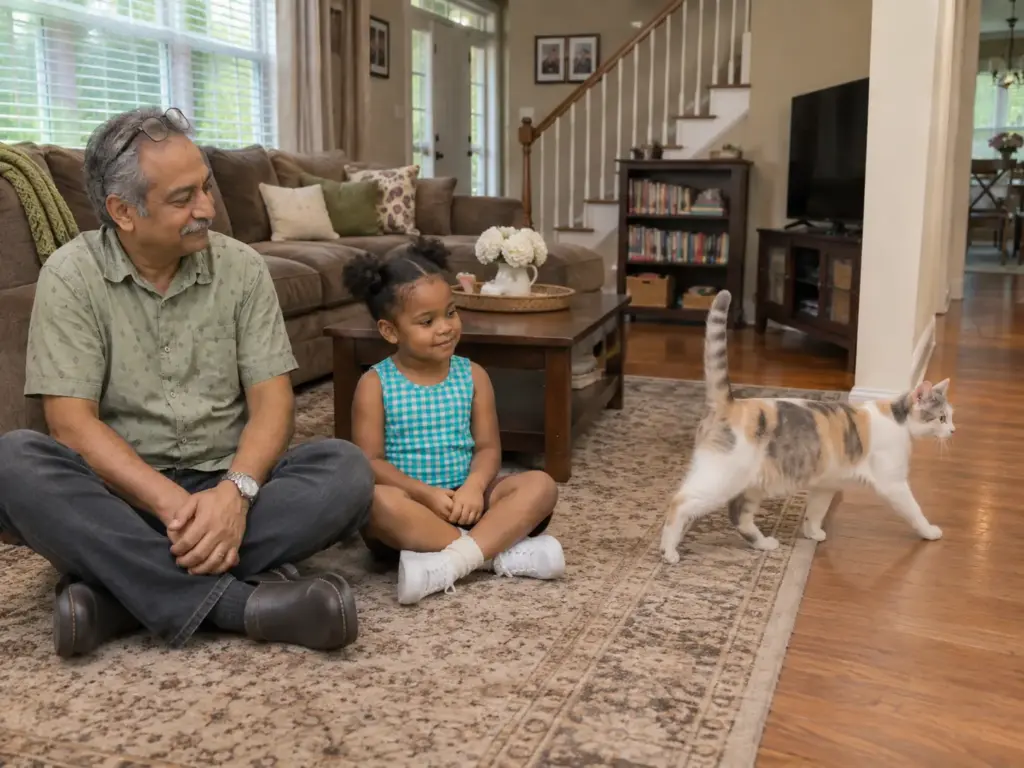
Cats Protection lists what the cat does first: the pupils widen into dilated pupils, the ears swivel out to the side or sit ears back, the tongue flicks over the nose in a quick nose lick, the tip of the tail twitches in a fast tail flick, she grooms one spot suddenly, she looks away. Each of those is something a three-year-old can learn to name, which is the point of teaching them. Flattened ears, a lashing tail and a hiss are what arrives after, and why a cat swats is a separate question from what the hands should have done before it got there.
The full list is in Cats Protection’s own guide to cats and children, and it is worth a read before the first session.
The good signals are plainer. A cat who leans in, goes bunting along the hand and purrs with her tail up is asking for more; one who edges away or goes still is not.
The Adult Names It, the Child Learns the Word
The adult learns to narrate the signal: it is said out loud at the moment it happens, and the hand comes away together with the child’s. The same short words every time, so the child starts to hear a name where a cat once only looked unreadable. The word is the signal. It is never a scolding.
Give each signal one short name and the same verb every time, say it aloud the instant you see it, and move the child’s hand away with your own. A cue that changes from day to day is just more noise, and a toddler cannot sort noise.
When the Hands Stay Away Altogether
Some moments are closed to the hand: while the cat eats, drinks, sleeps or uses the box, and whenever she is hiding. A cat who has gone under the bed or into a box has finished the lesson, and the lesson ends there. Nobody pulls her out, corners her or follows her.
After play the cat is still hunting. Connecticut Humane asks for ten minutes of calm before any hand goes near, and a child who reaches at second nine collects the bite that was meant for the lure.
Why the Cat Arrives on a Seated Lap and Nobody Carries It
Watch a three-year-old love a cat. Arms around her, face pressed in, then the lift. All three are how a small human says affection, and all three read to the cat as being held in place.
Hugs, Kisses and Carrying Read as Restraint
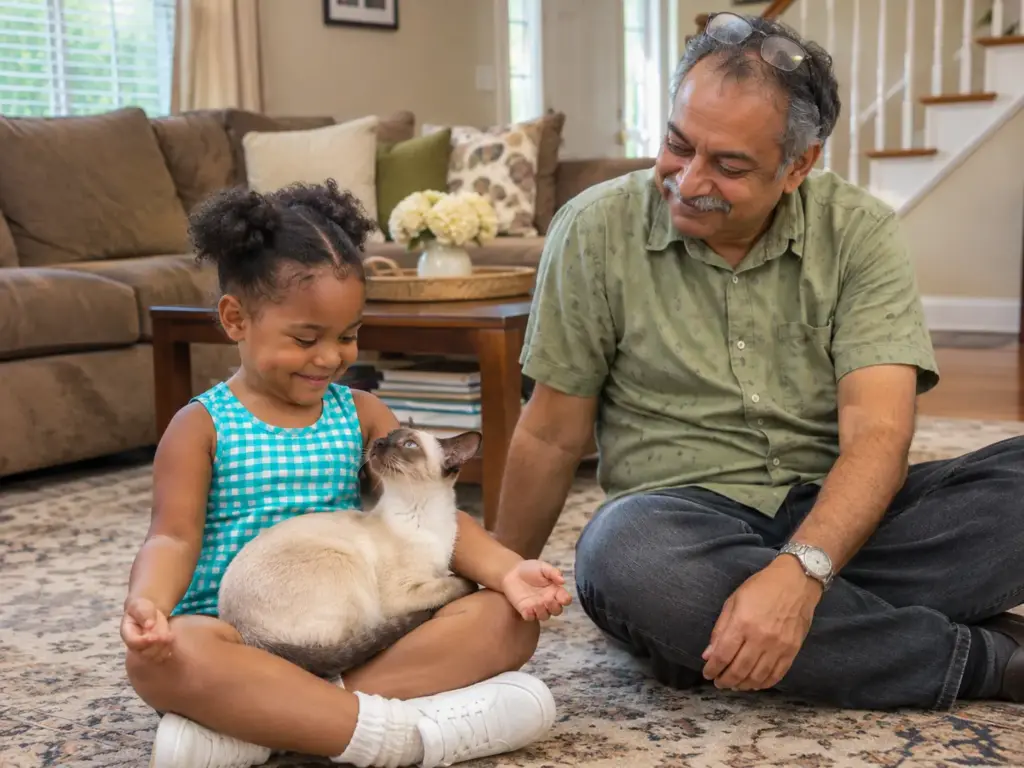
The cat is describing a constraint and the child is describing a preference, and on the constraint the cat is right. International Cat Care advises against lifting a cat during social contact because it takes her choice away, and allows it only for a child strong enough to support all of the cat’s weight, which rules out a toddler. Connecticut Humane’s seated-child rule closes the gap from the other side: the child sits, and the cat arrives.
What a Hold Looks Like When an Adult Does It
The usual instruction for picking up a cat is to support the chest with one hand and the hind legs with the other, tucked against your own chest, never dangling. That is the right mechanic for an adult holding a cat who wants to be held, and the wrong thing to teach a small child, whose arms cannot do it. So the child is taught that the cat comes, and the lift stays with the adult and only on the cat’s say-so.
Swap the Love Language, Keep the Affection
Affection does not get banned; it changes language. A slow blink from across the floor, a treat that only the child gives, set down on the floor, the wand dragged along in front of her, and a family phrase for hello that does not involve arms. Each gives the child a way to say it that the cat can accept.
If the household is still choosing a cat, American Humane’s advice is a cat past two or three years old for a child under five or six, since an eight-week-old kitten is an adult in under a year.
Play Without Hands: One Wand for the Adult, One a Small Hand Can Hold
Why Hands Become the Toy
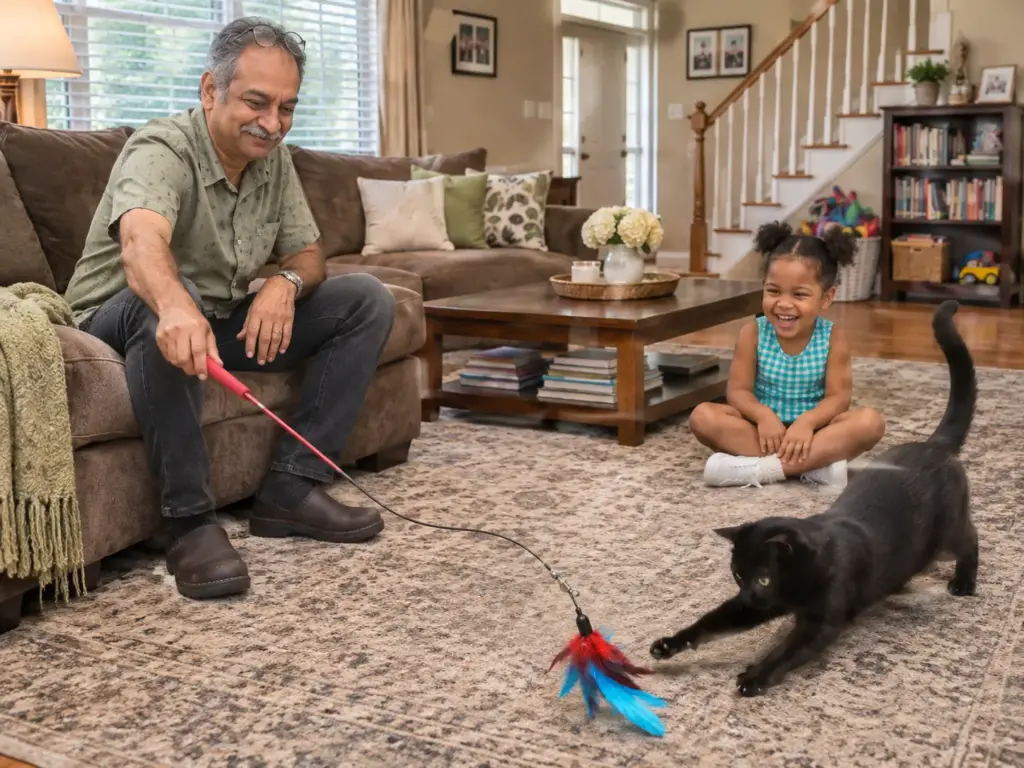
A hand that moves looks like prey, and that is where predatory play starts. Herron and Buffington’s Ohio State review of indoor-cat enrichment notes that hands as toys teach a cat to stalk, pounce on and bite the person, and recommends toys that keep distance between the cat and the person. A wand is not a prettier toy. It is the one that leaves the teeth at the far end of a string.
Pounce, bite and swat also look alike from across the room, which is one more reason to keep skin out of the game altogether; when play turns into a real fight covers how to tell the two apart when two cats are the players.
The Wand That Keeps the Teeth at the Far End of a String
A length of cord, or a sock knotted to the end of one, is the free string toy, and the adult runs it while the child sits alongside. A wand toy arrives later, because it makes the game repeatable. The MeoHui 2-piece retractable cat wand is a feather wand that telescopes from 15 to 38.9 inches with 23.6 inches of string on top, so with an adult and a child at the handle end the cat stays about three feet from both pairs of hands, well past arm’s length. It comes with 9 feather refills, which matters because every cat destroys feathers.
The wand snaps with use, and loose string and feathers are a swallowing risk, so it is a toy that gets watched and then put away.
Put both wands on a shelf the child cannot reach the moment the session ends. A string or ribbon left lying in the open is exactly what a bored child picks up and carries around, and neither toy is meant to be unsupervised.
A Ribbon a Three-Year-Old Can Drag Along the Floor
The wand a small hand can hold is the Cat Dancer Rainbow Cat Charmer: a 16.5-inch wand with a 4-foot fleece ribbon and no hard lure or feathers to swallow. It is light enough for a three-year-old to drag along the floor in an S while the cat stalks, which puts the child on the floor and the cat in charge of the hunt.
The ribbon knots if it gets dragged without anyone watching, and Cat Dancer labels it not for children under 3 years, so it is a toy for age three and up, with an adult beside the child and the ribbon put away between sessions. The ten minutes of calm afterward are the ones already described. No laser pointers aimed at eyes, and nothing the child has to grip while running.
No Spare Room: A Gate With a Cat Door and a Perch Above the Fingertips
A child-free room, a safe room the child cannot open, is easy to recommend and hard to find in a two-bedroom apartment, where two rooms for the cat are a luxury. The version that survives a real floor plan has four parts, and the first one is free.
A Door That Closes Is Free
A door that shuts beats almost anything sold for the job, and the highest corner the cat already uses beats most trees. The height that counts is not the one the cat can jump but the one the child can reach.
Stand the child against a wall with one arm straight up, and mark where the fingertips land with painter’s tape, which will not damage a rental wall. Every perch, cat shelf and cabinet top has to clear that mark, and the measurement gets repeated when the child stretches. A high shelf or a wall shelf works where the floor is short, but a rental that bans holes rules the wall shelf out. A door and a perch above the rail works on the same logic for a crib, and it holds just as well for a living room.
A Gate That Only the Cat Fits Through
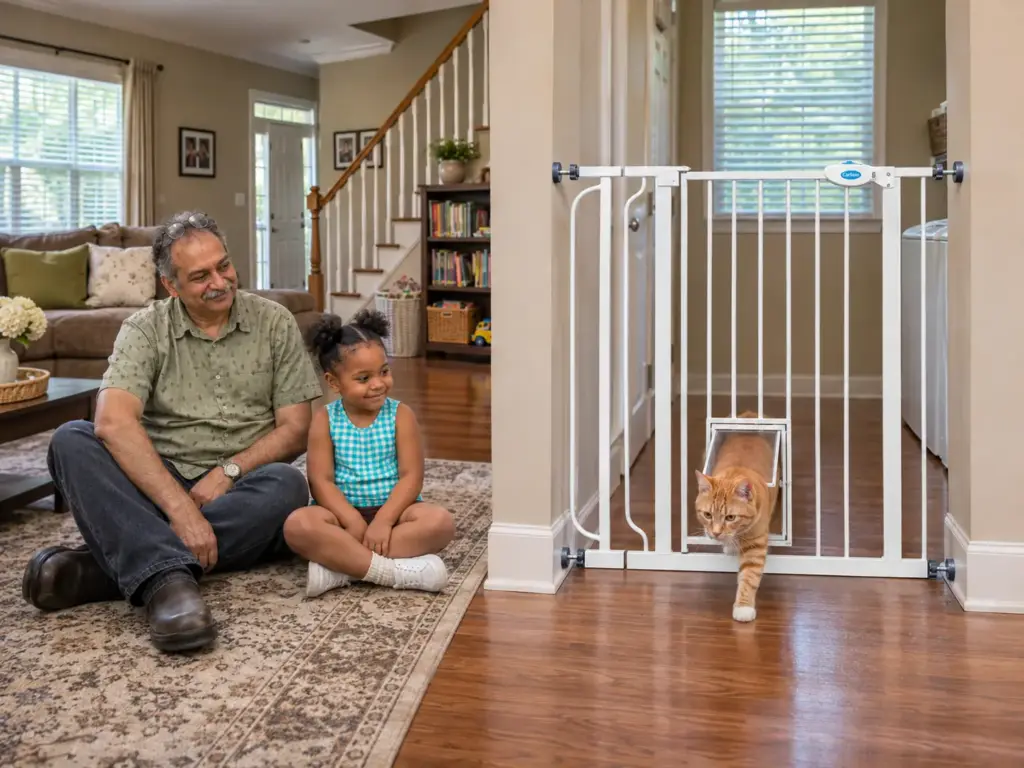
A baby gate with cat flap, a gate with cat flap in its panel, lets the cat out and does not let the child follow. The Carlson 36-inch extra tall walk-thru gate fits openings from 29 to 36.5 inches, has a 7.5 by 7.75 inch cat door and a 16.5 inch walk-through, and is pressure mounted, so there is no drilling, which suits a rental. The latch on the walk-through is stiff, and the cat door is small for a big cat, so a large breed may find it a squeeze.
For an opening wider than 36.5 inches, the Babelio CatPrivilege III is 36 inches tall and spans 29 to 43 inches. A gate buys seconds, not safety, and an adult stays in charge. Which pet gate with a cat door fits a rental doorway measures the real opening instead of the frame.
A Perch Above the Child’s Fingertips, and a Second Way Down
Cats climb better than they come down, according to Cats Protection, so a perch needs a second way off. One ladder up and the same ladder down that passes the child is a trap, and the cat stops using it. The Ohio State review names pursuit by small children as a stressor and asks for perching options where a cat is safe from people, which makes height a welfare need and a safe zone, not a decoration.
Measure the tape mark first. A perch is only above the child if it clears the line. The PAWZ Road 72-inch cat tree stands 72.4 inches tall on a 21.6 by 17.7 inch base, with two platforms at the top far above any three-year-old’s standing reach. The build gets mixed marks, and at that height the wall strap stops being optional, so a rental that bans holes needs an answer before the tree arrives.
The tallest tree is the obvious pick, and a smaller room is where the second choice works. The FDW 54-inch cat tree fits where 72 inches will not, and the K&H EZ Mount window perch, 12 by 23 inches and rated for 50 pounds, is the vertical option that takes almost no floor. Either one only counts if its highest platform clears the tape.
Put the painter’s tape on the wall at the child’s fingertip height before any shopping, then check that the cat has a second way down that does not run past the child. If both pass, the furniture you have may already be enough.
The Box and the Bowls Out of Reach
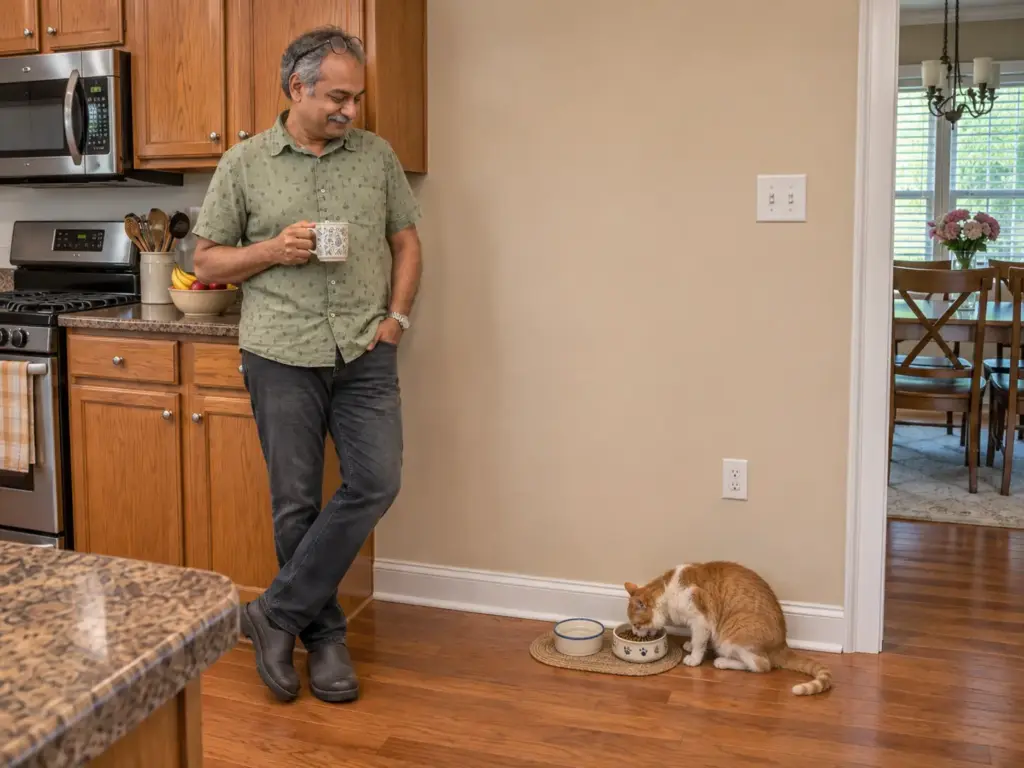
Keep the litter box out of reach, and the food bowl and water bowl with it, without moving them out of the cat’s reach: a box in a room the cat can enter by a route the child does not block, bowls on a surface above the tape line, the door that closes behind her. Moving the box is not hiding it, and with two cats the count and the spots follow how many litter boxes two cats need.
One Cat Is Not Two: The Tolerant Cat Teaches the Wrong Lesson
In a home with a mellow cat and a shy one, watch who leaves when a toddler gets loud.
The Mellow Cat Absorbs the Grab and the Shy One Pays
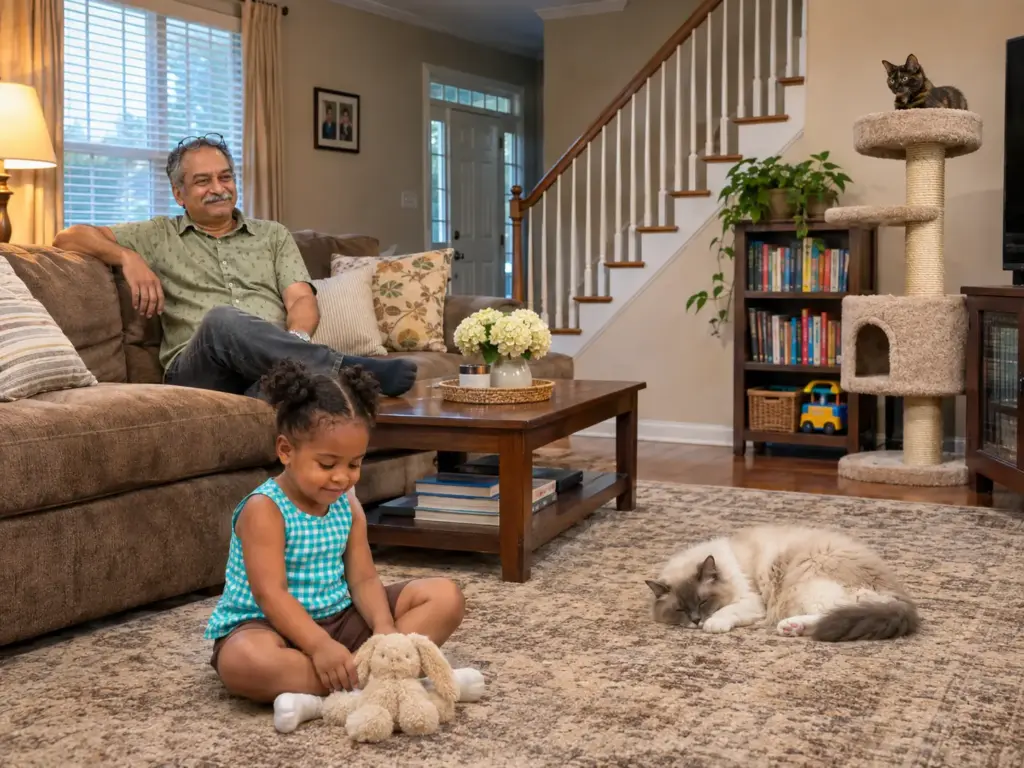
The shy one is gone before the voice peaks. The mellow one, the confident cat of the pair, stays, complains, flicks her tail and does not walk away, and the child learns the wrong lesson from it: a cat takes whatever comes. That lesson lands one day when even the mellow cat swats, claws in, and the child learns in a second what months of coaching had not. It is a lesson best delivered on purpose, with a plush and an adult, not left to a cat’s patience.
The shy cat pays the rest. She hides, stops using the low route through the room and spends more of the day out of the room. The spot that matters most in the house is the one the shy cat has for leaving.
Each Cat Is Taught Separately, by Name
What one cat accepts the other does not, so each gets taught by name and with her own limit: this one says enough with her tail, this one just moves off. Each cat needs her own high spot and her own seat, and the count follows the resource rule for homes with more than one cat: a spot per cat, plus one more. Without it, the cat who loses her place to the child makes the other cat pay.
The Lap the Cat Loses to the Child
What looks like jealousy is usually something in the house that moved first: the lap, the hour, the sofa. What changed in the home before a cat looks jealous walks through it. A cat who loses a spot and gets no replacement shows a habit change, and if the change is abrupt, that is a question for the vet.
The mellow cat is never the trainer. Practice stays on the plush and with the cat who chooses to come over, never with the one who simply will not leave, and the adult sits on the floor between the child and the cats.
The Plush Before the Cat, the Tape Before the Tree
The order is short. Rehearse the hand on a plush before it meets fur, touch for three seconds and lift away, keep hands out of play and let a wand take the game, and give each cat a perch above the child’s fingertips with a second way down and a door that closes. The two exceptions stay exceptions: a bite that breaks the skin goes to the doctor today, and a cat who suddenly will not be touched goes to the vet.
The sign that it held shows up in days to a few weeks of short daily sessions. The cat walks up to the child’s hand by herself and meets it for three seconds, and the child says gentle before anyone asks.
Today, sit on the floor with the child, close your hand over theirs, stroke the plush once, say the word and put both hands back in the lap. Then stand the child against the wall and tape the line.
Frequently Asked Questions
01How do you teach a toddler to be gentle with a cat?
Sit the child on the floor, curl an adult finger inside the child’s palm so the fist cannot close, and say gentle every time the hand touches the cat. Rehearse on a plush first, and take the child out of the room for 30 to 60 seconds after a grab.
02Where can a child pet a cat?
On the cheeks, chin and head first, with one flat hand for three seconds, then the hand comes away and the child waits to see if the cat leans back in. The back comes second, and the cat’s own lean decides. Belly, paws, tail and a hand coming straight at the face stay off the list.
03Should a child ever pick up a cat?
Not a small child. International Cat Care advises against lifting a cat during social contact because it takes away her choice, and allows it only for a child strong enough to support all of her weight. The version that works is the cat arriving on a lap while the child sits on the floor.
04Should kids play with cats using their hands?
No. Hands that move become prey, and the cat learns to stalk and bite the person. A wand keeps her teeth at the far end of a string, and the adult plays beside the child, followed by ten minutes of calm before any hand goes near the cat.
05What if the cat scratches or bites the child?
A bite or scratch that breaks the skin is a call to the child’s doctor today, and this guide cannot say what it needs. A cat who suddenly will not be touched anywhere is a question for the vet. Everything else here changes what the hands and the room do.
Leave a comment