Are Cats Mean to Babies, or Did the Floor Change?
Are cats mean to babies? Mostly no: startle, grabbing, overload or a lost exit. Five causes, the 8.5-month crawl [range 5.2-13.5] + the fixes.

Alfredo RamsesFounder · Updated November 17, 2026 · 22 min read

On this page9 sections
- 1What "Mean" Is Made Of: Startle, Grabbing, Overload, Redirection or Pain
- 2Who to Call: the Vet, the Doctor or a Behaviorist
- 3The Hiss Is the Last Warning, Not the First
- 4The Date the Risk Moves Is the Crawling Month, Not the Birth
- 5Two Ways a Swipe Happens, and What Supervising Is For
- 6A Route Up, a Door That Is the Cat's, and a Hide No Crawler Reaches
- 7What the Label Costs the Cat, and the Changes That End It First
- 8Read the Low Rungs, Build Before the Crawl, Call the Right Number
- 9Frequently Asked Questions
Your cat swatted when the baby shrieked, or hissed from the arm of the sofa, and now you are typing “are cats mean to babies” with one ear on the monitor. No, and there is rarely a mean cat in the picture. What reads as mean is a handful of separate events with separate causes, and the cat has the point in nearly every one: his floor changed, a pair of hands reached him, or a door took away the way out he used to have.
Almost all of it gets fixed with placement, which is the one thing in the apartment you can change this week. Below: what sits under the word, who to call when the house is not the problem, the order cats warn in, the month the risk really moves, and what to change in a small apartment before the label costs the cat his home.
Quick Answer
No. What looks mean is a startle, a grab, overload or a swat meant for something else, and placement fixes most of it. A hiss is the last warning, not the first. Risk rises when the baby crawls (about 8.5 months), not at birth. If the cat’s habits changed suddenly, call the vet first. Never leave them alone together.
What “Mean” Is Made Of: Startle, Grabbing, Overload, Redirection or Pain
Cats Protection says cats are not typically hostile, and a cat that feels threatened will usually back away and hide; plenty simply ignore a new baby and leave a wide margin. So a cat that swats at a baby is, nearly every time, a cat with no escape route. That is why the label aggressive cat fits so few of these homes: what gets called cat aggression toward a baby is mostly a floor problem. The layout of the whole apartment between a cat and a child lives in how to lay out a small apartment between a cat and a child, and this page does one narrower job: it takes the word apart, because each piece has a different owner.
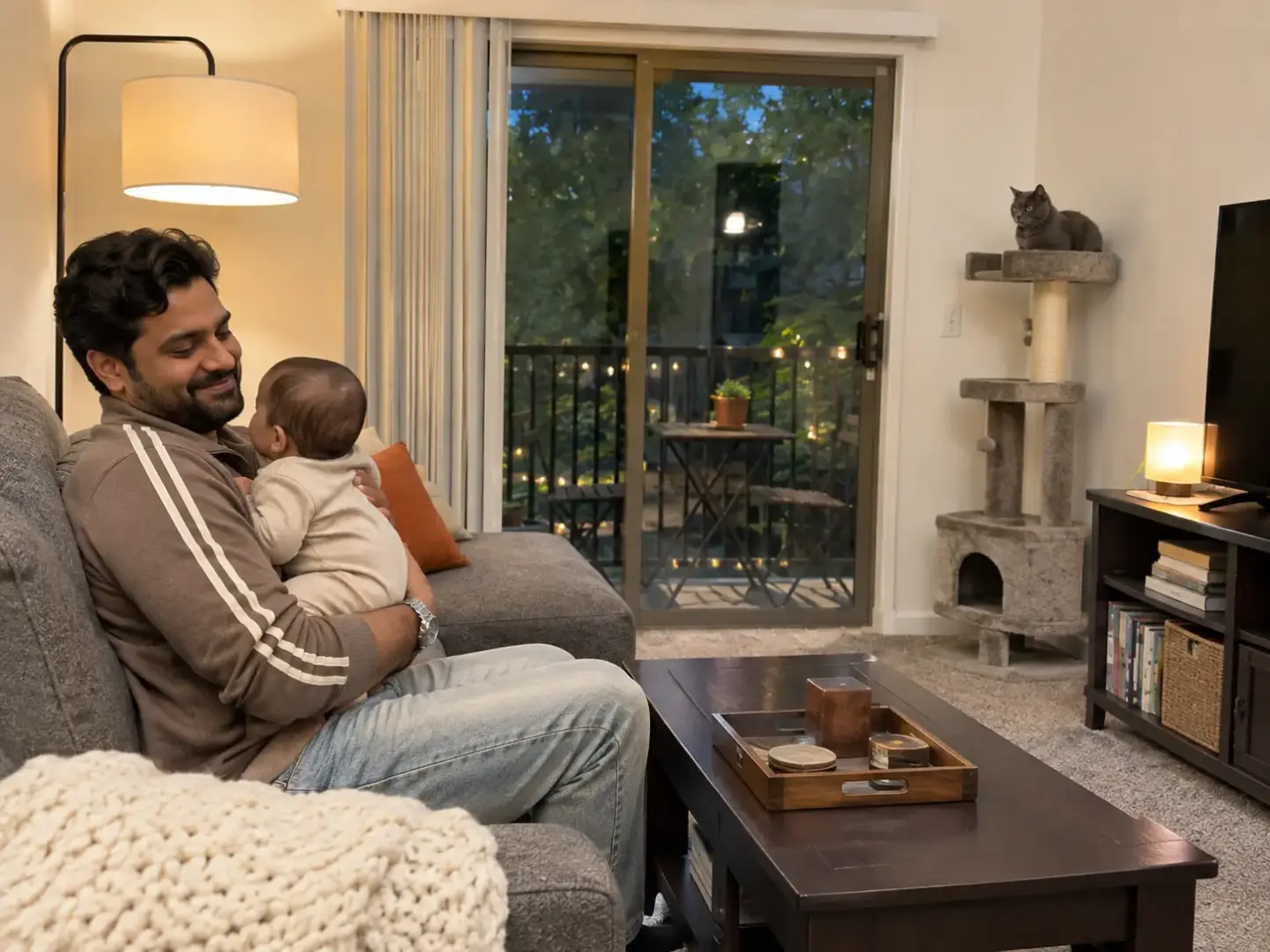
Startle: a baby moves like nothing the cat has met
A baby’s movements are jerky, sudden and uncontrolled, and the family-safety guide from the Victorian government notes that they can catch a cat unaware and make him defend himself. Cats Protection adds that unexpected noise can frighten a cat, and a baby’s cry is ordinary household noise that arrives at full volume with no pattern.
The swat that follows is a startle response, a flinch with claws, and when it repeats it gets called fear aggression, which is exactly what it is: fear. A fast, flapping hand can also wake a cat’s hunting instinct and prey drive, and that is play aggression more than anger: the pounce is real, the malice is not. The cat did not pick the baby. The baby arrived on his blind side.
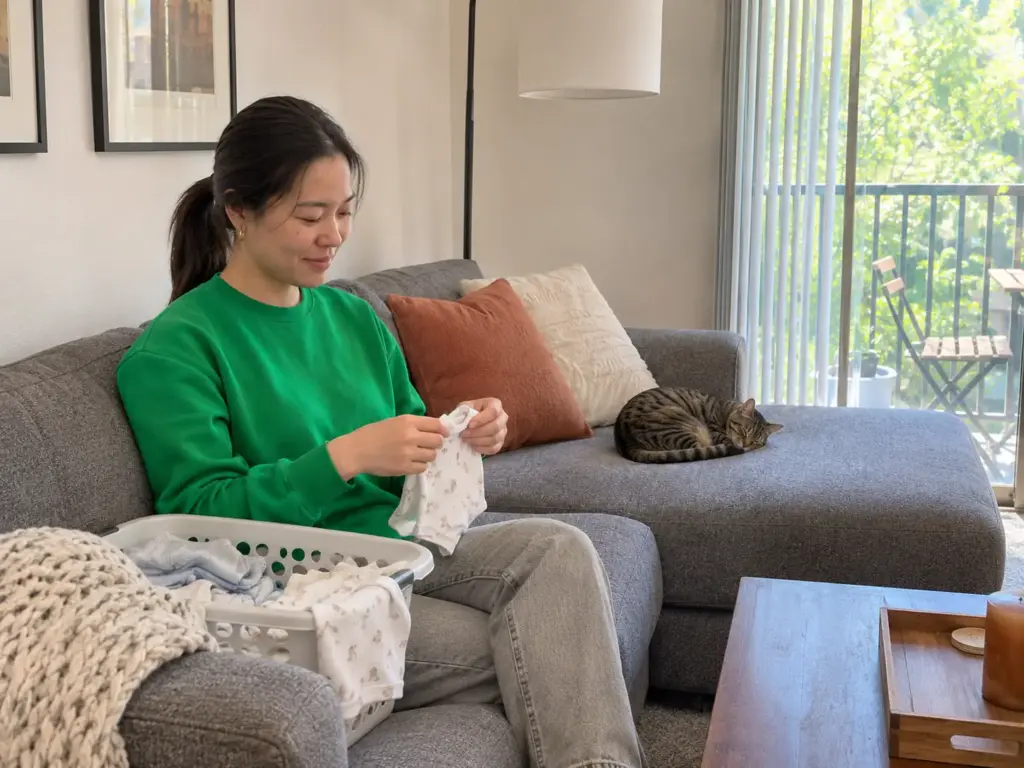
Grabbing and carrying: the handling that ends in a swipe
A crawler or a toddler grabs fur, ears and tails without meaning anything by it (a pulled tail, a squeezed middle: the mishandling behind most of what gets called mean), and a cat that feels threatened or hurt and cannot get away may bite or scratch (the same guide says so).
Adults have their own version: scooping the cat up to show him the baby, holding him still for a sniff, carrying him to another room when he did not ask to go. In each of those the swat works as a push, and what it says is put me down. The correction runs through the hands. The cat comes to the baby on his own legs, or he does not come.
Too much, and a target that moved: when something else sets it off
Other causes look like meanness too and are not. One is overload, or overstimulation: too much touch, too much noise, too many visitors leaning over the cat’s spot, until the paw is all he has left.
The other is redirected aggression. Something else winds him up (an outdoor cat at the window, the second cat, the buzzer) and the swat is redirected at the baby, because whoever is closest gets it, and a baby on a play mat is closest. It is the same mechanic as why a barrier works better than hands when a cat is already wound up, and it is the most common version in a home with two cats, where one cat’s hiss sets off the other and the baby is standing in the line.
Pain: the one cause that is not about the house
Pain and illness can make a cat shorter-tempered, International Cat Care and the AAFP both say, and no rearrangement of furniture touches that. This article does not try to read any sign of it. A cat whose own habits changed suddenly goes to the vet, and the section after this one says exactly when.
Everything else here is about the room. It also retires two labels that follow this question around, jealous and out to hurt the baby: a cat is a tenant guarding a spot, an exit or his own tail, and he does not run on rivalry.
Who to Call: the Vet, the Doctor or a Behaviorist
Some of this is not the house’s to fix, and each part has an owner. When the cat’s own habits shift all at once (eating, the box, grooming, hiding more than usual) and the swatting arrives on top of that, the first call is for a vet check, before a single thing moves in the apartment. International Cat Care words the rule this way: if a cat suddenly shows these behaviors when he did not before, or keeps showing them, contact your veterinary team. This article names that and stops there.
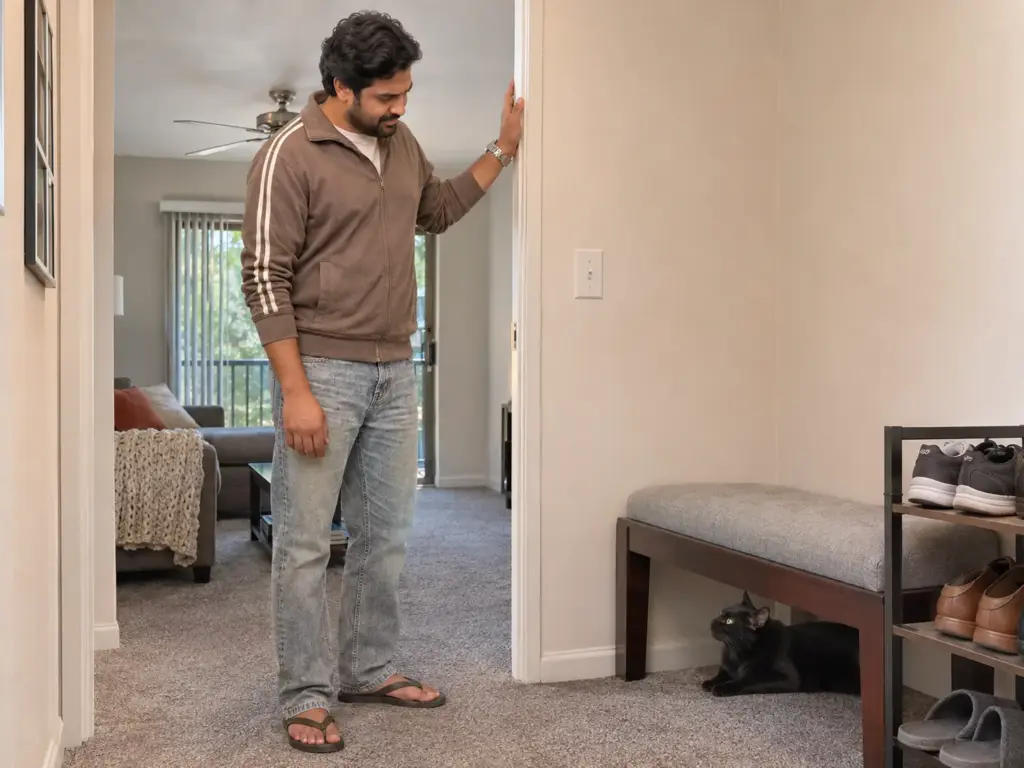
A bite that breaks a person’s skin goes to a doctor the same day, HSE Ireland says. A cat scratch is a different phone call, and the section on injuries further down separates the two. If the vet has cleared the cat, the house has been changed, and he still neither retreats nor gives notice, ask the vet to refer you to a qualified feline behaviorist; that referral is the usual road to one.
None of this reorders the work: the room comes first, unless the cat’s habits changed overnight. With two cats and a change in only one, that cat is the one who goes to the vet.
Before you call, write down the day the change started and what was different in the apartment that week: a new piece of furniture, a shut door, a visitor. It is what the vet will ask for first, and it is the detail people have lost by the time they are on the phone.
The Hiss Is the Last Warning, Not the First
Most households meet the hiss and assume the trouble started there. The cat had been asking for a while.
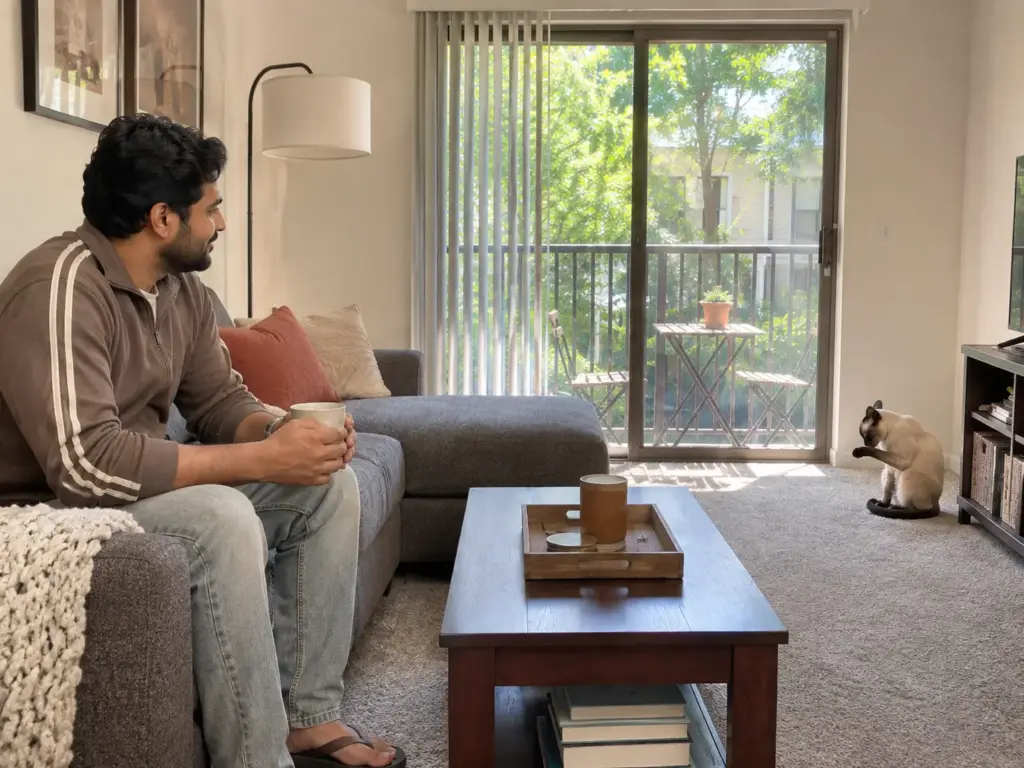
The ladder, in the order a cat climbs it
Cats give notice in a sequence, and how International Cat Care reads a cat’s warning signs lays it out in the order cats actually use. First he walks away, or turns an ear down or sideways. Then comes a fixed stare with wide, dilated pupils, then stillness or a low crouch, then a thumping tail, skin rippling along the back, lip-licking. Only after all of that does he growl, hiss or spit, and only after that does the paw come out, and then the teeth.
International Cat Care calls those last behaviors repelling behaviors and says they do not make him a hostile cat: they ask for the distance the earlier signs did not win.
Read it by the signs: flattened ears, tail flicking and then tail lashing, dilated pupils. Any one of those from across the room is the cat already asking.
A hiss sits at the top of the ladder, which makes it the last courtesy and not the first sign. By the time it comes, he has asked, politely and more than once, for room nobody gave him.
Why most households only meet the top rung
In a 2023 survey of 154 cats by González-Pech and Medina-Barrera, 62% of the aggression episodes were preceded by a vocalization or a change in posture, and 76.2% of owners judged the resulting scratches and bites as needing no medical review. Read the two numbers together: the cat warned, and the household filed what followed under nothing.
The same pattern shows up in homes. The first swat is a warning swat, a paw with the claws in or half in, and it gets read as the cat just saying something. The swipe that breaks skin is nearly always the second one.
And what the household does with the hiss decides what comes next. Scold it and the cat learns to leave out the notice, so the next swat arrives without one. Pick him up to calm him and you have made the single move that turns notice into a bite, because lifting is contact, and contact is exactly what he is trying to stop.
What to do at each rung, and what never to do
On what to do with a cat already showing those postures, the ASPCA is blunt: according to its guidance on what to do with a cat already showing those postures, “A rule of thumb is to not touch, attempt to reassure, or punish cats showing these postures!”
So move the baby, not the cat, and open the exit so the cat can leave without crossing anything.
Keep his routine steady: meals, play time and attention at their usual times, because a cat who loses those has fewer reasons to be patient. Reward calm when it shows up, a treat for the cat who stays loose while the baby makes noise across the room. And never punish a hiss, and don’t scold the cat for it either. With two cats, the second one is reading the first one’s notices too, and a hiss between them while the baby sits in the middle is the redirected swat from the first section with a target already in place.
The Date the Risk Moves Is the Crawling Month, Not the Birth

A newborn is furniture, and that is the easy month
A newborn does not move, reach or approach, so the cat has nothing to defend against and most households relax. That is fair, and it tells you very little about the month that follows. How the first weeks at home go, hour by hour covers that stretch, so it stays there.
Crawling changes the size, the speed and the reach
Hands-and-knees crawling starts at 8.5 months on average, according to WHO data reported by Kretch and colleagues in the paper that reports when babies start crawling, and why CDC dropped it.
From the 1st to the 99th percentile the range runs from 5.2 to 13.5 months, and 4.3% of babies skip crawling altogether.
The CDC took crawling off its milestone checklists in 2022 because it varies too much to count as one. Do not plan around 8.5, then. The crawling age is a spread more than eight months wide, and 8.5 sits in the middle of it. The baby at the early end is moving at five months, while the cat is still learning the old floor.
Watch the baby, not the calendar.
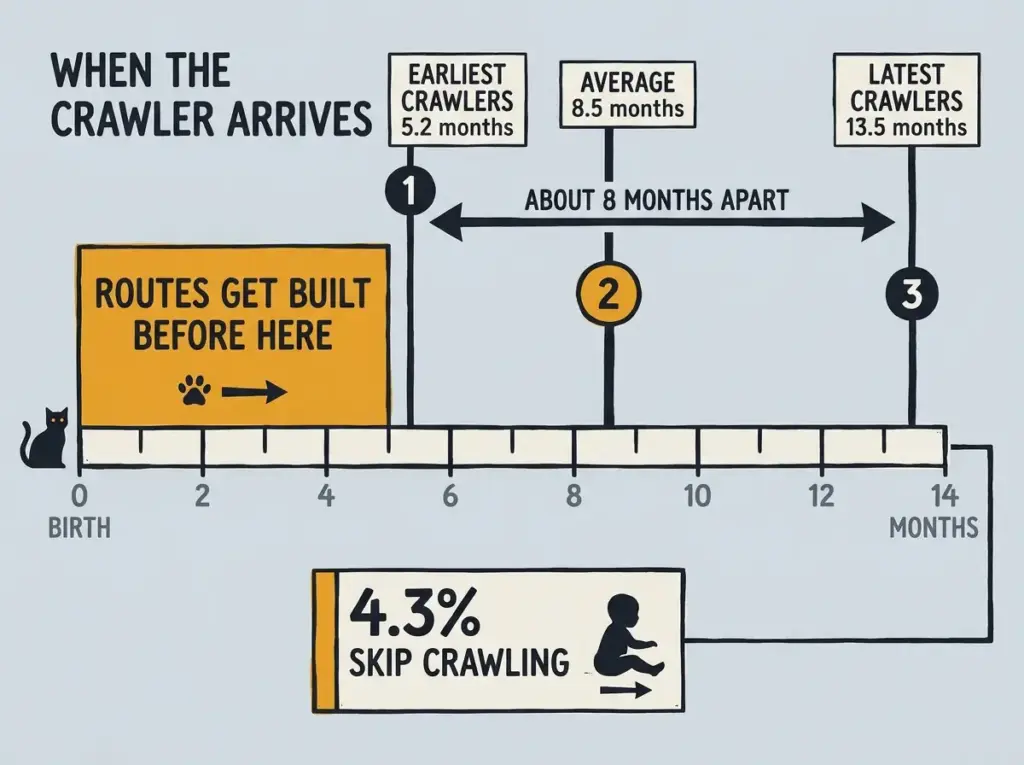
What changes when a baby gets mobile is that he can reach the cat, and the cat can no longer ignore him. The Victorian guide boils it down to mobility plus opportunity equals accident, and the grabs at fur, ears and tail start the week the baby can get there.
The cat who used to walk away has lost his guaranteed retreat once the floor belongs to the baby. A cat who was fine for months and then plants himself two feet from the play mat, ears back, swatting when the crawler comes toward him, is the same cat with new traffic on his floor. So build the routes before the early end of the range, before five months, and not the week the cat changes. The changes themselves are further down.
The toddler is the least popular person in the house
A survey of 865 families by Hart and colleagues found 32% of cats were very affectionate with adults and 27% with children aged 6 to 12, and only 14% with children aged 3 to 5. Aggression was more common in older cats, with a median band of 7 to 10 years. The cat that tolerated a newborn is not a preview of the cat that meets a three-year-old who runs, grabs and shrieks. It is the hardest stretch for the household, and it gets a second look when the time comes.
With two cats, the one who retreats most is the first to run out of places to retreat when the floor changes hands.
Two Ways a Swipe Happens, and What Supervising Is For
The cat that is carried, held or cornered
The first mechanism is a cat who is picked up, held down, boxed into a gap or carried when he did not choose it. His reach is short, and the swat is the push that gets him released. This one is fixed with the hands: do not bring the cat to the baby, and do not leave him in a gap with one way out and the baby at the mouth of it.
The cat that was warning from the floor
The second is the cat who has been signaling for a while from under the sofa, behind a door or beside the rug, and nobody at the baby’s height could read it. What looks like an ambush from under the sofa is usually a cat who ran out of rungs. This one is fixed with the house: a clear floor, a way out that does not run past the baby, and an adult close enough to see the cat.
Height matters here more than people expect. Children from 0 to 14 are 20.1% of the recorded cat-bite victims and carry 1.37 times the risk of the rest of the population, and in children the head and neck are hit far more often than in adults, as the study that counted who gets bitten, and where reports. The cat is not aiming at a face. A child’s face and a cat’s paw are at the same height.
A scratch and a bite are not the same phone call
A cat scratch is a surface injury. A cat bite punctures, and the skin can close over the hole, which is why a bite that breaks a person’s skin is a question for a doctor the same day (HSE Ireland names it so), not a question for a piece of furniture. This article says nothing about what to do with the wound itself. That belongs to the person who treats it.
What watching is for, and the gate for the minutes you can’t
Cats Protection and HSE Ireland both say a baby and a cat are never left together without someone watching (never unsupervised, not even for a minute), and that rule only turns into something you can keep once you know what the watching is for: seeing the notice before it becomes the paw. An adult in the room, looking at the cat and not the phone, catches the stare, the turned ear, the still crouch. The room where the baby sleeps is a separate rule with its own page, the rule about the room where the baby sleeps.
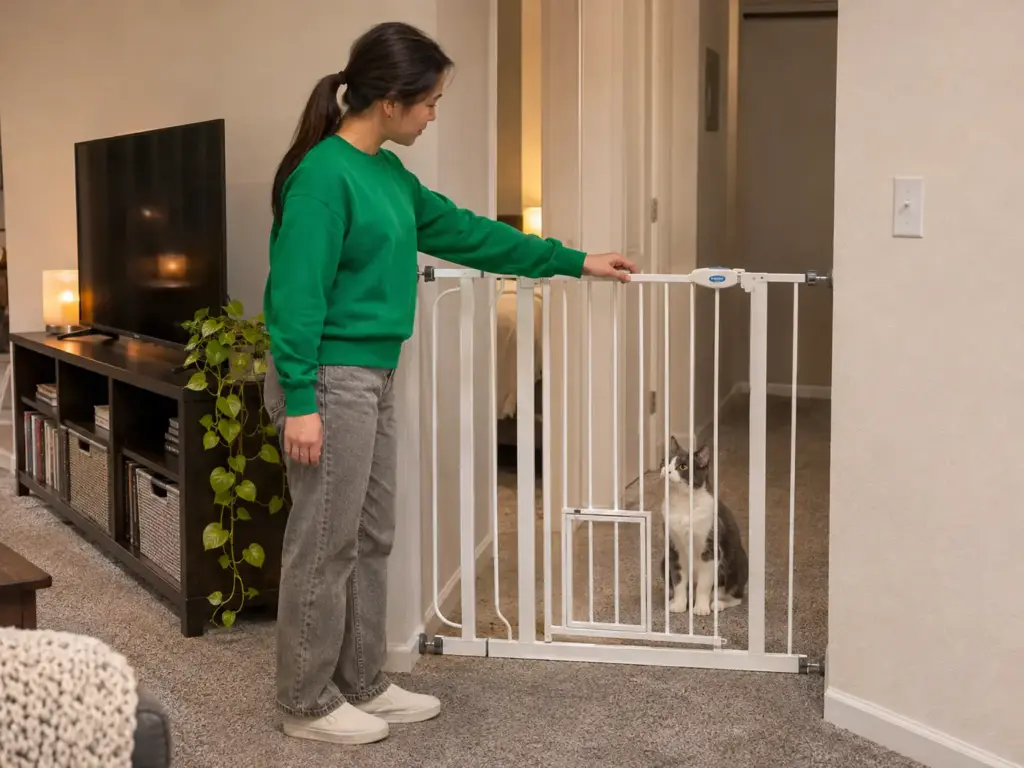
Watching has gaps: the bathroom, the phone, the kettle. For those minutes, put something between them that is not a person. The free option goes first, a door that already closes and the hallway you already have. Where the doorway does not close, a baby gate with a cat door covers the gap.
The Carlson Extra Tall Walk-Through Pet Gate with Small Pet Door (Amazon) stands 36 inches tall and fits openings from 29 to 36.5 inches by pressure, so a rental’s doorframe stays untouched, and its 8 by 8 inch pet door is one the cat uses and a baby rarely tries.
Rarely, not never: the pet door is wide enough for a determined crawler, so the latch is a daily habit and not a fitting, and the 16.5 inch human door and its latch are narrow enough that some units give out within a couple of months. How to pick a gate with a cat door for a rental doorway measures the options properly.
Before you put the baby down on the floor, get down there yourself and look at where the cat can go from his spot. If his only way out passes through the baby, that is the first thing to change.
A Route Up, a Door That Is the Cat’s, and a Hide No Crawler Reaches
Free first: the route the cat already uses
Start with what the cat already has. The back of the sofa, a wall shelf, the top of the wardrobe: the route he uses is not covered or moved, and the gap under the table and the corner behind the door do not get filled with baby things. A cardboard box on its side with two holes cut in it counts as a hiding place. In a small apartment the route is also an exit, and why a small apartment comes down to exits explains why losing one is the quiet cause of a lot of trouble.
The usual advice is a baby-free room for the cat. In a one bedroom apartment where the only door that closes is the bathroom’s, that room is a corridor, a gated alcove or the bathroom itself, and what matters is that it holds the cat’s things and keeps the crawler out. A cat-only room is the cat’s safe room, not his punishment.
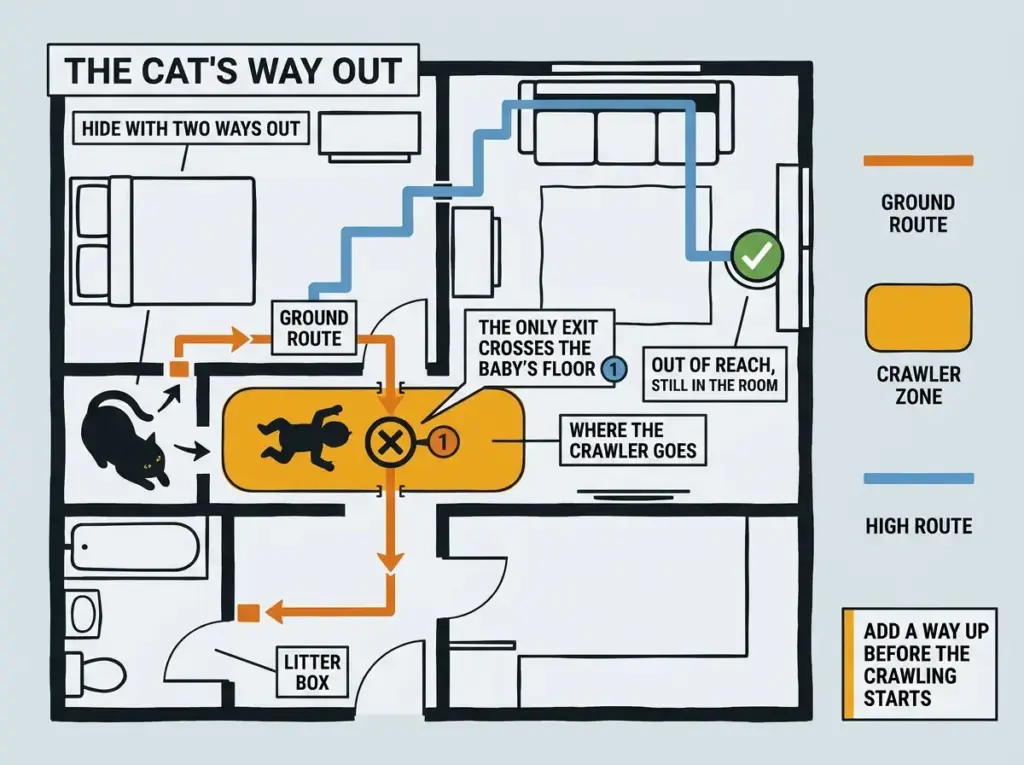
The cat’s only way out running across the crawler’s floor is the usual shape of the problem, and a high place he reaches without crossing the floor takes him out of it.
A way up that does not move when the cat lands
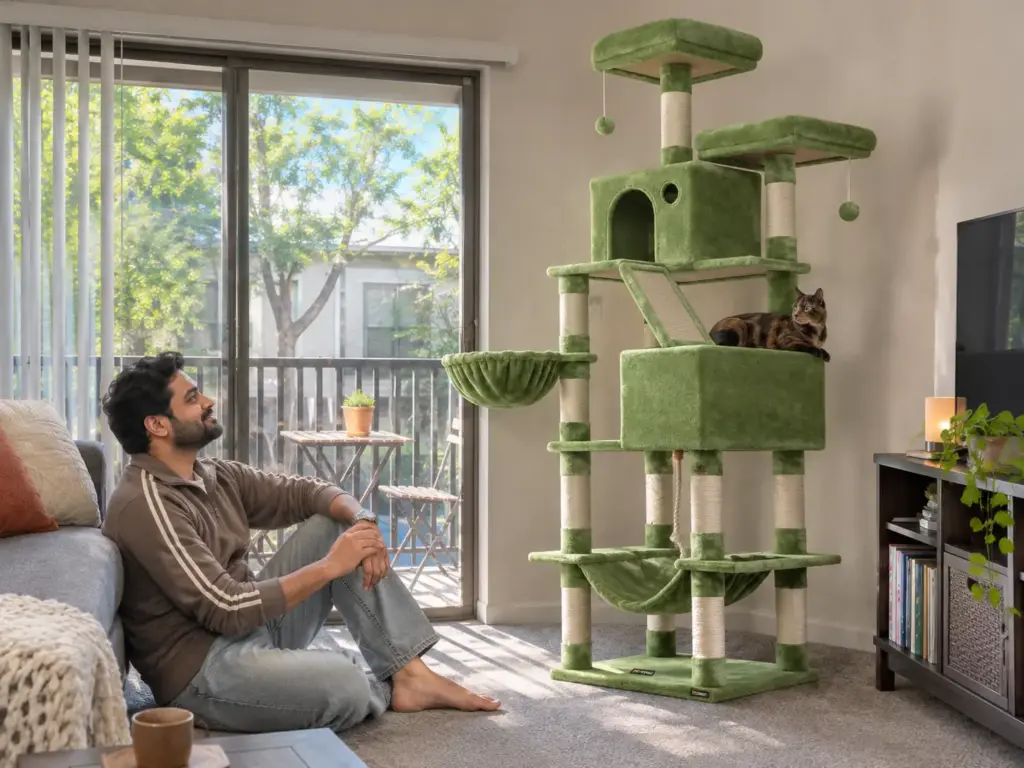
A way up is a measurement, not a mood. It has to be sturdy, it must not move when the cat lands, and it has to reach above his full stretch, which is the AAFP’s standard for a post. The steps matter as much as the height: levels 12 to 16 inches apart let a cat walk up and not launch himself. Measure it from your cat.
The Feandrea Cat Tree 81.1 inch (Amazon) is the tall tower at the budget end: 81.1 inches, five levels, 12 to 16 inches between them, and a base of 23.6 by 19.7 inches that fits a corner. Its flaws are real. It sways toward the top, the fabric wears through, and the per-cat limit of 15.4 pounds is less than a very large adult cat weighs. The anti-tip kit is not optional, and it needs a screw into the wall, which in a rental is a conversation with the landlord.
That is the pick everybody names, and for a big cat it is the wrong one. For a heavier cat the PAWZ Road 72 inch Cat Tree (Amazon) is built for large cats: 72.4 inches, eight levels, a 20 by 16 inch hammock, seven scratching posts, and a 21.6 by 17.7 inch base with no drill. Its size divides opinion, durability is mixed, and it is the costlier of the two, so a cat under that Feandrea limit is as well served by the cheaper tower. Whichever you choose, the build is the one used for a landing shelf and two exits in a house with a dog: a place to land and a second way out.
A window perch when the floor is spent
When there is no floor left to give, the way up goes on the glass. The K&H EZ Mount Kitty Sill (Amazon) is a 23 by 12 inch platform that hangs on suction cups, for windows 27 by 23 inches or larger, folds up behind the curtain and needs no wall to ask about. It is a lookout a crawler cannot reach. The suction cups are the uneven part: some windows hold for months and others let go, and a cup that lets go at the wrong moment drops the cat, so it is not the perch for a cat that launches himself.
A hide with two ways out
The AAFP describes a safe place as big enough for one cat, with sides, raised off the ground and enterable and exitable from at least two sides, one per cat. A hide with one hole is a trap with a lid: the cat has to leave without passing the thing he is hiding from. The AAHA and AAFP guidelines put the need plainly, in the AAHA and AAFP line on why cats need places to rest and hide: “Cats develop patterns of resting and hiding in the home that should be complemented by a variety of appealing places.” With two cats, that is a hide each, and a route with exits at both ends, because in a hallway one of them ends up cut off the moment the baby comes through.
Before buying anything, move the piece of furniture the cat already climbs, and clear what is blocking it, instead of covering it up. A cat uses what he already uses, and that alone settles more of this than any tower.
What the Label Costs the Cat, and the Changes That End It First
The road that starts at a shut door
The same road shows up in home after home. The bedroom door is shut at night, the cat calls at it, and within weeks he is urinating on it. From there come the vet visits, the diffusers and the specialists, all of them aimed at the cat and none at the route he lost.
A cat who starts urinating at a door goes to the vet before anything else changes, and what the house adds on top of that is the lost route. He did not begin that way. It began the week the baby started to move and the whole house changed its rules without giving him a new one.
What ends nearly all of it is a cat-only room with food, water, a box and something to climb; a closed door for the nursery at night, not for the whole apartment; a high route that stays open; and hands that never chase. That costs placement before it costs money.
What a diffuser can and cannot do
FELIWAY is a pheromone diffuser, a synthetic copy of a cat pheromone, and the AAFP describes how it can mimic a cat’s natural pheromones and give a calming effect. The review of what pheromone products can and cannot do finds that results on stress have been mixed, and that much of the evidence is funded by the industry. The FELIWAY Classic Diffuser Kit 48 mL (Amazon) is one diffuser and a refill that lasts 30 days and covers one room, with 4 feet of clear space around it, venting upward.
It is small, cheap and non-sedating, and it changes nothing about where the cat can go. In some homes it does nothing, in some it fades within days, and a minority notice a burning smell.
Try it while you fix the placement, never instead of fixing it. What a pheromone product does and does not do when two cats are tense goes further on it.
The box and the bowls are the cat’s places too
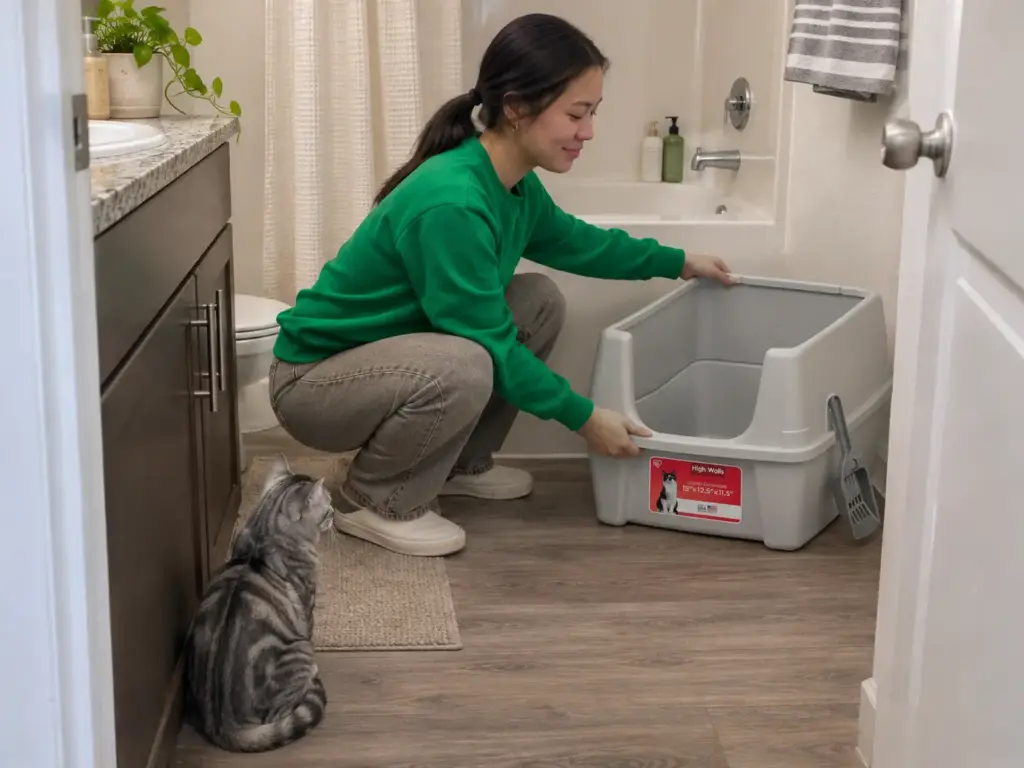
When the box sits on the floor the baby crawls across, the first thing the crawler finds is the box. Then the box moves to the cat’s room or behind the gate with the cat door: a litter box out of reach of the crawler, and the bowls with it. The AAFP’s rule is one box per cat plus one, in different places and not all on the same floor: two boxes pushed together are one box. Where a litter box actually fits in a small apartment works through the options, and whether the bathroom can take the box covers the one room a one-bedroom may still have to give.
The IRIS USA Large High Sided Litter Box (Amazon) is 19 by 15 by 11.75 inches, open on top, with tall walls against scatter. It can sit in view without throwing litter across the room, and it is easy to move into a room the crawler does not reach. But 19 inches of length is short for a cat much over 12 pounds, the 11.75 inch wall is a step for a senior cat, and some lids do not stay put.
The label comes before the surrender
Cats Protection says rehoming is the question parents ask, and that the answer is usually no. This article does not take that for granted.
If the cat’s own habits changed, the vet comes first. If a bite broke skin, a doctor comes first. What changes the answer after that is the house, not the word.
If the cat starts calling or urinating at a door, look at the route he lost first, and call the vet if the habit changed overnight. Neither one gets fixed by shutting more doors.
Read the Low Rungs, Build Before the Crawl, Call the Right Number
A cat gives notice long before he acts, and your part is to read the low rungs of the ladder, not wait for the hiss. The risk moves the month the baby crawls, which can be anywhere from about five months to thirteen, so the routes go in before the early end of that range. A change in the cat’s own habits is the vet’s before it is the apartment’s, and a bite that breaks skin is a doctor’s. Everything else comes down to where the cat can go, and that is placement.
Look at the house again from the floor the week the baby starts to scoot, and once more when he pulls up to stand on the sofa. For the three-year-old, look the day he starts chasing. Those are days and weeks, not months.
Today, lie down on the floor at the cat’s eye level and look at the room from his side: where he can leave without crossing the spot where the baby will be.
Frequently Asked Questions
01Are cats mean to babies?
No: a cat that swipes or hisses at a baby is almost always startled, handled, overloaded, wound up by something else or hurting, and the hiss is a warning, not the first move of a fight. Placement and calm hands fix most of it. If the cat’s own habits changed suddenly, call the vet first.
02Can cats be around babies?
Yes, with someone watching, a route out for the cat and a floor he does not have to cross to leave. Cats Protection says cats are not typically hostile and tend to retreat. The risk moves when the baby crawls, about 8.5 months on average.
03Why does my cat hiss at my baby?
Because he asked for distance first and did not get it. A hiss is the last warning before a swat. Do not scold him or pick him up: move the baby and open the cat’s way out.
04Is it safe to leave a cat alone with a baby for a minute?
No: Cats Protection and HSE Ireland both say they are never left together without someone watching, and watching exists to catch the warning before the paw. When you cannot watch, close a door between them.
05Should I rehome my cat if it scratched my baby?
Do not decide after one swipe: the vet comes first if the cat’s own habits changed, a doctor comes first if a bite broke skin, and most of the rest is the house. Cats Protection says the answer is usually no.
Leave a comment