Cat Out of the Crib? Rail Height Can’t Help, a Door Can
Keep your cat out of the crib without a taller rail: the door that holds, a month-early [cardboard & tape] layer, and a perch above the rail.

Alfredo RamsesFounder · November 16, 2026 · 19 min read

On this page9 sections
- 1Getting a Cat Out of the Crib Is Not a Height Problem
- 2When It Stops Being a Crib Problem
- 3What Each Barrier Does on the Third Night
- 4Why the Closed Door Beats the Net and the Tent
- 5No Door to Close: A Screen, a Gate, and a Rental
- 6A Perch Above the Rail, Where the People Are
- 7Two Cats, One Crib, and the 4 a.m. Door
- 8Close the Door, Clear the Shelf, and Look Again When the Room Changes
- 9Frequently Asked Questions
The crib is built, the fitted sheet is on, and the cat is already curled in the middle of the mattress, exactly where the baby will sleep. Getting a cat out of the crib is not about jealousy or about taming him: he found the warmest, highest, best-smelling bed in the apartment, and it is the one piece of furniture you cannot make taller, since the crib standard asks for at least 26 inches of rail above the mattress support and a cat clears five feet from a standstill. What holds is a closed door while the baby sleeps, a mattress that feels wrong to him a month before the birth, and a perch that beats the rail in the room where the people sit. The sections below take each barrier in the order it holds up and say which one has no way to fail.
Quick Answer
A crib cannot be made taller than a cat can jump, so the plan runs on access and on surface, in this order:
- Close the door while the baby sleeps, or screen off a doorless room.
- Cover the empty mattress with cardboard and double-sided tape a month before the birth.
- Remove that sticky layer before the baby’s first night in the crib.
- Put a perch above the rail in the room where people sit.
- Keep foil, tape, nets and the cat out of the crib with the baby.
Getting a Cat Out of the Crib Is Not a Height Problem
Every fix that works for a litter box or a scratching post works by changing a height, and the crib is the place where that habit stops paying. The cat is not scheming; he found the best bed in the apartment, and the guide to sharing a small apartment between cats and kids already covers why a crib wins that contest. This piece is about the one object.
Twenty-six inches of rail against a five-foot jump
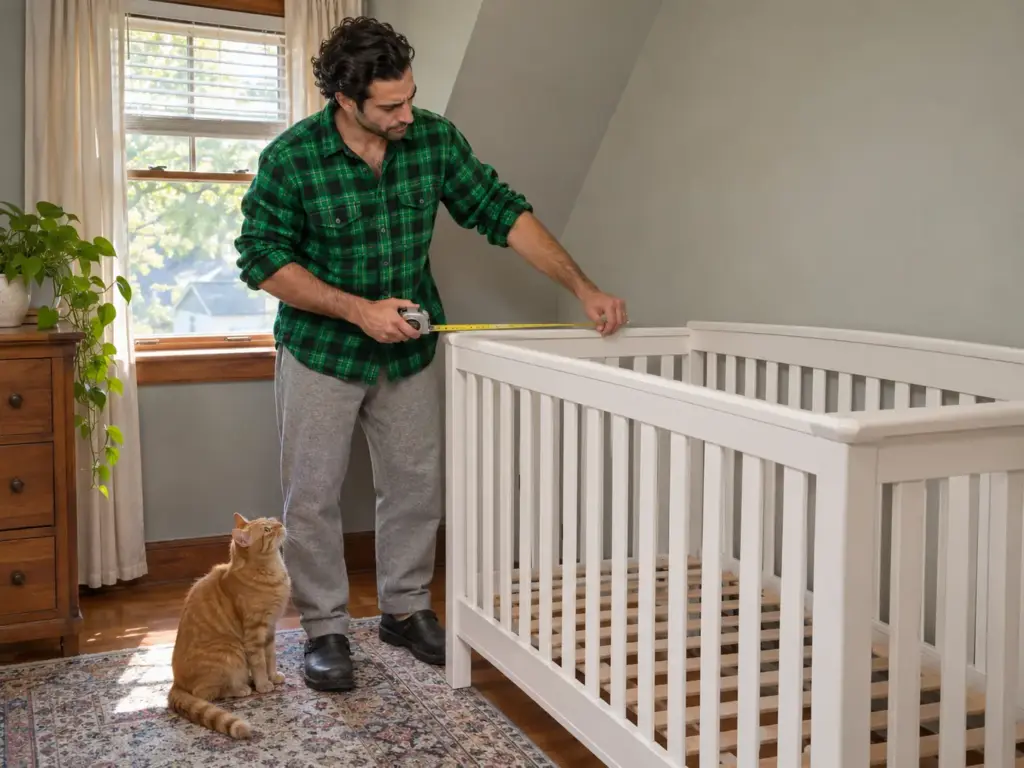
Under the full-size crib rules the CPSC enforces, the top of the rail must stand at least 26 inches above the mattress support, measured with the rail at its highest and the support at its lowest (that is the ASTM F1169 standard, made mandatory). The inside measures 28 inches by 52 3/8 inches, a flat, soft, raised platform about the size of a coffee table with a view of the whole room. A cat clears five to six feet from a standstill, and the rail on a typical crib ends up somewhere around three feet off the floor, so for him it is a ledge on the way in and not a wall.
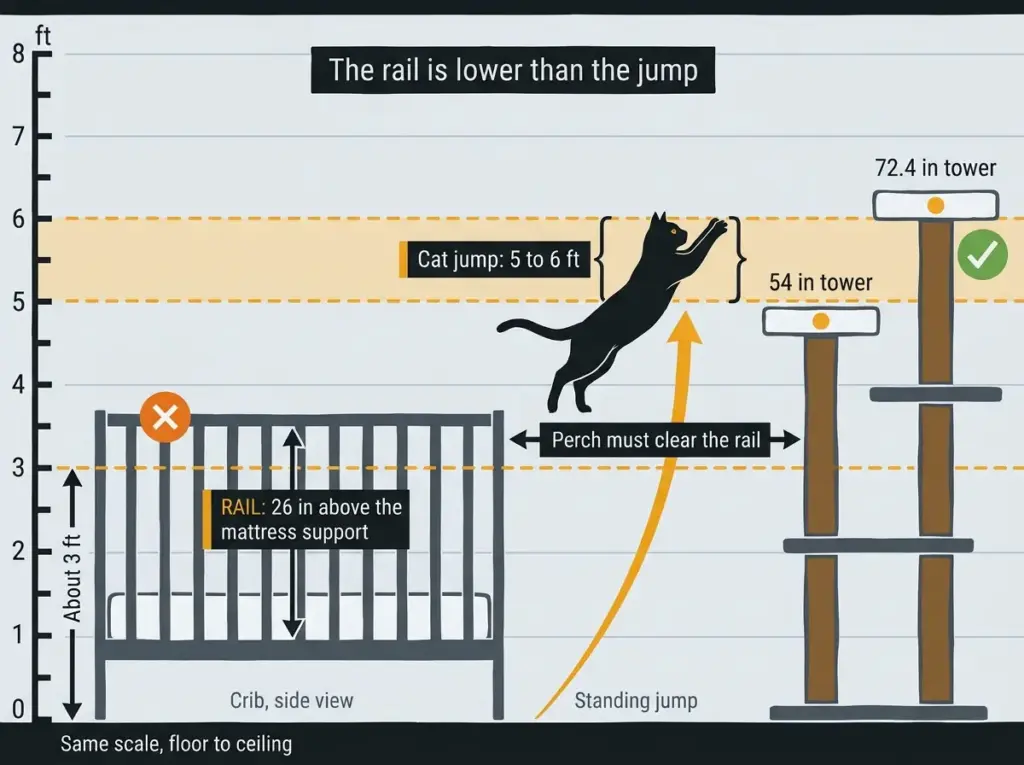
That 26 inches is a floor, not a ceiling, so no crib can be shorter. And it kills the move that works everywhere else in the apartment: a taller box, a taller post, a higher bowl.
There is no taller version of the crib that fixes this, which leaves two levers, what the surface feels like when he lands and whether he can reach it at all. Measure yours before reading on: floor to the top of the rail, with the mattress at the setting you use. That number comes back in the perch section, because it is the one a perch has to beat.
The mattress drops as the baby grows, the rail does not
For the first months the mattress sits on its highest setting, close under the rail (the standard asks for at least 9 inches of side above it there), which makes it the shallowest landing the crib will ever offer. Lowering the support as the baby grows makes the inside deeper and does nothing to the rail’s height from the floor, so the jump he has to make never gets harder with the months. Plan for the crib to be as reachable in month eight as in week one.
A warm spot or a lookout: which cat you have
A cat goes into a crib for three things: warmth, height and the smell of the people who sleep there; cheek rubbing on the rail or the sheet is the same smell claim. The one that wants the mattress is after the warmth and the smell, and the one that wants the rail is after the height and the view, though most want both. It reads as a lost claim on a resting spot, not jealousy, and that guide gives the longer reason. For this plan the split sets the weighting: the surface and the door for the first cat, the perch for the second.
One rule here belongs to its owner and is not ours to explain. The ASPCA’s own crib advice says a newborn cannot turn over or even move her head at first, and that a heat-seeking cat who curls up against her face could make it hard for her to breathe. Everything that follows is built around that sentence.
When It Stops Being a Crib Problem
If your cat’s habits change from one day to the next, that is a question for the vet before it is a question for the house. A box he stops using, a bowl he leaves half full, hiding more than usual, marking, grooming until the fur thins: describe what you see to the vet and let the vet read it, because nothing here does. The pregnancy months and the first weeks with a newborn are crowded, so the call is easy to postpone, and it should not wait.
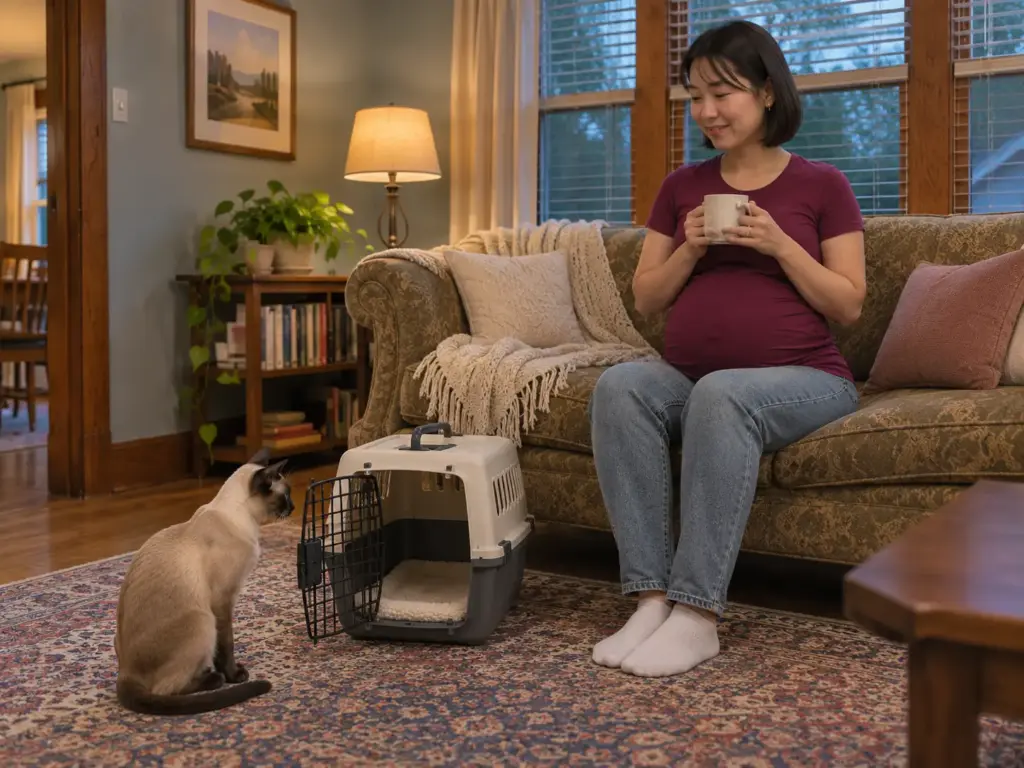
The house comes next, once that is covered. If the litter box lived in what is now the baby’s room, move it a few inches a day, as the ASPCA’s advice on moving the litter box a few inches a day puts it, and the guide on whether the bathroom can take the box when it has to leave the second bedroom helps pick where it lands.
And do not send him to the back room or the basement. A cat pushed out of the family’s circle is the one that starts marking and grooming too much, and those habits outlast any liking for the crib. The nursery door shuts the baby’s room, not the house.
If he has already been in the crib before the baby arrives, that is a cat inspecting a new room. Do the surface work in the next section early and skip the scolding, which teaches him to avoid you and not the crib. A cat that ignored the old crib for years will often claim it again the week the room is rebuilt, because moved furniture is new territory, so expect a second look at the finished room.
What Each Barrier Does on the Third Night
Foil is a startle, and by night three it is a toy
Foil comes first because it is the free one in the kitchen drawer. Laid across the mattress it startles a cat the first night, and by the third it is a sheet that crackles under his paws and gets batted around. It costs next to nothing and holds about as much, and nobody with authority publishes a success rate for it, so treat it as a first-night trick and the backup plan, never the plan.
The oils sold as deterrents are the ones that are toxic to cats
Citrus and peppermint oil are the scents sold hardest as cat deterrents, and they sit on VCA’s list of the essential oils that are toxic to cats: cats have fewer of the liver enzymes that break them down, and an active diffuser puts droplets on a coat. In a nursery, running all night beside where the baby sleeps, that is the wrong tool in every way, so the oils stay out.
Scolding teaches him to avoid you, not the crib. A sonic device is built so that you cannot hear it, which means you cannot tell whether it works. A motion-sensor spray fires at whoever walks in, including the adult doing a night diaper change. None of them earns a place here, and none gets a product.
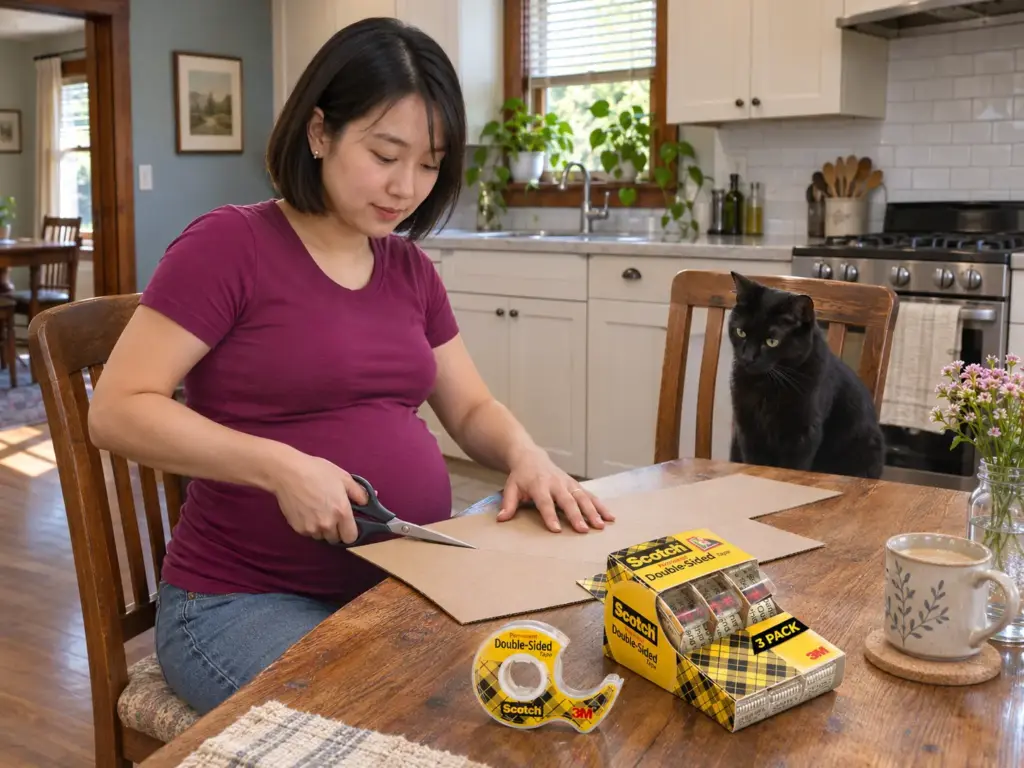
Cardboard and double-sided tape, one month early
The only method with an owner and a clock is the ASPCA’s, and it counts backward from the due date. The room goes up early and stays open to the cat for several weeks, while it is still boring. At least a month before the birth, a sheet of cardboard cut to the surface goes into the crib sticky side up, and onto the changing table too if that is a landing spot. The litter box moves a few inches a day if it was in there, and the cat’s care routines pass to whoever will keep doing them one to two months before the birth.
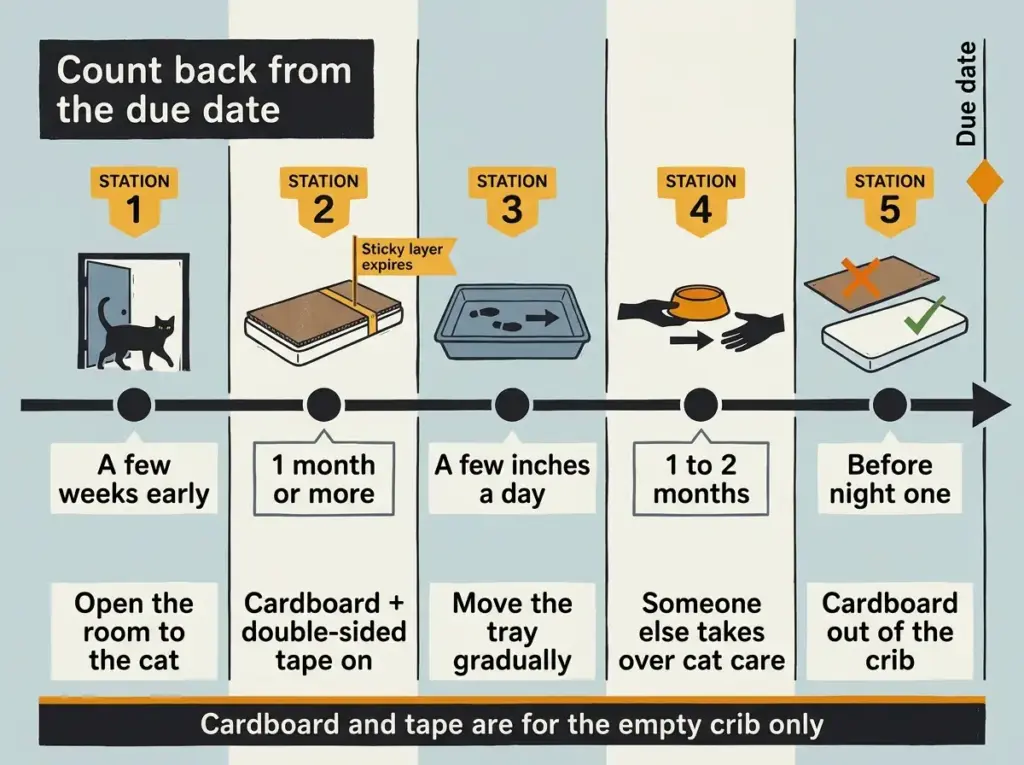
The ASPCA says it plainly: “Cats tend to avoid sticky surfaces, and by the end of the month should learn to steer clear of these sites.” The month is the part that gets skipped. Put down the weekend before the birth, the layer has no time to teach anything, and the method gets written off.
The cardboard is a delivery box. The only thing to buy is the tape, and Scotch double-sided tape (half an inch wide, 250 inches a roll, three rolls to the pack) is the half of the method that sticks. Its weak point is the adhesive: cat hair and dust settle into it, and after a few weeks it stops gripping. That is tolerable, because the layer only has to last the month and then it comes out, but replace any strip that has gone furry.
Write the removal date on the cardboard in marker the day you lay it down, a day or two before the due date. A sticky layer is easy to forget in a room you are busy finishing, and the date on the sheet is the reminder.
The rule that governs all of it: the cardboard-and-tape layer is for the empty crib. The American Academy of Pediatrics is blunt in its safe sleep guide about what goes in a crib: “Use a fitted sheet only—nothing else should be in the crib with your baby.” Nothing in the crib is the rule, so the cardboard and tape come out before the first night, and the foil with them. Every method in this section expires the day the baby sleeps there, and the door, covered below, is what stays.
Why the Closed Door Beats the Net and the Tent
The tent the ASPCA suggests was recalled
For a nursery with no door, the ASPCA suggests a temporary screen door or a crib tent over the crib. The tent half has a history. In 2012 came the 2012 recall of about 330,000 crib and play-yard tents from one maker, Tots in Mind: 27 failures between January 1997 and April 2012, one of them fatal and one a catastrophic brain injury, with the hazard being a dome that could invert inside the crib. The company no longer exists, so there is no repair, and the CPSC told parents to stop using the tents immediately.
Nothing in that notice says a cat caused any failure. What joins the recall to this article is what it describes, a dome over the mattress that gives way inward, and what a cat does when he lands on one. The AAP’s rule closes the other side, since a tent, a net or a crib cover over the sleep space is one more thing over it.
So the advice that sounds like the neat workaround is the part to skip. A mesh net, the mosquito-net kind over a bassinet, holds for a few days, until the cat works out that it is a lid, climbs on, collapses it and sleeps in what is left. And a cat that has proved the route teaches the second one.
What the first week behind a closed door sounds like
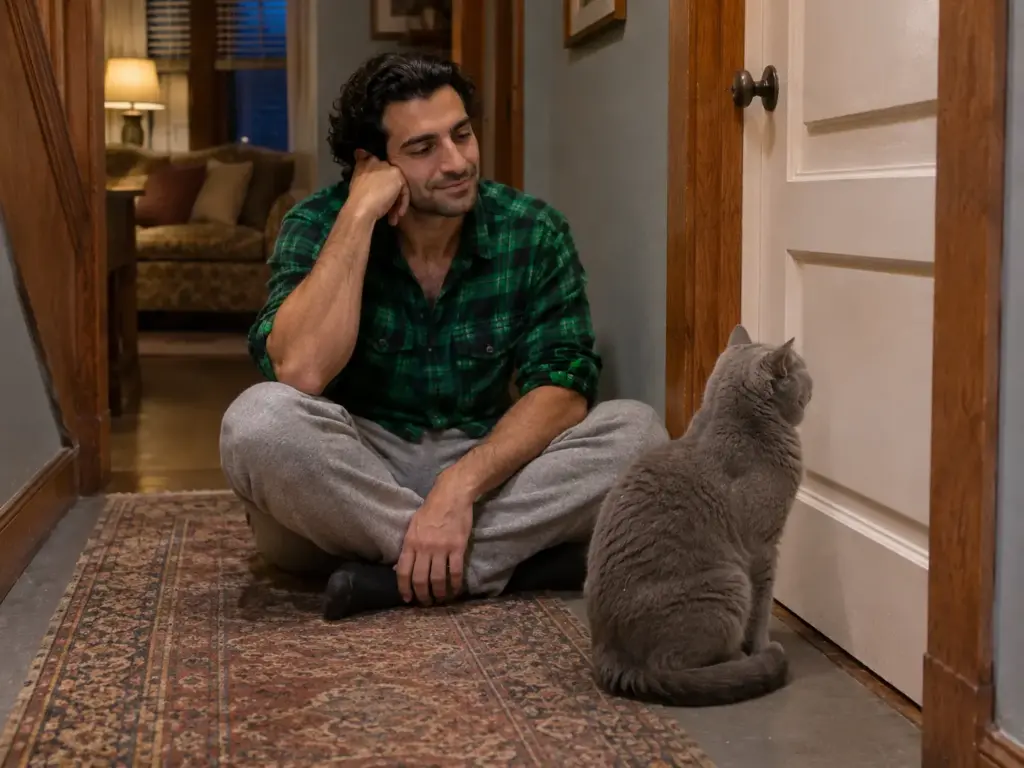
A closed door has no failure of that kind: it hangs over nobody and cannot give way. Its cost is the first stretch. Expect a week of singing at the door and a cat who throws himself at it in the middle of the night.
What gets a household through is white noise loud enough to cover the meowing and a baby gate in front of the door so the claws land on metal and not on the wood. Most cats stop in about a week, and give up on the midnight diaper change somewhere around two.
Open the door in a quiet gap, never in answer to the noise. A door that opens for a yowl teaches the yowl, and the week of protest turns into a month.
The same closed bedroom door, and what the first week of protest looks like, is laid out in the guide on keeping a cat out of the bedroom for allergies, down to the two-cat version.
The first six months, the door is your bedroom door
The AAP recommends sharing a room, not a bed, for at least the first six months and, if you can, up to twelve. That changes which door it is. The crib or bassinet sleeps in your room, so the door that closes is the bedroom door, and the cat ends up outside the room where the household sleeps, away from the people who smell most like home.
The answer is not to leave it open: it is the perch below, in the room where people sit, plus the routines he already had: the same play time and the same attention at the same hours. And the door is only the sleeping-hours barrier. What happens at nap time once the baby is home has its own guide, so the door here stays a bedtime question. The door that is already hanging in the frame goes first, before anything is bought.
No Door to Close: A Screen, a Gate, and a Rental
A folding screen where the doorway has no door
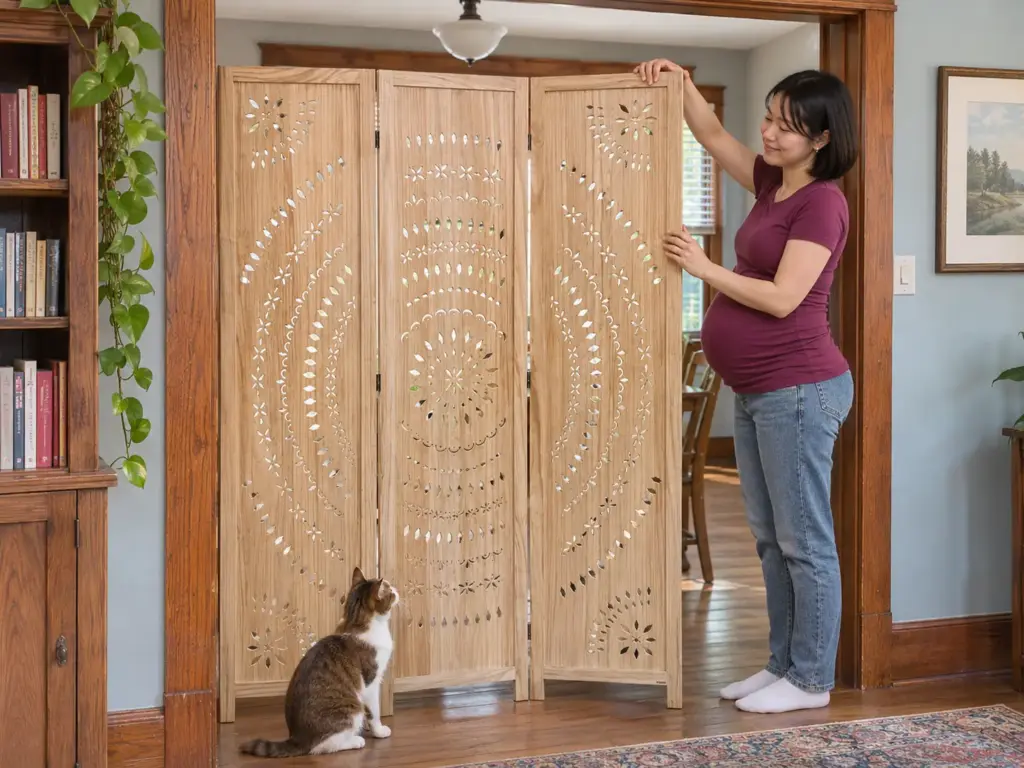
The second-bedroom rental is the usual setting: a doorway with no door, or one the landlord will not let you screw a screen door into. Telling that reader to close the door leaves them stranded. A 5.6-foot three-panel folding room divider, 66.9 inches tall and 47.2 inches wide, stands by itself with no screws and no frame, so nothing in it will worry a landlord. It stands taller than the five-foot jump, but not taller than six.
Its flaw is in its name: it is a screen and not a door. The panels meet at open hinges, so there is a gap to walk around at each end, nothing anchors it to the wall, and a determined, athletic cat at the top of the jump range can clear it. When you set it up, check that it spans the opening wall to wall with no gap he can slip through sideways and no ledge he can climb. It is the step down from a door, not the equal of one.
A tension gate, and why it is the part that takes the scratching
A pressure-mounted gate in front of the doorway puts metal where the claws land, with no holes in the frame. A standard gate is not what stops him, since he clears it, but it spares the door and the paint. For sizing one, the guide to a pet gate with a cat door, sized to the cat’s chest shows how a gate is measured; for this job, skip the version with a cat door in it.
The apartment where no room closes
In an open-plan apartment the plan moves to the sleep space itself: the cardboard layer while the crib is empty, and a perch where the people are. The night barrier is the weaker half, because there is no door and nothing hangs over the mattress, so this is done with months of lead and not days. If any room closes, the crib sleeps there, even if that means your own bedroom for the first months, since the room with the door is the room with the plan. The guide to an apartment with no door to close covers the open layout from the other side.
A Perch Above the Rail, Where the People Are
Taller than the rail, with something soft on top
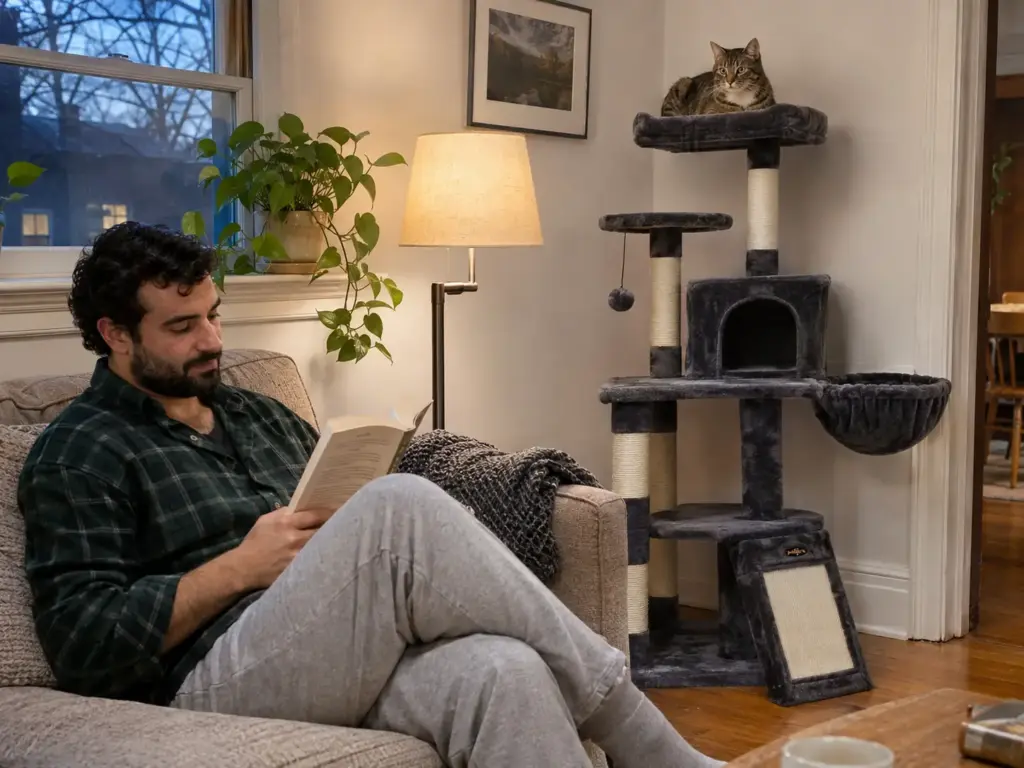
Give him what the crib was giving him, which is height and a soft place, plus vertical space that is his. The free version is a high shelf already on the wall: clear it and fold a blanket on top, and measure it against the rail before anything is bought. A cat with a spot of his own is the one that loses interest in the crib.
The number to beat is the rail, about 40 inches from the floor on a typical crib, and the perch has to be reachable without crossing the crib. A short post that stops under the rail does not beat it, and fails a cat that is already looking at the rail. What wins is height plus softness: a padded platform, not a bare pole.
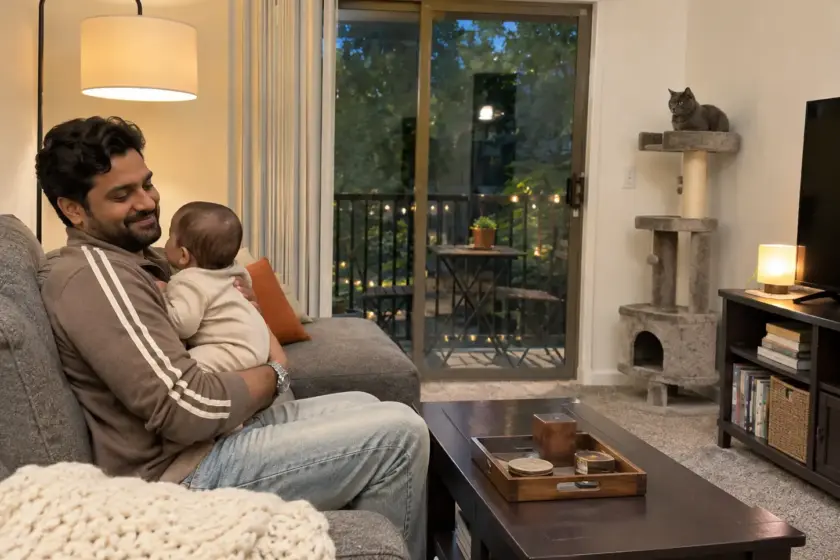
A 54-inch tree like the FDW 54-inch cat tree, 19 by 19 inches at the base, puts its top post well above the rail and brings both things back. Assembly takes patience, how sturdy it stands is worth checking once it is built, and the platforms are small for a big cat.
Rub the top pad with a blanket from the sofa before the perch goes into the room. A pad that already smells like the household is a better substitute for the mattress than a clean one.
In the room where you sit, not in the nursery
Put the perch where the people are, in front of the television or beside the desk, and not in the empty nursery. A perch in a room nobody uses asks him to choose loneliness over the family, and a cat pushed to the edges is the one that marks and over-grooms. In a small apartment the nursery is the second bedroom, so the perch goes in the living room and the crib is handled by the door.
Give it two ways down, so a cat coming off the top is never cornered, the same logic as a landing shelf above eye level with two ways down. Where the perch sits among exits and routes is covered in routes, exits and the window perch in a small apartment. And a perch does not cure the cat that wants the mattress. If it is warmth he is after, give him a soft, sunny spot beside where you sit, not another piece of furniture.
A window sill that hooks on, for a rental
When nothing can be drilled, a window perch that hooks on does the job. The Zakkart windowsill perch is 24 by 15 inches, holds 40 pounds, and comes off when you move. Say its flaw before recommending it: its height is the window’s, not yours, and it needs a sill slot at least half an inch deep to hook onto. On a window with the sill below the rail, it does not beat the crib.
Two Cats, One Crib, and the 4 a.m. Door
The second cat copies the route the first one proved
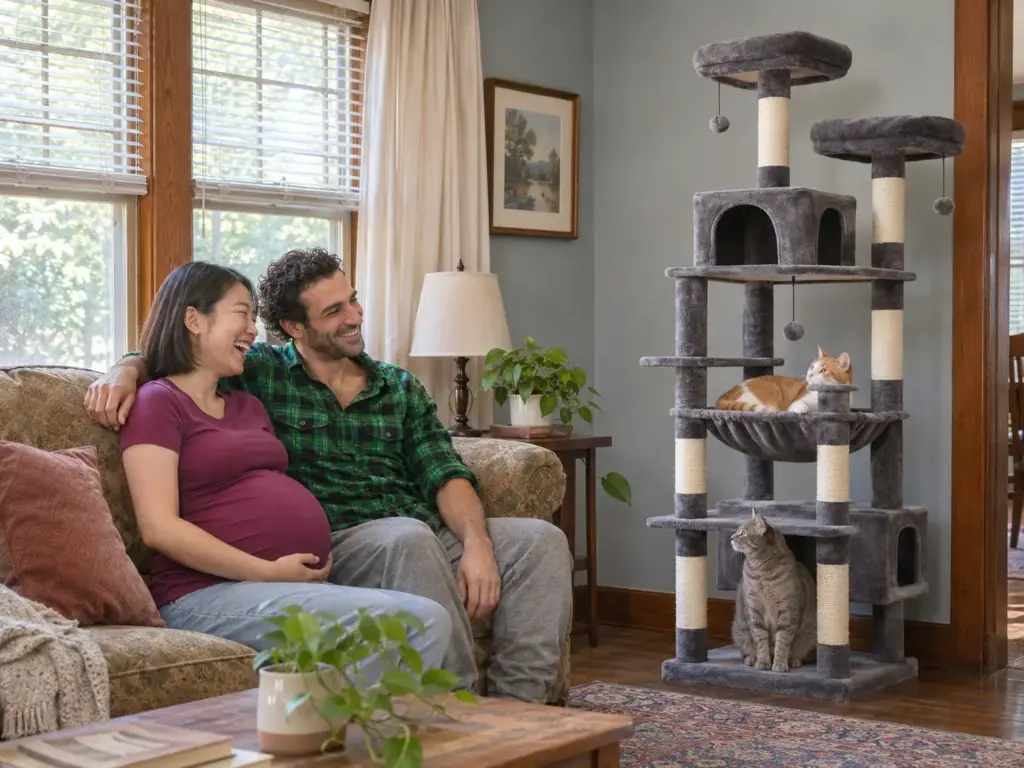
The cat that got in is the one you saw. The second one is the cat you never catch, and cats copy a route as soon as one of them has shown it works. So the second cat is the first cat’s success repeated, not a new problem, and everything above applies to both of them at once.
One perch per cat, or the second takes the crib
The resource rule (one per cat, plus one) applies to perches, not just to bowls. Two cats on one perch with a single way down is a dispute with a view, and the cat that loses it takes the crib by default. Why a spare doesn’t count in the resource rule explains the arithmetic.
For a big cat or a house with two, the PAWZ Road 72-inch cat tree stands 72.4 inches tall with a 20 by 16 inch hammock that holds an adult cat lying flat and not folded, and its top sits well above the rail. Its footprint of 21.6 by 17.7 inches is real floor in a small room, and the build is the part to watch, so check for wobble after assembly and every so often afterward. With three, perches go in pairs, and when one pair out of three stops getting along shows what that looks like.
The door breaks for the cat outside it
It is the cat on the wrong side of the door that breaks the plan at 4 a.m., not the one inside. Two cats shut out of the bedroom make twice the noise, and a household that gives in once has taught both of them the schedule. The week of protest is the same week as with one cat, and it is held the same way: the white noise, the gate, and no opening for the yowl.
Close the Door, Clear the Shelf, and Look Again When the Room Changes
The door, or a screen where there is no door, is the barrier that is left when the baby sleeps in the crib, because nothing else may stay there. The cardboard and tape belong to the empty crib, go down a month ahead and come out before the baby’s first night. And a perch above the rail earns its place only when it sits where the people are.
A cat is never alone with a sleeping baby: when the cat is near the baby he is supervised, and when nobody can watch, the door is shut.
Watch the days when the perch is new: if he takes it, the plan is working, and if he walks past it to the crib, the perch is in the wrong room or too low. Watch the week of closed-door protest, which should fade within about seven days. And look again the day the mattress is lowered or the crib moves, because a changed room is changed territory and he will inspect it again.
Today, with no purchase attached: close the bedroom door at bedtime, clear the shelf that is already on the wall and fold a blanket on it, and measure the rail from the floor with a tape measure. Then see whether he uses the shelf before the nursery is even finished.
Frequently Asked Questions
01How do I keep a cat out of the crib?
Close the door whenever the baby sleeps, or stand a screen across a doorway that has no door, and give the cat a perch higher than the rail. A month before the birth, make the empty crib unwelcoming with cardboard and double-sided tape, then take it out before the first night.
02Is it safe to have a cat in the house with a newborn?
Many homes keep the cat out of the baby’s sleep space entirely, with a closed door while the baby sleeps. The ASPCA says a newborn cannot move her head at first, so a cat curled up at her face could make breathing hard. Health questions go to your vet, obstetrician or pediatrician.
03Does a crib tent or mesh cover keep a cat out?
A crib tent is the weak choice: the CPSC recalled about 330,000 crib and play-yard tents from one maker because the dome could invert into the crib. The AAP also says nothing else belongs in the crib with the baby. A closed door has neither problem.
04Does aluminum foil keep a cat out of the crib?
Foil startles a cat on the first night, and by the third it has become a toy that crinkles under his paws. It is also something in the crib, so it comes out before the baby sleeps there. The door is what stays.
05Should the cat see the nursery before the baby is born?
Yes: set the room up early and let the cat explore it for several weeks, while it is still boring. A month before the birth, make the surfaces unwelcoming, as the ASPCA lays out. A room that bored him before the baby arrived is easier to keep him out of afterward.
Leave a comment