Introduce a Cat to a Baby in Seconds, Then Give It Weeks
Send the hospital blanket home first, greet your cat alone for 10 minutes, and keep the baby's first meeting to a few seconds [small-apartment plan]

Alfredo RamsesFounder · Updated November 17, 2026 · 17 min read

On this page8 sections
- 1To Introduce a Cat to a Baby, Start With the 3-3-3 Clock
- 2The Blanket Goes Home Before the Baby Does
- 3Ten Minutes on the Floor Before the Car Seat Comes In
- 4The First Meeting Lasts a Few Seconds, and That Is a Pass
- 5Two Cats Meet the Baby One at a Time
- 6The Door at Nap Time, and the Routes That Stay Open
- 7Judge the Adjustment at Three Weeks, Then Look Again at Three Months
- 8Frequently Asked Questions
The car seat comes through the front door with something alive in it, and your cat’s tail goes up before anyone has said a word. He has not formed an opinion about the baby. He has noticed that the house changed overnight and nobody consulted the tenant. A cat reads a home through its smells, its routes and its schedule, and a new baby rewrites all three in one afternoon.
To introduce a cat to a baby well, work in the order you will actually live it: the blanket that travels home first, who walks in before the baby, a first meeting measured in seconds, and a calendar counted in days and weeks rather than in one evening.
Quick Answer
Run the homecoming in this order and the cat gets the information before the noise.
- Send the used hospital blanket home first and leave it where the cat sits.
- Greet the cat alone, with your hands free, before the baby comes in.
- Sit with the baby in your arms and let the cat come to you.
- Keep the cat out of the room where the baby sleeps.
- Keep his meals, box and hiding spots fixed, and judge at the three-week mark.
- Call the vet if he stops eating, misses the box or hides past three weeks.
To Introduce a Cat to a Baby, Start With the 3-3-3 Clock
Judge the first day too hard and you will undo the plan by bedtime. A cat who vanishes under the bed on day two has not handed down a verdict on your newborn; he is doing what a cat does in a house that suddenly smells, sounds and runs differently. The nursery plan, the door and the pregnancy calendar live in a separate guide on a small apartment shared with kids and cats. This section is about time: how long the cat needs, and what counts as normal while he takes it.
The first three days belong to the cat
Expect hiding, a skipped meal or two, and a cat testing which house rules still apply. Put his food and water near wherever he retreats, ideally a safe room with the door left open, and leave him there. Pulling a cat out from under the bed so he will use the box is what turns a two-day retreat into lost trust: afterward he comes out for ten seconds at a time to eat and goes straight back.
People call all of this jealousy, but what changed in the house first, before jealousy explains most of it better. New smells, new sounds, a person who sits differently and a door that is shut more often are a lot of change for a creature who runs on routine.
Three weeks for the routine, three months for the house
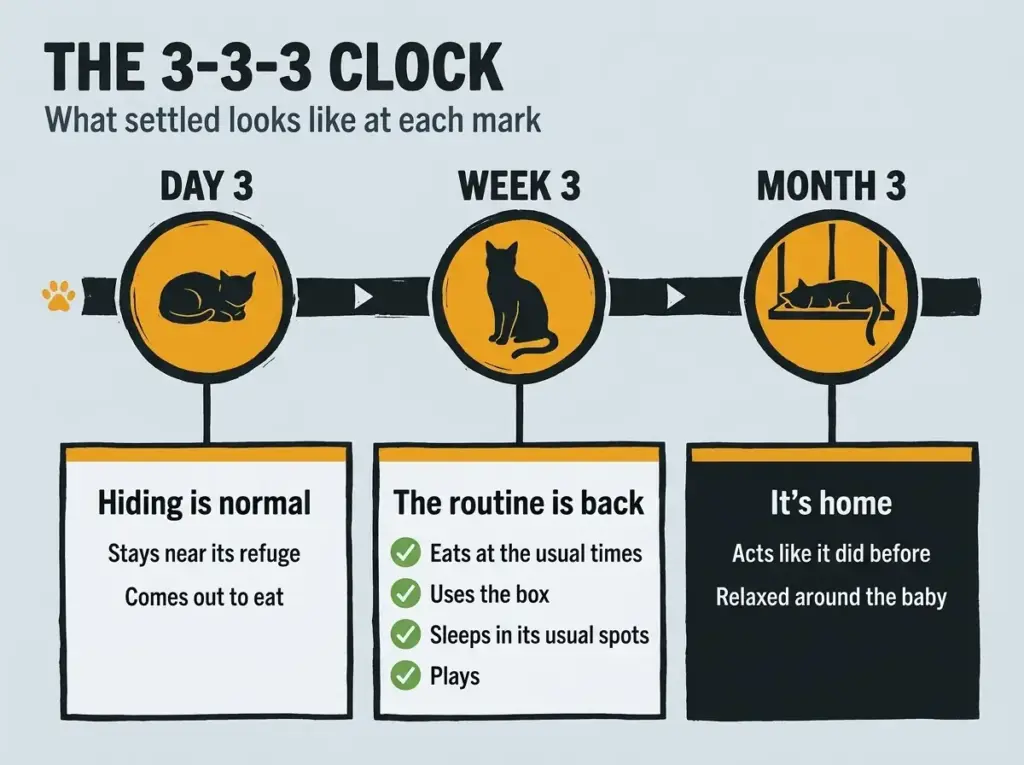
VCA’s 3-3-3 rule puts three numbers on an adjustment: three days of hiding and testing limits, three weeks for the routine to settle, and three months before the cat treats the house as his again. VCA wrote it for adopted cats, but a newborn makes the house new in the same way, so it works as a rough shape, not a promise.
Apply the middle number to the cat, not to your evening. By the three-week mark he eats at his usual times, uses the box, sleeps in his usual spots and plays. Cat time is not human time, and a bad night on day nine is not a failed plan.
What settled looks like, and where it becomes a call
Blue Cross describes a settled cat in owner’s terms: he behaves as he did before, stays relaxed near the baby, sleeps, eats and plays. Check those four at the three-week mark, not on the worst night. International Cat Care’s list of stress signs explains why the check is worth doing: cats show emotion quietly, and the signs build over weeks. Hiding, spraying, toileting outside the box, overgrooming, eating less and playing less all appear, and they show up in the box and the bowl before they show up in the cat.
Any of those, a cat who stops eating, a box that starts failing, or a cat still hidden well past the three-week mark is a call to your vet first and a behavior specialist after. What it means is theirs to say, and nothing in this guide can stand in for that call. (If you are the one who is pregnant, questions about handling litter go to your doctor.) Everything below is about the furniture, the doors and the routine.
A way up and a place to go
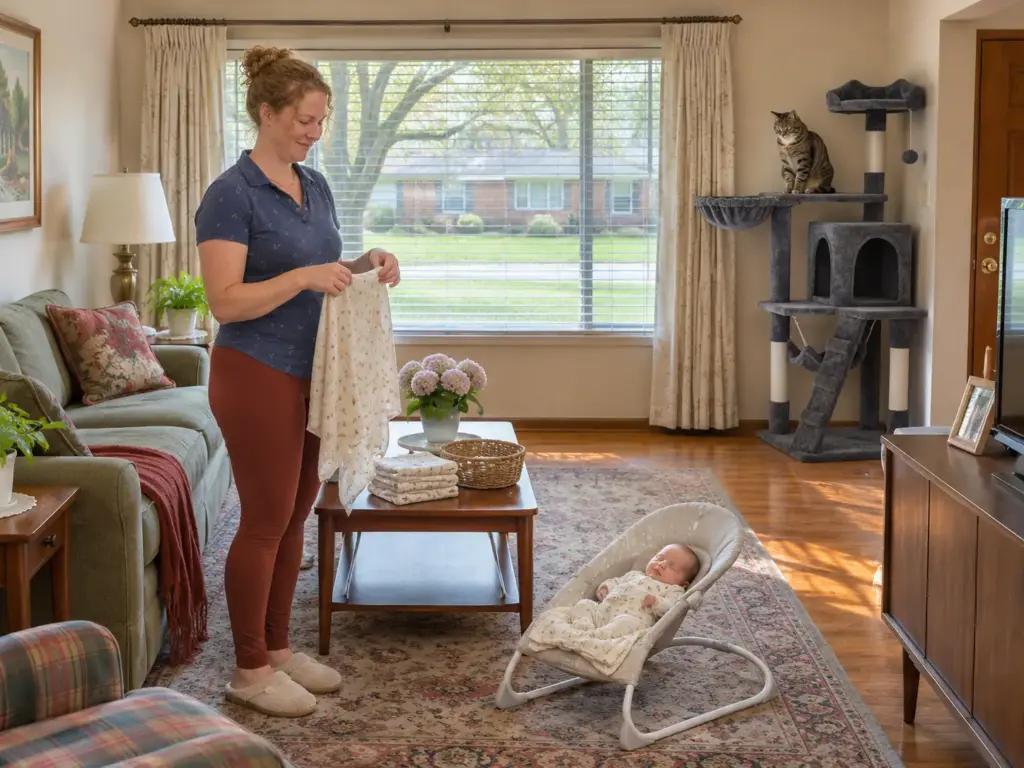
A small apartment has no wing for a cat to retire to, so the retreat has to be made of height and one quiet corner. A tree is the reflex purchase, but in a rental the order flips: a sturdy bookshelf or shelf already in the room is the high route, and he climbs, watches and comes down when he chooses. Nothing was bought and nothing was drilled.
A tree earns its floor space only when no shelf in the room can take his weight. The Yaheetech 54 in Cat Tree climbs 51 inches on a 19.5 by 19.5 inch footprint and carries three sisal posts. The anti-tip kit in the box is a screw in the wall, so it is not a renter’s tree by default. And it wobbles even when anchored, with a top ball that comes apart, so test the sway before the baby is home: a tree that moves gets ignored.
Put the high route where he can see the hallway and the nursery door without sitting between them. From above he is gathering information. In the middle of the hallway he is in everyone’s way.
The Blanket Goes Home Before the Baby Does
A bottle of baby lotion and a doll that cries feel like preparation, and they do almost nothing. What the cat needs to learn is one particular baby, and the object that carries it is smaller and plainer than anything on the registry.
One baby’s smell, not baby smell
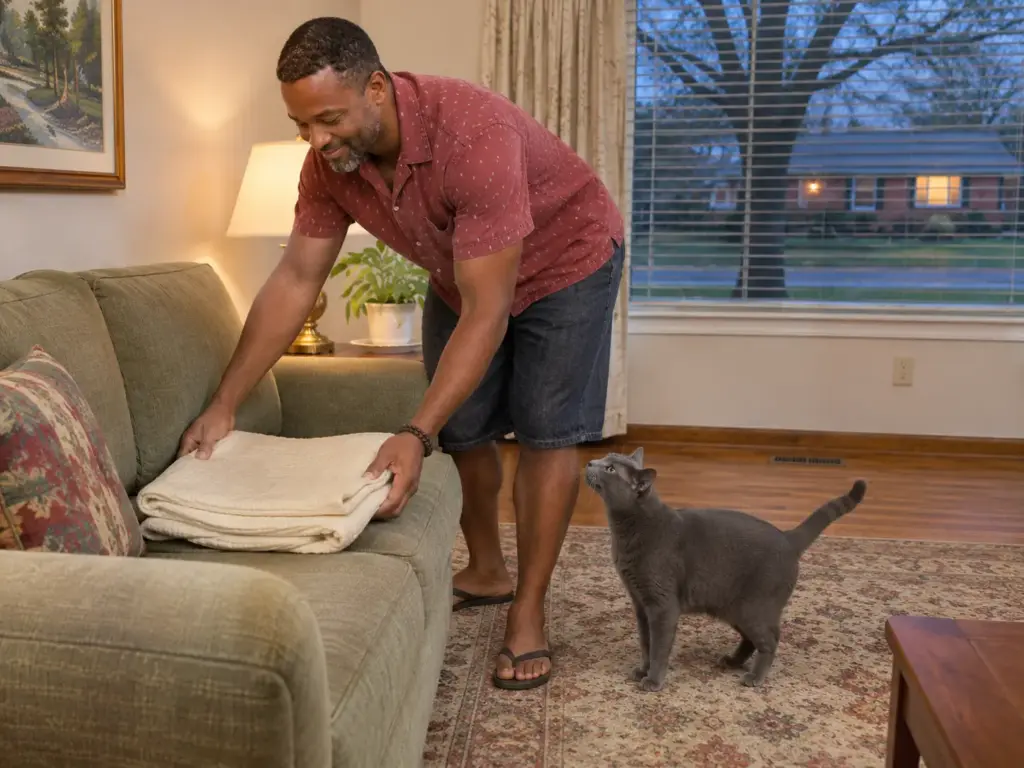
Lotion and baby powder carry the smell of the category: any baby, every baby. It is a weaker, generic cousin of the real thing. The ASPCA’s own guide to cats and babies is explicit about the object that holds one baby’s scent: a used receiving blanket or a piece of infant clothing, set where the cat can investigate it.
Both the ASPCA and Blue Cross recommend wearing the lotions and powders early, so keep doing it, but treat them as the background and the blanket as the point. The crying doll is the same story: it teaches a sound and nothing else.
The blanket goes home first, and goes where the cat already is
Ask whoever is heading home first, a grandparent, a partner on a supply run, to carry the worn blanket that wrapped the baby at the hospital and drop it on the sofa in a room the cat already uses. The baby stays in another room. The smell arrives before the noise does, so by the time the car seat crosses the threshold the cat has met the baby’s scent without a single sound attached to it. Placement decides whether a scent item helps or backfires, and where a scent item goes so it helps instead of backfires covers the rule in more detail: where he already sits, never in the corner you are hoping he will adopt.
For the room he retreats to, a diffuser can add a second layer, and Blue Cross names one as part of the preparation. The FELIWAY Classic Cat Pheromone Calming Diffuser Kit is the single-cat version, a 48 ml refill that runs 30 days, and it wants an outlet with about four feet clear in front and the vents facing up. The effect is uneven: some homes see no change, in others it fades within days, and a burning smell turns up with some units. It is an extra, and the free blanket does the heavier lifting.
Sound is a volume knob
Blue Cross’s four-month preparation plan starts recorded baby sounds, a crying baby included, early: short stretches, barely audible at first, the volume raised a little at a time, and only while the cat is calm. Start loud on day one and he learns that the noise predicts something bad. Four months is the charity’s planning number; for a cat who already startles at the dishwasher, take four as the minimum, not the plan.
End every recording session while the cat is still calm, never after he reacts. The last thing the sound should predict is nothing at all.
Ten Minutes on the Floor Before the Car Seat Comes In
Discharge day is the least planned hour of the whole project. Everyone is tired, the car seat is heavy, the bags are in the doorway and the cat is sitting exactly where the door opens. Those ten minutes on the floor decide more than a month of recordings, because the cat reads you before he reads the stroller.
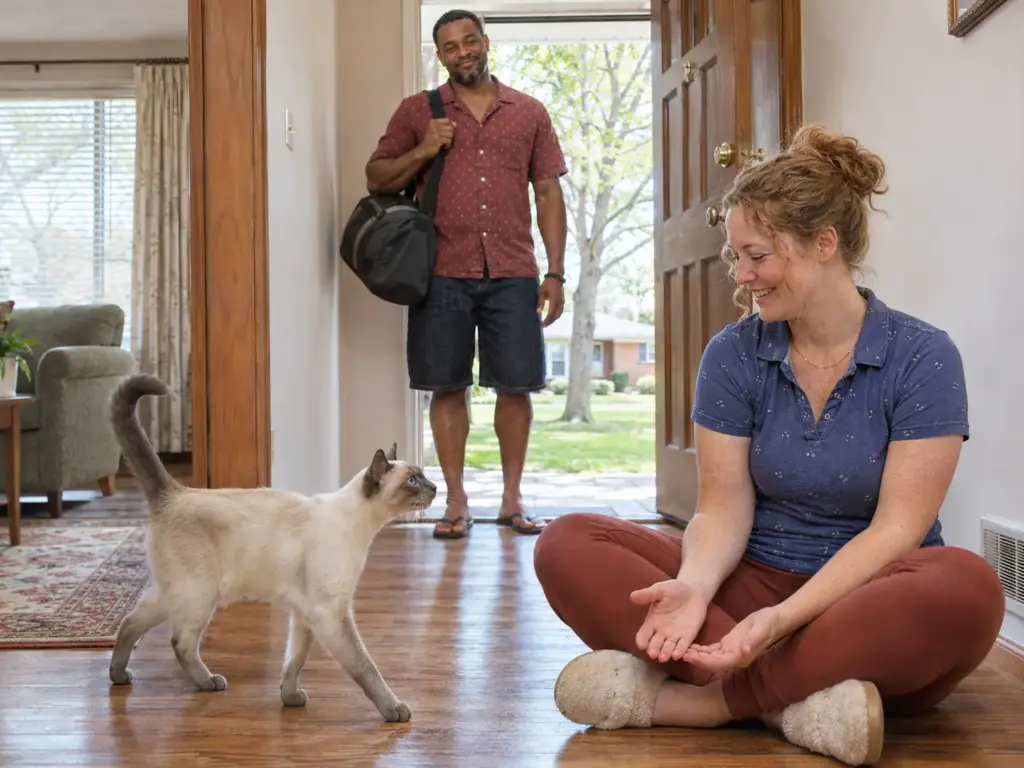
You first, alone, hands free
On the way in, the ASPCA’s guidance reads: “When you first arrive home from the hospital, peacefully greet your cat in a quiet room without interruption.” The next part is the blog’s advice, not the ASPCA’s: arrive with your hands empty.
Set the bags down, and have the baby wait in another room, or in the car or the hallway outside, with the other adult until the greeting is done. Then sit on the floor and let him come. Don’t pick him up and don’t call him over. If he approaches, offer an open hand and the low voice he knows; if he stops a yard away, that counts too.
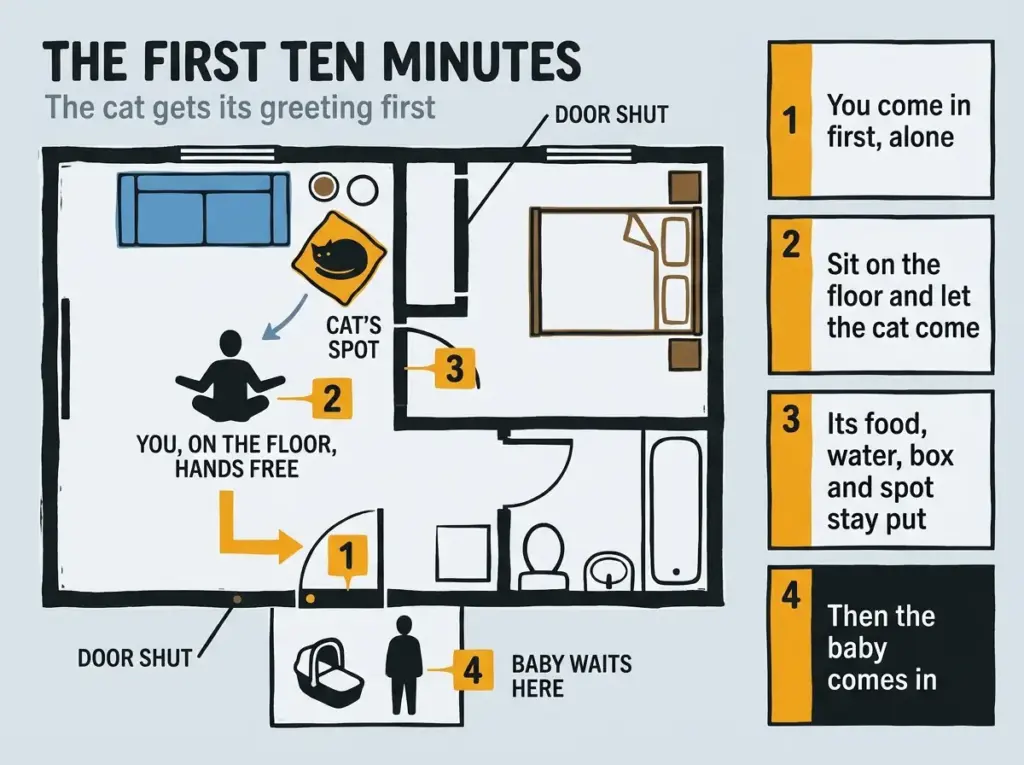
Where the baby waits
Without a spare room, the greeting happens in the hallway or in a bedroom with the door shut, and the baby stays outside with the second adult. The point is a quiet room without interruption, and a small apartment usually has exactly one of those, so pick it before the day arrives.
Open the door he usually retreats through before you sit down. A greeting goes better when his way out is already clear.
What the ten minutes are for
They are for showing him that the person who just walked in is the same one who left. So nothing in his day moves yet: his feeding time, his water, his box and his spot on the sofa stay put. The house already changed smell, and his routine has to be the part that does not.
Which rooms and exits the cat counts as his own in a small apartment is worth a read before the due date, because those are the routes you will be tempted to close first. If he goes to his hiding spot after the greeting, the greeting still worked.
The First Meeting Lasts a Few Seconds, and That Is a Pass
Parents want the photo: the cat curled up next to the baby. The photo is not the goal. A sniff and a stroll away is.
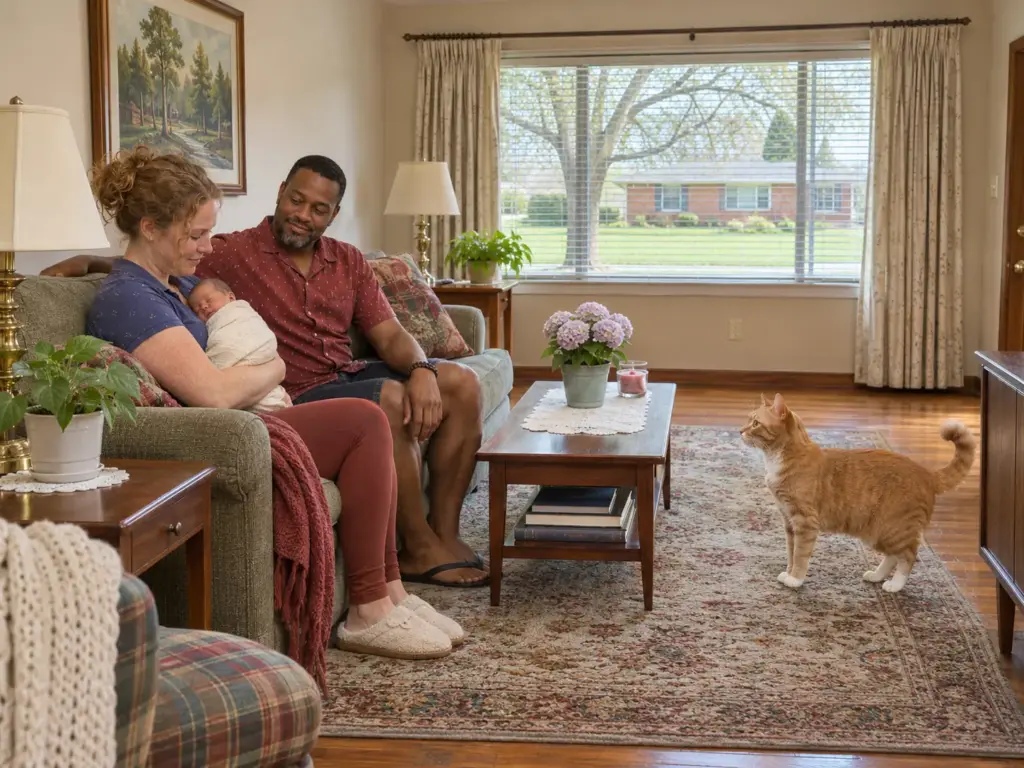
A neutral room, you seated, the baby in your arms
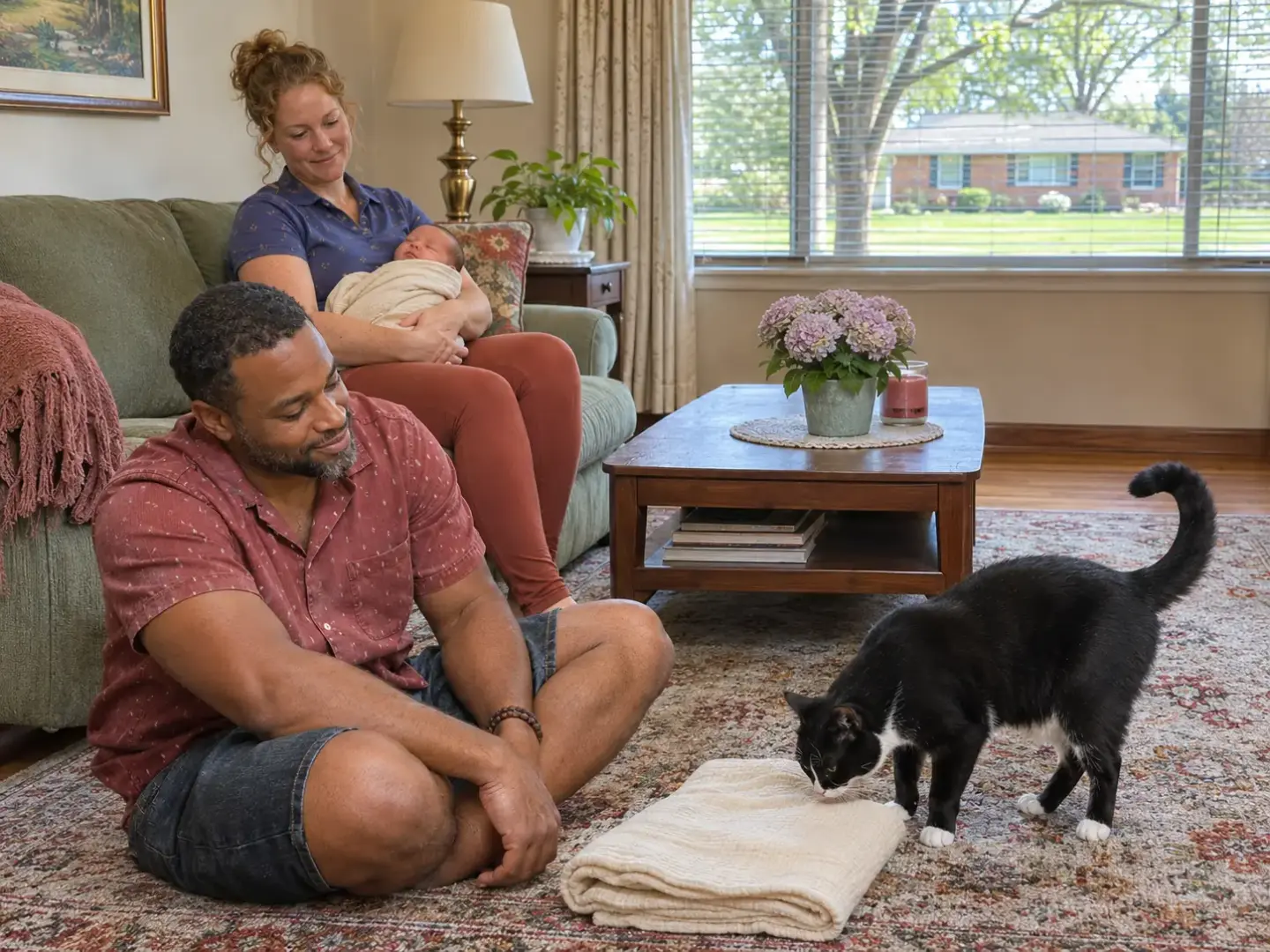
Pick a quiet room that belongs to neither of them, sit down with the baby in your arms and let the cat come to you, so the cat can approach on its own terms.
Keep your voice low and offer a treat for staying calm, so the baby and the treat arrive together: a positive association, built in seconds. Never force contact: don’t carry the cat toward the baby, drag him over or hold him in place. The usual instinct is to keep him close so he gets used to the baby faster. The better call for the first meeting is distance he controls, because a cat who chose to approach has a way out built into the encounter.
What a normal first sniff looks like
Blue Cross’s step-by-step for the first meeting is short on drama and short on minutes: “Your cat may appear interested for a few seconds. They will usually then lose interest.” A cat who sniffs once and wanders off has done the job. A cat held there for a full minute is being taught to dread the stroller.
The method borrows from an introduction measured in distance and seconds instead of dates, which is how a dog is introduced too.
The stop rule
Read his body language and end the meeting the moment you see flattened ears, a tail flick or a tail pulled in tight, dilated pupils, a frozen posture or a hiss. These are the cat’s own signals of stress, taken from International Cat Care’s list.
End it quietly, with no scolding and no last try, and repeat another day. Don’t push for a little more inside the same session. The signs an introduction is going wrong between sessions are easier to read once you know what a normal retreat looks like.
The two mistakes behind the scratch
Two mistakes lead to most scratches: carrying the cat toward the baby, and holding the baby at the cat’s face height.
A third belongs to the house. A cat spooked by the car seat who has a person, a baby and a wall around him, and the only exit behind the person, goes for whatever is in front of him, often a parent’s leg.
He is cornered by the layout, not vicious, and the fix is to keep his exit free at all times. One rule has no exceptions: the baby and the cat are never alone in a room, and supervision means an adult in that room, awake. If the adult leaves, the cat leaves too, or the door closes.
Two Cats Meet the Baby One at a Time
Two cats turn one homecoming into two. The confident one meets the stroller at the door and the shy one is not seen for three days, and the shy one is the cat who needs the room, not the cuddle.
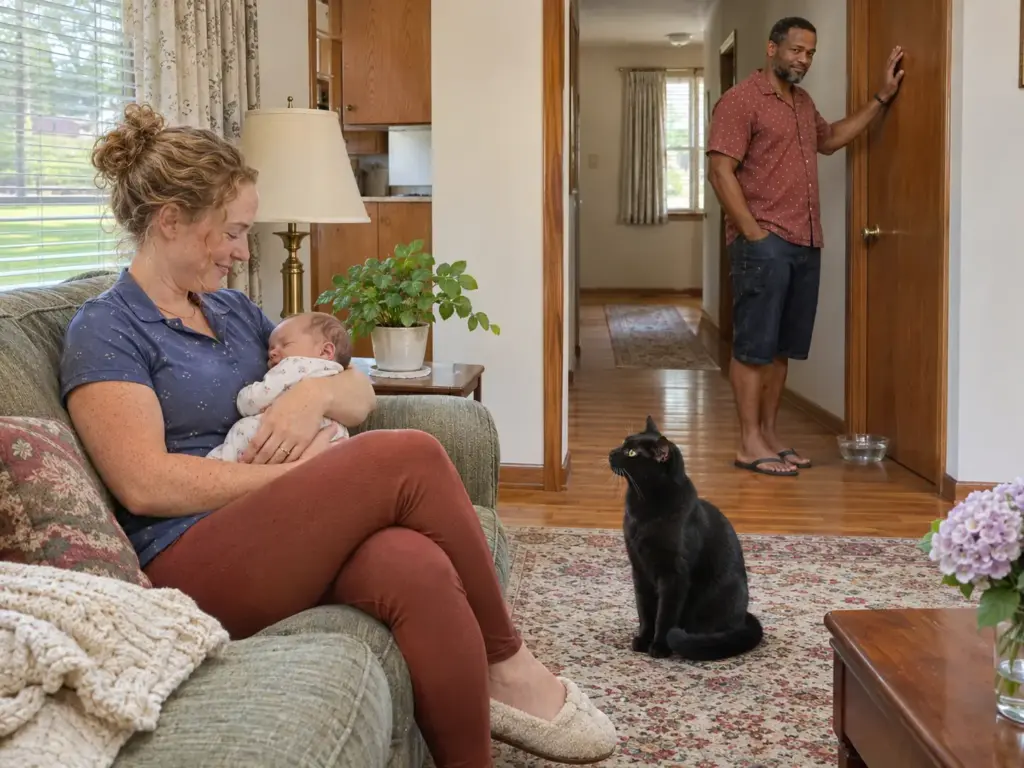
One greets, the other waits behind a door
Never both in the doorway. Settle one cat in a safe room with his own water and a closed door, and give the other the greeting first. That order is this blog’s judgment, and it removes the one situation that goes wrong with two: a pair reading each other’s reaction to something new.
The second turn comes an hour later
The cat who waited gets his own turn about an hour after the first, with the same quiet room and the same seated adult.
One more thing changes with two cats: the one who guards the hallway decides whether the other can cross it for weeks. If the shy cat cannot find a clear route, it is not that he rejects the baby; he cannot get past. In an apartment without a spare room, the high route from the first section works as a second exit. If two cats who used to get along begin to fight after the baby arrives, that is a question for your vet and a behavior specialist, and what to do when there is no second room to separate them covers the floor plan side.
Three of everything, in three places
International Cat Care’s rule is one resource per cat plus one extra, in different locations. With two cats that means three bowls, three beds, three hiding places and three boxes. A spare placed next to the original does not count, and why a spare bowl or box has to be somewhere different explains the logic. Each cat also keeps his own clock: one can be settled at the three-week mark while the other is not, so judge them separately.
The Door at Nap Time, and the Routes That Stay Open
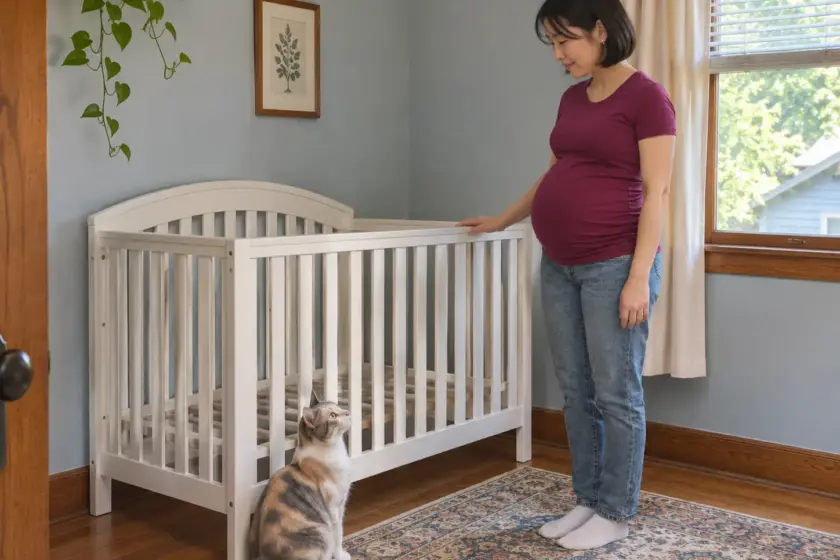
For the first six months the baby usually sleeps in your bedroom, which is the room the cat already shares with you, and that door closes first.
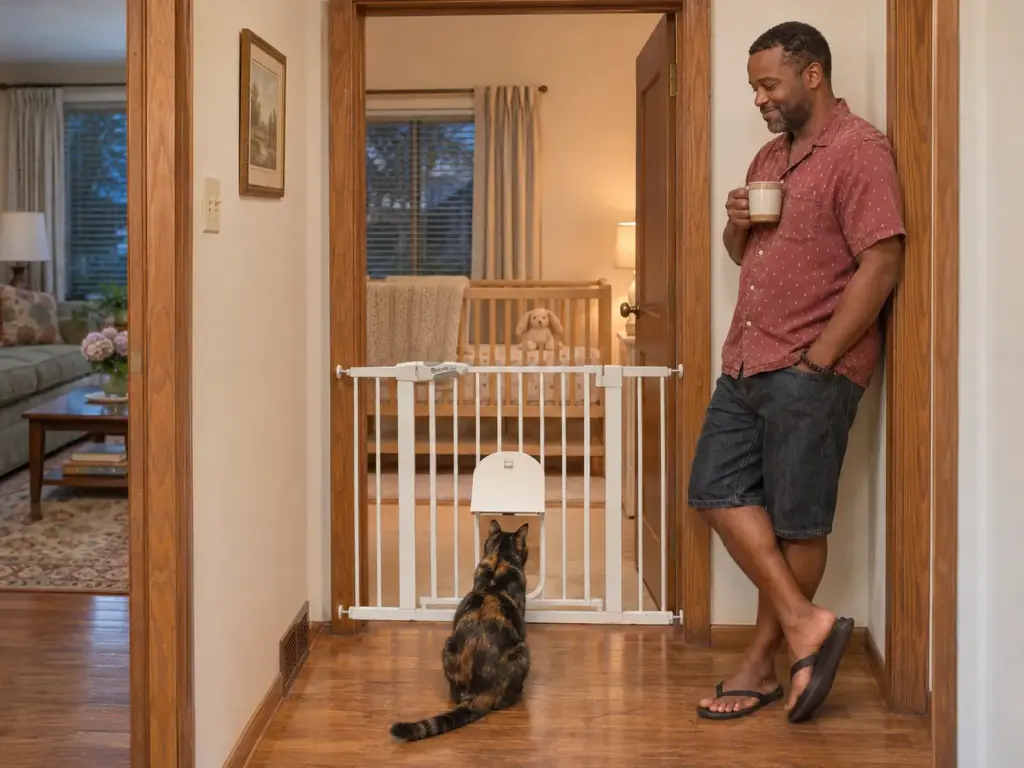
The bedroom first, the nursery door later
Blue Cross’s advice on the first six months and the nap-time door has two stages: the cat stays out of the parents’ room while the baby sleeps there, then the nursery door is closed at nap time. One rule sits underneath it: the cat does not share the place where the baby sleeps. The ASPCA’s reason is that a newborn cannot turn or move its head, and a cat curled against a face can make breathing difficult.
The ASPCA also suggests cardboard covered in double-sided tape on the crib and the changing table at least a month ahead. The same bedroom-door problem seen from the allergy side covers the mechanics of shutting a cat out of the room he used to sleep in.
No door? A screen, a tent, or a gate with a cat door
The free option is the door you have, closed. If there is none, the ASPCA’s advice on a screen door or a crib tent is a temporary screen door across the doorway or a tent over the crib, both of which still let you hear the baby. Some cats work out that the crib is the warmest bed in the apartment, which is why the tape and the tent matter.
Sometimes the cat needs the hallway route while the baby needs a shut room, and a pressure-mounted baby gate solves that without drilling a rented frame. The Babelio Auto Close Dog Gate with Cat Door, CatPrivilege I fits openings from 29 to 43 inches, stands 30 inches tall, and has a cat door listed at 7.8, 5.3 and 2.5 inches that locks completely shut, so it turns solid on the day the baby crawls. Measure the doorway first, because some frames do not line up, and the handle tends to break inside a year. For which gate suits which opening, see which pet gate with a cat door suits a rental doorway.
The routine that does not move
The ASPCA asks you to hand the cat’s daily care to another person one to two months before the birth, so he gets used to the new hands while the house is quiet. If you have to move the box, the same guide says to shift it a few inches a day, months ahead, and to scoop twice a day.
How often to scoop, per cat per day has the schedule. Any change of box finishes before the due date: a new type of box starts weeks ahead, never the week of the birth. And where a litter box actually fits in a small apartment covers the case where the hallway is the only spot with an outlet and floor to spare.
The free answer is a smooth plastic box you already have and a scoop, two passes a day.
If you would still like the chore handed over for the first fortnight, the PETKIT Purobot Max Pro 2 measures 25.9 by 21.2 by 23.7 inches, weighs 30.9 pounds, and its 8-liter bin runs up to 17 days with one cat. The entry is about 10 inches off the floor. It needs that much floor and an outlet close by, which in a small apartment means the hallway nook, not a corner. Reliability is uneven, and litter can fly out onto the floor.
Judge the Adjustment at Three Weeks, Then Look Again at Three Months
The blanket goes home before the baby does. You greet the cat first, alone and with empty hands. A few seconds of sniffing is a pass.
A door closes at nap time, and the cat’s meals, box and hiding spots stay exactly where they were. That sequence is the homecoming; the products only make a few steps easier.
Give the routine until the three-week mark before judging it, and look at the house again around month three, when the cat treats it as his own once more. If he stops eating, misses the box or stays hidden in that window, ring your vet before you rearrange anything. Today, add one line to the hospital-bag list: a blanket that comes home before the baby does. At the next nap, shut the door you already have.
Frequently Asked Questions
01What is the 3-3-3 rule with cats, and does it apply to a newborn?
VCA’s 3-3-3 rule gives a cat three days to hide and test limits, three weeks for the routine to settle and three months to treat the house as home. It was written for adopted cats, but a newborn makes the house new just as an adoption does, so judge the routine at three weeks, not the first evening.
02How long should a cat’s first meeting with a newborn last?
A first meeting should last a few seconds: the cat looks interested, sniffs, then loses interest and walks away, which is a pass, not a rejection. Keeping him there longer teaches him to dread the stroller, so let him leave when he chooses.
03Should I get a cat with a newborn?
Whether a particular cat suits life with a newborn is a question for your vet, and this guide covers only a cat who already lives in the house. A cat adopted around the birth starts his own three-month clock, and the baby arrives on top of it.
04Where should the cat sleep once the baby is home?
Outside the place where the baby sleeps: for the first six months that usually means outside your bedroom, and after that the nursery door stays shut at nap time, according to Blue Cross. With no door, the ASPCA suggests a temporary screen door or a crib tent.
05What if my cat hides for days after the baby comes home?
Hiding for about three days is normal, so leave the cat his retreat, with food and water close by and nobody pulling him out. A cat who stops eating, misses the box or is still hidden well past three weeks needs a call to your vet, and then to a behavior specialist.
Leave a comment